Welcome to your second lesson. In our previous session, we established a solid foundation in pointer arithmetic, learning how C++ allows us to navigate contiguous blocks of memory with type-aware precision. We saw that array indexing like arr[i] is simply convenient syntax for the pointer operation * (arr + i).
Now, we will address a fundamental question: where do these memory blocks come from in the first place? A running program utilizes two primary memory regions to store its data: the stack and the heap. Understanding the distinct mechanics and, more importantly, the performance characteristics of each is absolutely critical for high-performance computing. Your goal of writing efficient GPU kernels starts with mastering how memory is organized and accessed on the CPU. This lesson will dissect the stack and the heap, revealing why the choice between them is one of the most important performance decisions a systems programmer makes.
1. The Stack: Fast, Ordered, and Automatic
The stack is the default memory region for your program. It's a highly organized, efficient area of memory that operates on a Last-In, First-Out (LIFO) principle. Think of it like a stack of plates: you add new plates to the top and you remove plates from the top.
Every time you call a function, a new "stack frame" is "pushed" onto the top of the stack. This frame holds all the local variables for that function, its parameters, and the return address. When the function finishes, its entire frame is "popped" off the stack, and all its local variables are automatically destroyed.
The most crucial characteristic of the stack, from a performance perspective, is the speed of its allocations and deallocations.
To understand why the stack is so fast, watch this segment from the video "Stack vs Heap Memory in C++" by The Cherno.
Focus on the explanation of stack allocation from this section. The key insight is that "allocating" memory on the stack isn't a complex search operation. It's simply decrementing the stack pointer register by the required number of bytes. This is typically a single CPU instruction, making it exceptionally fast. Deallocation is equally fast—the stack pointer is simply moved back when a function returns.
This mechanism—a simple pointer adjustment—is why stack allocation is often described as being "free" in terms of performance cost. Local variables that you declare directly in your code, like int x = 5; or double coordinates[10];, are allocated on the stack.
However, this speed and simplicity come with a significant limitation: the stack has a fixed, and relatively small, size (typically a few megabytes). Attempting to allocate too much memory on the stack—for instance, by declaring a very large local array or through excessively deep recursion—will exhaust the available space and cause a stack overflow, crashing your program.
2. The Heap: Flexible, Dynamic, and Manual
When you need to allocate a large block of memory, or when the size of the memory is not known at compile time, you turn to the heap. The heap (also known as the "free store" in C++) is a large, unstructured region of memory that is available for your program to use dynamically.
Unlike the stack, allocation on the heap is an explicit and much more complex operation. In C++, you request heap memory using the new keyword.
// Allocate an array of 1,000,000 doubles on the heap
double* large_array = new double[1000000];

// ... use the array ...

// Manually release the memory back to the heap
delete[] large_array;
This process is significantly slower than stack allocation. Let's explore what's happening under the hood.
Which is faster: Stack allocation or Heap allocation
This Stack Overflow answer provides an excellent explanation of what a heap allocator does.
Please read the answer that begins with the line "It has been mentioned before". Focus on the description of the process: the operating system or C++ runtime maintains a data structure (like a linked list) of free memory blocks. An allocation request requires traversing this structure to find a sufficiently large block, performing bookkeeping to mark it as used, and potentially splitting it.
This search-and-bookkeep process involves many more instructions than the stack's single pointer adjustment. Furthermore, heap allocation is a library/OS function call, which carries its own overhead. Deallocating with delete also requires bookkeeping to mark the block as free again, and possibly merging it with adjacent free blocks. This complexity makes heap operations orders of magnitude slower than stack operations.
3. A Visual Synthesis: Stack and Heap Working Together
In a typical C++ program, the stack and heap work in concert. The stack holds pointers (which are small and fixed-size), while the heap holds the large data structures that these pointers refer to.
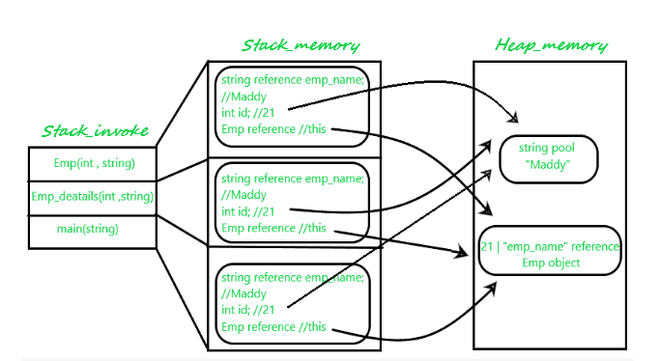
This model is fundamental: keep small, fast-to-access control data (like pointers and local variables) on the stack, and place large, long-lived data on the heap.
4. Performance Implications Beyond Allocation Speed
The performance difference isn't just about the initial allocation. The choice between stack and heap has profound implications for how efficiently your program runs, especially regarding how the CPU cache is utilized. This is a topic of paramount importance in high-performance computing.
Cache Locality
Modern CPUs are vastly faster than main memory (RAM). To bridge this speed gap, CPUs use several levels of small, extremely fast caches (L1, L2, L3). When the CPU needs data, it first checks the cache. If the data is there (a cache hit), access is very fast. If it's not (a cache miss), the CPU must stall and wait for the data to be fetched from the much slower main memory.
The LIFO nature of the stack provides excellent data locality.
- Temporal Locality: Data that is used recently is likely to be used again soon. A function's local variables are all in the same stack frame and are accessed frequently.
- Spatial Locality: Data items that are close to each other in memory are likely to be accessed sequentially. Stack frames pack a function's data together contiguously.
This high locality means that when one piece of a stack frame is fetched into the cache, the rest of the frame's data often comes with it, leading to a high cache hit rate.
The heap, however, does not offer this guarantee. Over time, as you allocate and deallocate blocks of various sizes, the heap can become fragmented. This means that two objects you allocate sequentially might end up in completely different parts of main memory. Accessing them in succession could lead to two separate cache misses, significantly slowing down your program.
The video "WHY IS THE STACK SO FAST?" from Core Dumped gives a great overview of these hardware-level considerations.
Please watch two segments: This part explains CPU caches, cache hits/misses, and the concept of data locality. The summary provides a concise recap of the stack's advantages (compact data leading to better cache performance) and its limitations.
Concurrency Overhead
In a multi-threaded program, each thread gets its own private stack. This is a major advantage because threads can allocate their local variables without interfering with each other—no locks or synchronization are needed. In contrast, the heap is a resource typically shared by all threads in a process. The heap allocator must therefore be thread-safe to prevent data corruption. This thread safety is usually implemented with locks (mutexes), which introduce contention and can become a significant performance bottleneck in highly parallel applications.
5. Summary and Rule of Thumb
We can summarize the trade-offs as follows:
| Feature | Stack | Heap |
|---|---|---|
| Allocation Speed | Extremely fast (one instruction pointer bump). | Slow (library/OS call, search, bookkeeping). |
| Lifetime | Automatic (tied to scope of function/block). | Manual (persists from new until delete). |
| Size | Small, fixed (e.g., ~8 MB). Risk of stack overflow. | Large, limited only by available system RAM. |
| Flexibility | Size of allocations must be known at compile time. | Can allocate memory of variable size determined at runtime. |
| Cache Performance | Excellent locality (LIFO structure) leads to high cache hit rates. | Prone to fragmentation, which can lead to poor locality and more cache misses. |
| Concurrency | Each thread has its own stack. No synchronization overhead. | Typically shared between threads. Requires locking, which adds overhead. |
This leads to a clear guideline for performance-critical C++ code:
Allocate on the stack by default. Use the heap only when you absolutely must.
You are forced to use the heap for:
- Objects that are too large for the stack.
- Objects whose size is determined at runtime.
- Objects that must live longer than the scope in which they are created.
Conclusion
In this lesson, we have moved from navigating memory to understanding its source. You've learned that the stack and heap are not just abstract concepts but distinct mechanisms with concrete and vastly different performance profiles. The stack is your fast, efficient, default choice, offering superior allocation speed and cache performance. The heap provides essential flexibility for large and dynamic data, but at a significant performance cost.
Key Takeaways:
- Stack allocation is a simple, single-instruction pointer adjustment, making it incredibly fast.
- Heap allocation is a complex library/OS operation involving searching and bookkeeping, making it orders of magnitude slower.
- The stack's LIFO structure promotes excellent cache locality, while the heap's potential for fragmentation can hurt cache performance.
- The choice is a fundamental trade-off between the stack's performance and the heap's flexibility. For HPC, you always prefer the stack unless program constraints force you to the heap.
We've established that using the heap is sometimes unavoidable, but it comes with the responsibility of manual memory management. In our next lesson, we will confront this challenge head-on. We'll explore the mechanics of new/delete and their C-style counterparts malloc/free, and importantly, we will study the common and dangerous pitfalls associated with them, such as memory leaks and dangling pointers.