Introduction
In our last lesson, we engineered a significant performance leap by implementing a parallel reduction using sequential addressing in shared memory. This design elegantly solved two major bottlenecks: severe warp divergence and shared memory bank conflicts. Our kernel is now much more aligned with the GPU's architecture.
However, the pursuit of "true compute" means we leave no inefficiency unexamined. Our current if (threadIdx.x < s) approach, while effective for larger strides, becomes divergent once the number of active threads s drops below the warp size of 32. In these final reduction steps, only a fraction of the threads in the last active warp are doing work, while the rest are idle.
This lesson introduces a powerful, hardware-centric solution: warp shuffle instructions. These primitives allow threads within a single warp to communicate directly, exchanging data held in their registers without the overhead of writing to and reading from shared memory. By replacing the final shared memory reduction steps with warp shuffles, we can eliminate the last vestiges of intra-warp divergence and achieve even greater efficiency.
From Shared Memory to Direct Register Communication
The communication pattern we've used so far for reduction involves a three-step dance with shared memory:
- A thread writes its data to a location in
__shared__memory. - All threads in the block wait at a
__syncthreads()barrier. - Another thread reads that data from shared memory to perform the next step of the reduction.
This is effective for communication between different warps, but for threads within the same warp, it's overkill. Since threads in a warp execute in a loosely lock-step fashion, a more direct communication path is possible. This is where warp shuffle instructions come in.
Let's begin by understanding what these primitives are and why they are so powerful.
05 Atomics Reductions Warp Shuffle
The video "05 Atomics Reductions Warp Shuffle" provides an excellent introduction to this topic. It explains the motivation for warp shuffles as a way to achieve direct thread-to-thread communication, contrasting it with the shared memory approach.
Please watch the segment from "warp Shuffle". The presenter introduces the core idea of exchanging data directly between threads in a warp, a concept that should resonate with your interest in low-level systems. Pay close attention to the overview of the different shuffle variants: shfl_sync, shfl_up_sync, shfl_down_sync, and shfl_xor_sync.
As the video explains, warp shuffles are intrinsic functions that map to single, low-level hardware instructions. They allow a thread to pull data directly from a register of another specified thread (a "lane") within the same warp. For our reduction, the most intuitive variant is __shfl_down_sync, which retrieves a value from a thread with a higher lane ID.
Implementing a Warp-Level Reduction
Using __shfl_down_sync, we can perform a complete reduction across the 32 threads of a warp using only registers. The logic mirrors our sequential reduction but operates on an offset within the warp rather than an index in shared memory.
The core of a warp-level sum reduction is a simple loop:
// Assume 'val' is a register variable holding each thread's initial value


#define FULL_MASK 0xffffffff // A bitmask representing all 32 threads in the warp

for (int offset = warpSize / 2; offset > 0; offset /= 2) {
    val += __shfl_down_sync(FULL_MASK, val, offset);
}
After this loop completes, lane 0 of the warp will hold the sum of all 32 val variables from that warp.
The following diagram illustrates this process for an 8-thread portion of a warp. In the first step, offset = 4, threads 0-3 fetch values from threads 4-7. In the next step, offset = 2, threads 0-1 fetch values from threads 2-3. Finally, with offset = 1, thread 0 fetches the value from thread 1, completing the reduction.
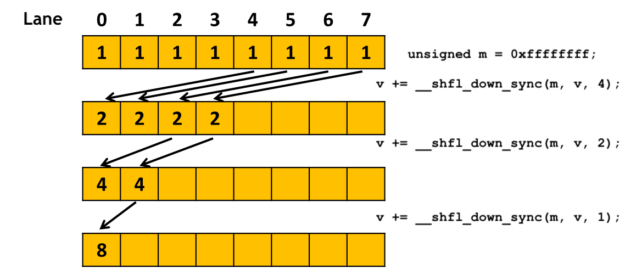
This is significantly more efficient than our previous shared memory loop for the final 32 elements. It avoids the load, store, and __syncthreads overhead, replacing it with a single, highly optimized instruction.
You can see a similar code example in the following resource.
Lecture 4: warp shuffles, and reduction / scan operations
These lecture slides from Prof. Mike Giles at Oxford offer a very concise summary of two ways to perform a warp-level sum.
Focus on method 1 (using xor) and, more importantly for our current discussion, method 2 (using down_sync). This shfl_down_sync example is functionally identical to the one we just discussed.
The _sync Suffix and the mask: Ensuring Correctness
You've noticed that all modern shuffle primitives have a _sync suffix and take a mask as their first argument. This is not just a stylistic choice; it is fundamental to writing correct, modern CUDA code.
Prior to the Volta architecture (CUDA 9), shuffle instructions were "unsynchronized." Their correct behavior relied on an implicit guarantee that all participating threads would execute the instruction in lock-step. However, due to compiler optimizations and changes in hardware scheduling, this implicit guarantee is no longer safe to assume. Divergent control flow could lead to situations where a thread tries to shuffle from an inactive partner, resulting in undefined behavior.
The _sync variants solve this problem by making participation explicit.
- The
maskis a 32-bit integer where each bit corresponds to a thread lane (0-31). - You set a bit to
1if you expect that thread to participate in the shuffle. - The hardware then ensures that all threads specified in the mask are converged and synchronized before executing the shuffle operation.
This explicit synchronization model is crucial for correctness, especially in complex kernels where warp divergence can occur. Simply assuming all 32 threads are active and using FULL_MASK (0xffffffff) is not always correct.
Using CUDA Warp-Level Primitives | NVIDIA Technical Blog
This NVIDIA blog post provides the definitive explanation for why the _sync primitives are essential.
First, read the section "Synchronized Data Exchange" to understand the role of the mask argument and see an example of how it can be computed dynamically using __ballot_sync. Then, read the critical section "Implicit Warp-Synchronous Programming is Unsafe", which details why the older, non-_sync versions are deprecated and dangerous.
A Hybrid Strategy: The Best of Both Worlds
We now have two powerful reduction techniques:
- Shared Memory Reduction: Excellent for aggregating results across different warps within a block.
- Warp Shuffle Reduction: Extremely fast for aggregating results within a single warp.
The optimal strategy is not to choose one or the other, but to combine them in a two-level hierarchy. This hybrid approach forms the basis of most modern, high-performance reduction kernels.
The strategy is as follows:
- Intra-Warp Reduction: Each of the warps in a thread block first computes a partial sum of its own 32 elements using
__shfl_down_sync. All this happens in registers. - Inter-Warp Communication: The thread in lane 0 of each warp now holds a partial sum. This thread writes its partial sum to a designated spot in shared memory.
- Final Reduction: After a
__syncthreads()to ensure all partial sums are in shared memory, a single warp (typically warp 0) is tasked with the final step. It loads the partial sums from shared memory (at most 32 of them, since a block can have at most 1024 threads / 32 threads/warp = 32 warps) and performs one final warp shuffle reduction to compute the block's total sum.
This structure is visualized perfectly in the diagram below.

This approach minimizes both shared memory traffic and synchronization overhead. __syncthreads() is only needed once, between the two main stages.
The following video provides a complete walkthrough of this exact hybrid implementation.
05 Atomics Reductions Warp Shuffle
This segment of the video details the complete implementation of the hybrid reduction strategy.
Watch the section from this walkthrough. The presenter explains how to modify the previous shared-memory code to incorporate warp shuffles. Follow the logic carefully: Summing into a local register variable val. The first warp shuffle reduction loop. Lane 0 of each warp writing its partial sum to shared memory. The necessary __syncthreads() call. Warp 0 performing the final reduction on the data from shared memory.
By following this hybrid model, we have constructed a kernel that is not only fast but also robust, leveraging the strengths of different parts of the GPU memory and execution hierarchy.
Conclusion
This lesson has moved us deeper into the hardware-specific optimizations that define high-performance computing on GPUs. By understanding and utilizing warp shuffle instructions, we've replaced a generic parallel algorithm with one that speaks the GPU's native language.
Key Takeaways:
- Warp Shuffles: These are primitives (
__shfl_down_sync, etc.) for direct, low-latency, register-to-register communication between threads within a warp. They are more efficient than using shared memory for intra-warp data exchange. - Correctness with
_sync: Modern shuffle primitives require amaskto explicitly define which threads are participating. This_syncmodel ensures correctness by preventing reads from inactive threads, a common pitfall in older, implicitly synchronous code. - Hybrid Reduction Strategy: The most effective reduction combines two levels of aggregation. First, each warp reduces its local values using shuffles. Then, one warp performs a final reduction on the partial sums from all warps, using shared memory as the intermediary.
- Efficiency: This hybrid approach minimizes the use of expensive
__syncthreads()barriers and reduces pressure on shared memory bandwidth, leading to a highly optimized kernel.
Our reduction kernel is now extremely efficient for a single thread block. But what happens when our input array contains millions or billions of elements, far more than a single block can handle? In our next lesson, we will expand our scope to tackle arbitrarily large inputs. We'll explore techniques for dividing the work across a grid of blocks and using atomic operations to safely combine their results, a critical step towards building truly scalable parallel primitives.