Introduction
In our previous lesson, we established the precise relationship between the radiation field, described by the particle fluence, and the initial transfer of energy to a medium, quantified by kerma. We saw that collision kerma, , can be calculated directly from the scalar flux, providing a vital link between the solution of the transport equation and its dosimetric consequences.
This lesson addresses the final, crucial step in this chain: relating the energy transferred to charged particles () to the energy actually absorbed by the medium. The central concept that connects these two quantities is Charged Particle Equilibrium (CPE). We will formally define the conditions for CPE and then rigorously prove that under these specific circumstances, the absorbed dose is exactly equal to the collision kerma. This is one of the most fundamental principles in dosimetry, bridging the theoretical calculation of kerma with the practical measurement of absorbed dose.
Absorbed Dose: The End of the Energy Trail
Before we can relate absorbed dose to kerma, we must be precise about what absorbed dose is. While kerma describes the energy transferred to set charged particles in motion, absorbed dose describes the energy imparted to the medium by these charged particles as they travel and slow down.
[PDF] Chapter 4 - Field and Dosimetric Quantities, Radiation Equilibrium
This section of the textbook provides the formal definitions for the quantities related to energy deposition. We'll use it to define absorbed dose rigorously.
In section 4.6.2, "Quantities related to the deposition of energy," please read the definitions of the key stochastic and non-stochastic quantities. Start with the energy deposit, \epsilon_i, which is the energy deposited in a single interaction. Next, see how this leads to the definition of energy imparted, \epsilon, as the sum of all energy deposits in a volume. Finally, focus on the definition of the non-stochastic quantity we are after: absorbed dose, D. Note that it is the expectation value of the energy imparted, d\bar{\epsilon}, per unit mass, dm. Also, take a close look at Figure 4.5, which provides an excellent visual summary of the distinction between the events contributing to kerma and those contributing to absorbed dose in a volume \nu.
As you've just read, the formal definition of absorbed dose is:
where is the mean energy imparted by ionizing radiation to a mass element . The unit of absorbed dose is the Gray (Gy), just like kerma.
Figure 4.5 from the reading clearly illustrates the key difference:
- Kerma is concerned with the kinetic energy transferred to charged particles at the point of their creation (e.g., electrons and ). The subsequent path of these electrons is irrelevant to the kerma calculation at that initial point.
- Absorbed Dose is concerned with the energy deposited along the tracks of charged particles within the volume (the small dots). It includes energy from particles created both inside and outside the volume (e.g., from , , and ).
For the absorbed dose in a volume to equal the collision kerma in that same volume, the energy carried into the volume by charged particles must exactly balance the energy carried out. This condition of perfect balance is known as Charged Particle Equilibrium.
Charged Particle Equilibrium (CPE)
Charged Particle Equilibrium is a state where, within a small volume of interest, the charged particle field is perfectly uniform. For every charged particle of a given type and energy that leaves the volume, another identical particle enters.
To build your intuition for this concept, let's watch a short video that explains the idea and its implications.
Charged Particle Equilibrium (CPE) and Dose
This video from MedPhysMan provides a clear and concise explanation of CPE.
First, watch the introduction, which defines CPE and states the key underlying assumption about the primary photon field. Then, continue watching the next section, which walks through an example interaction. Pay close attention to how the assumption of CPE (at 03:23) allows the energy that leaves the volume to be cancelled by an equivalent energy entering, simplifying the expression for dose and equating it to collision kerma.
The video provides an excellent intuitive proof. Now, let's formalize the conditions required for CPE to exist when a medium is irradiated by an external beam of uncharged particles (like photons or neutrons).
[PDF] Chapter 4 - Field and Dosimetric Quantities, Radiation Equilibrium
This section provides the rigorous definition and conditions for CPE.
Please read the first half of section 4.9.2, "CPE for external sources of uncharged particles". Focus on the four conditions listed (a-d) that must be satisfied for CPE to exist in a volume \nu. Also, absorb the conceptual argument presented in Figure 4.11, which illustrates how the balance of charged particle tracks is achieved.
To summarize, for a medium irradiated by an external source of uncharged particles, CPE exists at a point if:
- The medium is homogeneous in atomic composition and density in a region surrounding the point, with dimensions larger than the maximum range of any secondary charged particles.
- The fluence of the primary uncharged particles is uniform throughout this region. This is the most stringent condition and implies that the primary beam is not significantly attenuated over the range of the secondary charged particles.
- There are no external electric or magnetic fields to perturb the charged particle paths.
When these conditions are met, a state of equilibrium is reached where the spectrum of charged particles (in energy and angle) is constant everywhere in the region.
The Proof: D = K_col under CPE
We are now ready to formally prove the equality of absorbed dose and collision kerma under CPE. The video gave the intuition; the textbook provides the rigor. The proof hinges on the definitions of the mean energy imparted, , and the mean net energy transferred, .
Recall their definitions:
- Absorbed Dose:
- Collision Kerma: (This is the formal definition of , also called electronic kerma, , in the text)
To show , we must show that under CPE.
[PDF] Chapter 4 - Field and Dosimetric Quantities, Radiation Equilibrium
This part of the text provides the concise mathematical derivation we need.
Return to section 4.9.2 and read the short derivation from Eq. (4.85) to Eq. (4.89). This is the heart of the argument. Follow how the condition of CPE (which ensures charged particle energy in equals charged particle energy out) and the assumption that radiative photons escape the infinitesimal volume lead to the equality \bar{\epsilon} = \bar{\epsilon}_{n tr} and, consequently, D = K_{el}.
Let's walk through the key steps of this elegant proof:
- The mean energy imparted is related to the mean net energy transferred by accounting for the energy carried away by uncharged particles, both from primary interactions and secondary radiative processes. This is stated in Eq. (4.85) in the text.
- Under CPE, the charged particle field is in equilibrium. This implies that the secondary uncharged particle field (i.e., bremsstrahlung photons) must also be in equilibrium. Therefore, the radiant energy of bremsstrahlung photons leaving the volume, , is balanced by those entering.
- More specifically, the energy of bremsstrahlung photons produced within the volume that then escape, , is exactly balanced by bremsstrahlung photons produced outside that enter and are absorbed. For an infinitesimally small volume , we can assume all locally produced bremsstrahlung photons escape. The equilibrium condition then ensures that the total radiant energy of uncharged particles leaving, , equals the sum of the non-radiative component and this radiative component . This is Eq. (4.86).
- Substituting this into the previous equation leads directly to the conclusion that the mean energy imparted equals the mean net energy transferred: .
- Dividing by mass gives the final, celebrated result:
This means that if we can calculate the scalar flux (e.g., by solving the Boltzmann equation) in a region where CPE holds, we can calculate the absorbed dose directly using the formula for collision kerma from our last lesson:
The Reality: Buildup and Transient Equilibrium
The conditions for perfect CPE are strict, particularly the requirement of a uniform primary particle fluence. In any real scenario where a beam enters a medium, the primary particles are attenuated, so CPE is never perfectly achieved. This gives rise to the characteristic relationship between dose and kerma as a function of depth.
Let's re-examine the graph you saw at the end of the last lesson.
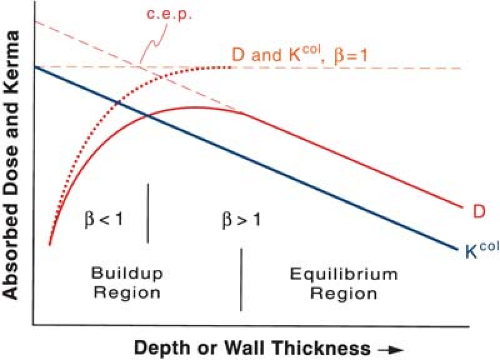
We can now interpret this graph fully:
- The Surface: At the surface (Depth = 0), has its maximum value, as the primary photon fluence is highest. The absorbed dose is near zero because no secondary electrons have been set in motion yet.
- The Buildup Region: As the beam penetrates the medium, begins to decrease due to the attenuation of primary photons. The absorbed dose rapidly increases. In this region, more charged particle energy is being created and projected forward than is leaving, so there is a net influx of energy deposited by charged particles. CPE does not exist here (, where ). The dose "builds up" until the rate of energy deposition by charged particles reaches a maximum.
- The Equilibrium Region (Transient CPE): Past the depth of maximum dose (), which is related to the range of the secondary electrons, the charged particle fluence comes into a state of quasi-equilibrium with the attenuating primary photon fluence. Because the primary beam is being attenuated, the number of electrons being set in motion at a given depth is slightly less than at a shallower depth. Since the dose at a point is deposited by electrons originating slightly upstream (where kerma was higher), the dose curve lies slightly above the collision kerma curve (). This condition is called transient charged particle equilibrium (TCPE) or partial charged-particle equilibrium (PCPE). The two curves then attenuate with roughly the same exponential fall-off.
The equality only occurs at the point where the dose curve crosses the kerma curve, typically on the falling edge of the buildup peak. Perfect CPE ( everywhere) would only occur if the primary beam were unattenuated, a theoretical idealization.
Conclusion
In this lesson, we have completed the fundamental chain linking the radiation transport field to absorbed dose. You have seen how the formalisms of kerma and absorbed dose are connected by the crucial concept of charged particle equilibrium.
Key Takeaways:
- Absorbed Dose () is the mean energy imparted to matter per unit mass ().
- Charged Particle Equilibrium (CPE) is a state where the charged particle field is uniform, meaning for every charged particle leaving a volume, an identical one enters. It requires a homogeneous medium and, critically, a uniform primary uncharged particle fluence.
- Under the conditions of CPE, absorbed dose is equal to collision kerma ().
- In practice, perfect CPE is rare. When a beam enters a medium, there is a buildup region where dose is less than kerma, followed by a region of transient CPE where dose is slightly greater than kerma due to primary beam attenuation.
Preview of the Next Lesson:
We have established the theoretical conditions under which . In many practical situations, especially in dosimetry for low-energy photons, the conditions for CPE are approximately met. This allows for a powerful simplification known as the kerma approximation, where one simply calculates kerma and assumes it is a reasonable approximation for the absorbed dose. In the next lesson, we will examine the conditions under which this approximation is valid and when it breaks down, solidifying the practical implications of today's theoretical discussion.