Introduction
In our last lesson, we established the crucial link between the solution of the Boltzmann transport equation—the angular flux —and the integral dosimetric quantities of particle and energy fluence. We saw that the scalar flux, , is precisely the energy-differential particle fluence rate, and from it, we can compute the total energy fluence, , which represents the total energy carried by the radiation field through a point.
Today, we will take the next logical step and use this concept of energy fluence to define and calculate kerma. Kerma is a foundational quantity in dosimetry for indirectly ionizing radiation like photons and neutrons. You will learn its formal definition, how it relates to the energy transferred from uncharged particles to charged particles, and most importantly, how to express it exactly in terms of the particle fluence and a material-dependent quantity called the mass energy-transfer coefficient. This provides a direct, computable connection between the radiation field and the first stage of energy deposition in a medium.
Defining Kerma and Collision Kerma
While you are likely familiar with kerma from your medical physics background, let's formalize its definition in the context of our transport theory framework. The term "kerma" is an acronym for Kinetic Energy Released per unit MAss. It quantifies the initial kinetic energy imparted to secondary charged particles (like electrons and positrons) by uncharged particles (like photons and neutrons) within a small volume of material.
To understand this formally, let's consult a standard text on dosimetry.
[PDF] Chapter 4 - Field and Dosimetric Quantities, Radiation Equilibrium
This chapter provides the rigorous ICRU definitions for dosimetric quantities. We will focus on the section that formally defines kerma.
Please read section 4.6.1, "Quantities related to the transfer of energy". Focus on the definition of energy transferred, \epsilon_{tr} (Eq. 4.43), and how it leads to the definition of kerma, K (Eq. 4.44). Also, pay close attention to the distinction made between kerma (K) and electronic kerma (K_\text{el}), which is also known as collision kerma (K_\text{col}).
As you've just read, kerma is the expectation value of the energy transferred, , to charged particles in a mass element, :
The unit of kerma is the Gray (Gy), where .
A crucial point from the reading is the distinction between total kerma and collision kerma. Once a charged particle is set in motion, it loses its kinetic energy through two main processes:
- Collisional interactions: Inelastic collisions with atomic electrons that lead to ionization and excitation. This energy is deposited locally.
- Radiative interactions: Interactions with atomic nuclei that produce bremsstrahlung photons (or in-flight annihilation for positrons). This energy is carried away by new uncharged particles and is not deposited locally.
This distinction gives rise to two components of kerma:
- Collision Kerma ( or ): The portion of the initial kinetic energy that is subsequently transferred by the secondary charged particles via collisions. This is the part that contributes to local energy deposition and, ultimately, absorbed dose.
- Radiative Kerma (): The portion of the initial kinetic energy that is subsequently lost by the secondary charged particles via radiative processes.
The total kerma is the sum of these two components: .
To connect the radiation field (fluence) to kerma, we need to introduce the material property that governs this energy transfer process.
The Mass Energy-Transfer Coefficient
The interaction of uncharged particles with matter is described by cross sections. To calculate kerma, we need a specific coefficient that accounts for the fraction of particle energy transferred to the kinetic energy of charged particles. This is the mass energy-transfer coefficient, .
Let's examine its formal definition.
[PDF] Chapter 4 - Field and Dosimetric Quantities, Radiation Equilibrium
This section defines the various interaction coefficients for uncharged particles, including the one we need for kerma.
Please read the beginning of section 4.5.2, "Interaction coefficients for uncharged particles". Start with the definition of the linear attenuation coefficient, \mu, but focus on the definition of the mass energy-transfer coefficient, \mu_{tr}/\rho (Eq. 4.23). Note how it is constructed from the underlying cross sections for different interaction types (\sigma_j) and the fraction of energy transferred in each (f_j).
The mass energy-transfer coefficient for a given material and incident particle energy is defined as:
where is the fraction of incident radiant energy that is transferred to the kinetic energy of charged particles while traversing a distance in the material of density . It has units of .
As Eq. (4.24) shows, this coefficient is fundamentally built from the microscopic cross sections:
where is the average fraction of the incident particle's energy transferred to charged particle kinetic energy in an interaction of type (e.g., photoelectric effect, Compton scattering).
This coefficient is the bridge we need. It encapsulates the physics of how much kinetic energy is "released" by uncharged particles per unit path length in a material.
Expressing Kerma in Terms of Fluence
We are now ready to combine these concepts to derive the central relationship of this lesson. We will show how kerma at a point is directly proportional to the energy fluence at that point, with the mass energy-transfer coefficient as the constant of proportionality.
[PDF] Chapter 4 - Field and Dosimetric Quantities, Radiation Equilibrium
This section provides a clear, step-by-step derivation connecting the field quantity (fluence) to the dosimetric quantity (kerma).
Now, please read section 4.7.1, "Photons". Follow the derivation from Eq. (4.58) to Eq. (4.63) carefully. The key is to see how the definition of \mu_{tr} is used, combined with the definition of fluence as the sum of particle track lengths per unit volume, to arrive at the final expression. Note the generalization to a polyenergetic spectrum in Eq. (4.64).
Let's summarize the elegant derivation you just read.
- The process begins with the definition of the linear energy-transfer coefficient, . For a single uncharged particle of energy traversing a small distance , the mean energy transferred to charged particles is .
- To find the total energy transferred within a small volume , we sum this quantity over all particle track lengths within that volume:
- By definition, kerma is this total energy transferred divided by the mass of the volume, :
- The crucial insight, which connects back to our previous lesson, is that the term in the first parenthesis—the sum of particle track lengths per unit volume—is precisely the definition of particle fluence, .
- This gives the relationship for monoenergetic particles: .
- Recognizing that the energy fluence is for monoenergetic particles, we arrive at the simple, powerful result:
For a realistic, polyenergetic radiation field characterized by an energy-differential particle fluence rate (which is our scalar flux ), we integrate over all energies. The kerma rate is:
As the text emphasizes, this relationship is exact and involves no assumptions about radiation equilibrium. It is a direct consequence of the definitions of fluence, kerma, and the energy-transfer coefficient.
The same logic applies to collision kerma. We simply replace the mass energy-transfer coefficient with the mass energy-absorption coefficient, , which only accounts for the energy destined for local collisional losses:
where , and is the radiative fraction.
Kerma Coefficients and Computational Context
This formalism is not just theoretical; it is the basis for practical calculations in both deterministic and Monte Carlo transport codes.
In many applications, especially with neutrons, the relationship is expressed using kerma coefficients (or "kerma factors"), denoted .
[PDF] Chapter 4 - Field and Dosimetric Quantities, Radiation Equilibrium
This short section shows how the same principle is applied to neutrons, introducing the conventional notation of kerma coefficients.
Please read the beginning of section 4.7.2, "Neutrons". Notice that the kerma coefficient \kappa_\Phi is simply a convenient grouping of terms: \kappa_\Phi = E_n (\mu_{tr}/\rho).
The kerma coefficient is simply the kerma per unit particle fluence, . This is particularly useful in computational settings where the particle fluence is calculated by a transport code, and pre-calculated kerma coefficients are then used to find the kerma.
For instance, the paper "Two-Dimensional Discrete Ordinates Photon Transport Calculations..." by Daskalov et al. describes using the DANTSYS code to compute dose distributions. It explicitly mentions this process. The authors state that their multigroup cross-section libraries include "group kerma factors for converting angular flux into kerma." After the code solves the transport equation to find the flux, a post-processing module is used to "convert the flux distribution to kerma by using the corresponding group kerma factors." Similarly, when describing their benchmark Monte Carlo simulations, they state that "mass-energy absorption coefficients were used to convert the scalar energy fluence into the collision kerma." This directly mirrors the equations we have just derived and highlights their central role in computational dosimetry.
Conclusion
In this lesson, we have built upon our understanding of fluence to derive a fundamental dosimetric quantity, kerma. You now have a first-principles view of how the energy released to a medium by uncharged particles is calculated directly from the radiation field.
Key Takeaways:
- Kerma is the kinetic energy released per unit mass to secondary charged particles by uncharged particles.
- Collision Kerma () is the component of kerma that excludes energy lost to radiative processes (like bremsstrahlung) and is responsible for local energy deposition.
- The mass energy-transfer coefficient () is the material property that quantifies the fraction of energy transferred from an uncharged particle field to charged particle kinetic energy.
- Kerma can be calculated exactly from the energy-differential particle fluence () via the integral:
- This relationship is the foundation for how transport codes compute kerma from a calculated flux distribution, often using pre-tabulated kerma coefficients.
Preview of the Next Lesson:
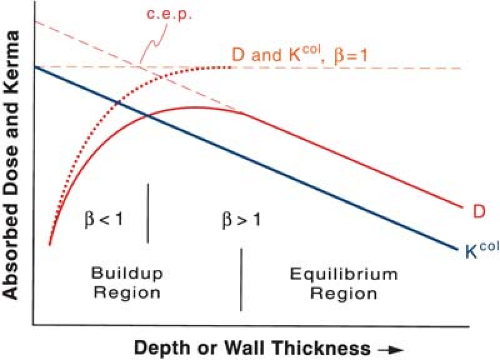
We have successfully defined the energy transferred to charged particles (kerma). The next question is: where does that energy go? The ultimate quantity of interest for biological effects is absorbed dose, which is the energy absorbed per unit mass. Under a special condition known as Charged Particle Equilibrium (CPE), the locally absorbed energy equals the energy transferred via collisions. In our next lesson, we will formally define CPE and show that under these conditions, absorbed dose is equal to collision kerma. This will complete the primary link from the radiation field to absorbed dose.