Introduction
Welcome back. In our last lesson, we carefully constructed the "Market for Lemons" as a formal game of incomplete information. We defined the players (a seller, Bob, and a buyer, Dylan), the seller's types (owning a high-quality or low-quality car), and the payoffs based on their respective valuations. We also established a crucial benchmark: in a world of perfect information, mutually beneficial trades would always occur for both car types, leading to an efficient market outcome.
Today, we will analyze the consequences of the information asymmetry we modeled. The central question is: can this efficient outcome survive when the buyer cannot distinguish a good car from a lemon? Our goal is to demonstrate how asymmetric information leads to market failure in the 'Market for Lemons' model. You will see how the logic of strategic behavior can cause the market for high-quality goods to collapse, a phenomenon known as adverse selection.
The Strategic Dilemma
Let's quickly recap the core of the strategic problem.
-
The Seller's decision is based on known quality. A seller will only sell if the market price is at least their reservation price.
- Owner of a Low-quality car sells if .
- Owner of a High-quality car sells if .
-
The Buyer's decision is based on uncertainty. The buyer doesn't know the quality of any specific car. They will only buy if the price is no more than the expected value they place on a car offered for sale.
This sets up the conflict. Can a single price exist that is high enough for the high-quality seller () and simultaneously low enough for a skeptical buyer?
The Market Unravels: Adverse Selection in Action
Let's investigate this question with a specific scenario. Assume the buyer believes there's a 60% chance that any used car is a lemon (). Can a market exist where both high-quality and low-quality cars are traded?
The following video segment walks through the calculation and its startling conclusion.
7. An Example for Bayesian Nash Equilibrium: Lemons Problem (Game Theory Playlist 9)
Professor Selcuk Ozyurt will now analyze the game under the assumption that the buyer is pessimistic about the car's quality. Pay close attention to the contradiction that arises when we try to find a price that works for everyone.
Watch the segment from 13:43 to 26:04. The key steps are: Why can't there be two different prices (one for high quality, one for low)? The seller of a high-quality car needs a price P ≥ $2,000 to be willing to sell. The buyer calculates their expected payoff from buying, knowing the car is low-quality with probability 0.6. Compare the maximum price the buyer is willing to pay with the minimum price the high-quality seller is willing to accept. What do you conclude?
Let's formalize the logic from the video.
-
A Single Market Price: As the video explains, we can't sustain separate prices for high and low-quality cars. Because the buyer cannot verify the quality, any seller (even one with a lemon) would claim their car is high-quality to get the higher price. Therefore, the market must have a single price, .
-
Buyer's Expected Value Calculation: The buyer must decide whether to purchase at price , knowing that both types of sellers might be in the market. Their expected payoff from buying is based on their belief . The buyer's willingness to pay for a car of unknown quality is their expected valuation:
Plugging in the values from our model:
This means a rational buyer will never pay more than $1,800 for a car of unknown quality in this market. Their condition to buy is .
-
The Contradiction and Market Failure: Now we see the problem.
- For a high-quality car to be offered for sale, the price must be .
- But a rational buyer will only pay a price of .
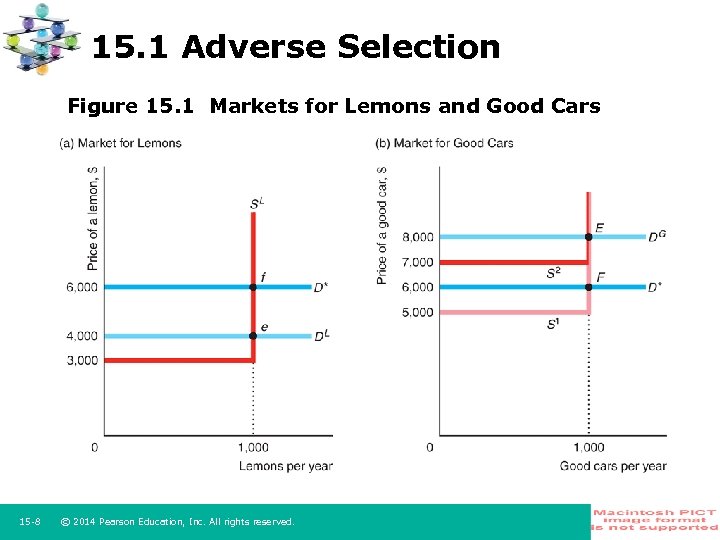
There is no price that satisfies both conditions simultaneously. It's impossible to sustain a market where high-quality cars are traded. The fear of buying a lemon drives the buyer's willingness to pay down so far that the sellers of good cars are forced to exit the market.
This is the essence of market failure due to adverse selection. The "bad" products have driven out the "good," and the potentially large gains from trading good cars (worth $3,000 to the buyer, but only $2,000 to the seller) are lost. The only market that can exist is one where lemons are sold at a price between $0 and $1,000.
To reinforce this crucial concept, let's review a formal write-up of this logic.
[PDF] Lecture Note 22: Private Information, Adverse Selection and Market Failure
This lecture note from MIT provides a concise, formal explanation of the market unraveling we just witnessed. It introduces the key idea that the quality of goods in the market becomes 'endogenous to price.'
Please read section 2 of the PDF (pages 3-4). Focus on the calculations for the buyer's willingness to pay (BU) as a function of the price (PU) and the proportion of lemons (λ). Notice how they arrive at the same conclusion: if the share of lemons is high enough (λ > 0.4 in their example), good cars are not sold.
The image below provides a classic supply-and-demand illustration of this failure.
Is Market Failure Inevitable?
Does asymmetric information always lead to a complete market collapse for good products? Not necessarily. The outcome critically depends on the buyer's prior belief, .
Let's see what happens if the buyer is more optimistic. Imagine they believe the chance of getting a lemon is only 20% ().
7. An Example for Bayesian Nash Equilibrium: Lemons Problem (Game Theory Playlist 9)
Now, watch the same analyst explore a scenario where the buyer is more optimistic about the quality of cars.
Watch the segment from 28:30 to 35:15. Follow the same steps as before, but now using q=0.2. What is the buyer's new maximum willingness to pay? Does a price range exist where both high- and low-quality cars can be sold?
In this case, the buyer's expected valuation is:
Now, the conditions for trade are:
- Seller of high-quality car requires:
- Buyer is willing to pay up to:
A price in the range [$2,000, $2,600] satisfies both parties. In this scenario, an efficient "pooling equilibrium" is possible, where both types of cars are traded. The market does not fail.
This comparison shows that market failure isn't a given, but a direct consequence of the severity of the information problem. If buyers become too pessimistic, the market for quality goods can evaporate.
Conclusion
In this lesson, we demonstrated the primary consequence of adverse selection in the Market for Lemons. By analyzing the strategic incentives of both the informed seller and the uninformed buyer, we showed how a market can unravel.
Key Takeaways:
- Market failure in the Lemons model occurs when the buyer's willingness to pay for a car of average quality falls below the seller's reservation price for a high-quality car.
- The buyer's willingness to pay is an expected value calculation that depends on their prior belief () about the proportion of lemons.
- When is sufficiently high, there is no single price that can satisfy both a skeptical buyer and a seller of a high-quality car. The result is adverse selection: the bad products drive the good products out of the market.
- This failure is not inevitable; if buyers are sufficiently optimistic (low ), a "pooling equilibrium" where all car types are traded can exist.
We have now seen how hidden information can paralyze a market. But what if sellers could do something to prove their quality? In our next lesson, we will explore this possibility by setting up Spence's job-market model, a canonical example of a signaling game where informed players take costly actions to credibly reveal their private information.