Introduction
In our last lesson, we saw how asymmetric information in Akerlof's "Market for Lemons" can lead to adverse selection, causing the market for high-quality goods to collapse. The core problem was that uninformed buyers had no way to verify quality, and their resulting skepticism drove down the market price, pushing good sellers out.
Today, we shift our focus from the uninformed party's problem to the informed party's potential solution: signaling. What if a worker with high ability could take a costly, observable action to credibly signal their quality to a potential employer? This is the central question of Michael Spence's Nobel Prize-winning job-market model.
Your learning outcome for this lesson is to set up Spence's job-market model as a signaling game. This involves defining the players, their types, the sequence of actions, their information, and their payoffs. We will also establish the critical assumption that makes signaling possible in the first place. This lesson will provide the complete architecture of the model, preparing us to analyze its strategic outcomes in the next session.
What is a Signal?
In game theory, a signal is an action taken by an informed player to convey their private information to an uninformed player. We saw in the "lemons" model that simply saying "my car is high-quality" is not credible; it's "cheap talk." For a signal to be credible, it must be costly in a way that makes it unattractive for a lower-quality type to mimic.
In Spence's model, the signal is education. The core idea is that even if education adds nothing to a worker's actual productivity, it can still be valuable if it serves as a credible signal of their innate ability.
(IME2) Chapter 11 - Video 5: Introduction to Spence's Job Market Signaling Model - Key Concepts.
To begin, let's explore this fundamental idea. This video introduces the dual role of education: as a tool for building human capital and as a costly signal.
Watch the first four minutes (00:00 - 04:17). Focus on the distinction Spence makes: even if education doesn't improve your skills, why might it still be valuable in the job market? What makes education a more credible signal than just claiming to be a good worker?
The Key to Credible Signaling: The Single-Crossing Property
The video you just watched highlights that a signal must be costly to be credible. But there's a more subtle and crucial requirement: for a signal to effectively separate different types, the cost of sending the signal must be different for each type.
Specifically, in the Spence model, it must be less costly for a high-ability worker to acquire education than for a low-ability worker. This is the foundational assumption of the entire model. It's often called the single-crossing property because, as we will see, it causes the indifference curves of the two worker types to cross only once.
This differential cost can arise for many reasons:
- High-ability individuals may find studying less mentally taxing.
- They might grasp concepts faster, requiring less time and effort.
- Their opportunity cost might be different; a high-ability person may have poorer alternatives outside of a skilled profession, making the educational path relatively more attractive for them.
The following segment explains this essential concept.
(IME2) Chapter 11 - Video 5: Introduction to Spence's Job Market Signaling Model - Key Concepts.
Let's explore why the cost of education must be different for workers of different abilities.
Watch the segment from 07:20 to 11:11. The speaker uses an analogy from 'The Big Bang Theory' to illustrate this point. What is the central argument for why education is 'cheaper' for a high-productivity person like Sheldon than for a low-productivity person like Penny?
Let's formalize this. If is the level of education and is the worker's type (ability), with , we can define a cost function . The single-crossing property is the mathematical statement that the marginal cost of education is lower for the high-ability type:
This inequality is the engine that drives the signaling model. It's what creates the possibility for a high-ability worker to choose a level of education that a low-ability worker would find too costly to imitate.
Setting Up the Model: Players, Actions, and Payoffs
Now we can assemble the full model. A signaling game is a dynamic game of incomplete information. The general structure was introduced in the previous module.
Game Theory 101 (#77): Signaling Games
This short video classifies signaling games and lays out the typical sequence of moves in an employment game.
Watch the first three minutes (00:00 - 02:47). Note the key distinction from our previous 'screening' games: here, the informed player (the worker) moves first. Observe the structure of the game tree: Nature moves, then the worker, then the firm.
Let's formally define the components of the Spence model, using the concepts from the videos and adding the mathematical rigor you prefer.
[PDF] Advanced Microeconomics III - Spence's Signaling Model
These lecture slides provide a concise, formal definition of the model's components.
Read slides 4, 5, and 6. They formalize the players, types, actions, payoffs, and the critical assumptions about the cost function we just discussed.
Synthesizing these resources, we can define the game as follows:
-
Players:
- One Worker (the Sender, Player 1), who knows their own ability.
- Two or more identical, competitive Firms (the Receivers, Player 2), who do not know the worker's ability.
-
Sequence of Moves & Information:
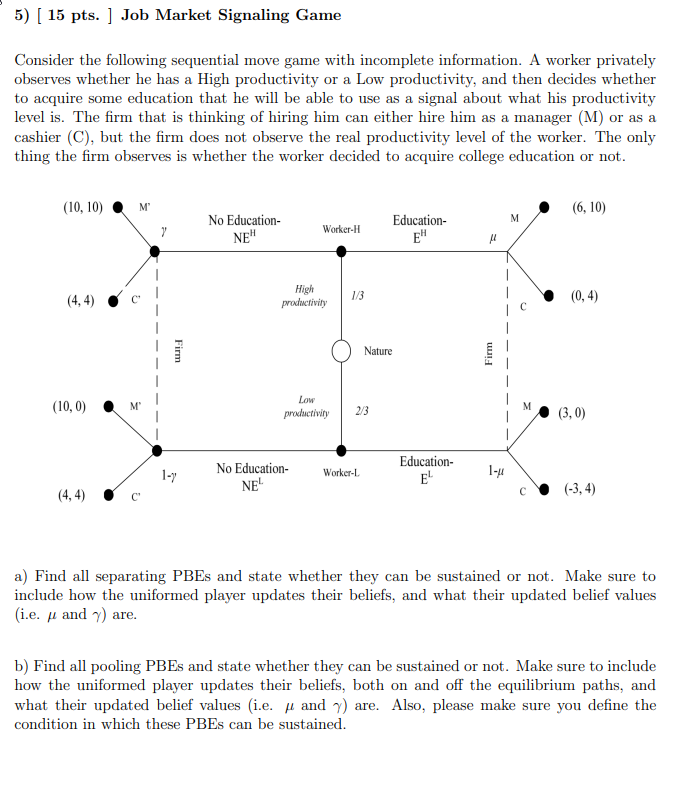
- Move 1 (Nature): Nature chooses the worker's type . The worker is either high-ability () with probability , or low-ability () with probability . The worker observes their type; the firms do not.
- Move 2 (Worker): The worker, knowing their type, chooses a level of education . This action is observable by the firms.
- Move 3 (Firms): The firms observe the worker's education level (but not ). They then update their belief about the worker's probability of being high-ability. Due to competition (similar to Bertrand competition), they all offer a wage equal to the worker's expected productivity, given the signal .
-
Payoffs:
- Worker's Utility: . The worker wants a high wage but dislikes the cost of education.
- Firm's Profit: If a firm hires a worker of type at wage , its profit is . In equilibrium, competition drives this profit to zero, so .
To make this concrete, let's use the parameters from the first video you watched.
(IME2) Chapter 11 - Video 5: Introduction to Spence's Job Market Signaling Model - Key Concepts.
This segment lays out a specific numerical example of the model we just defined.
Watch from 11:20 to 16:30. Take note of the specific values assigned to worker productivity (the firm's value), wages, and the costs of education for high and low types. This gives us a tangible version of the abstract model.
Let's summarize that example's parameters:
- Types & Productivity: , .
- Prior Beliefs: .
- Actions: The worker can choose no education () or get an education ().
- Costs:
- Cost of no education is zero: .
- Cost of education for high-type: .
- Cost of education for low-type: .
Notice that , satisfying the single-crossing property.
The following game tree visualizes a similar model, providing a clear map of the entire strategic interaction.
Conclusion
In this lesson, we have successfully constructed the Spence job-market signaling model. We moved from the problem of adverse selection, where information is hidden, to the potential solution of signaling, where the informed party takes costly action to reveal that information.
Key Takeaways:
- Signaling is a strategic action by an informed player to credibly convey their private information.
- For a signal to be credible, it must be costly. For it to be separating, it must be more costly for the low type to send than the high type. This is the single-crossing property.
- The Spence model is a dynamic game of incomplete information with the following structure:
- Nature assigns a worker's hidden type (e.g., high/low productivity).
- The worker chooses an observable education level .
- Firms observe , update their beliefs, and offer a competitive wage equal to the worker's expected productivity.
- Payoffs are defined by the worker's utility and the firm's profit .
We have now set the stage perfectly. All the components are in place. In our next lesson, we will use this very structure to derive the conditions for a separating equilibrium, where high-ability workers successfully use education to separate themselves from low-ability workers, commanding a higher wage and overcoming the "lemons" problem.