Introduction
Hello! In our last lesson, we established the formal definition of a Nash Equilibrium (NE) as a strategy profile of mutual best responses. We explored this concept through two key lenses: the "no regrets" principle, where no player wishes to unilaterally change their action after the fact, and the "self-fulfilling beliefs" idea, where the expectation of an NE outcome makes it rational for all players to bring it about.
While we now understand what a Nash Equilibrium is, the crucial next step is to develop a practical method for finding them. This lesson will equip you with a systematic algorithm to identify all pure-strategy Nash equilibria in 2x2 and 2x3 matrix games. This moves us from abstract theory to concrete problem-solving.
The Best Response Analysis Method
The definition of a Nash Equilibrium gives us a direct way to find one. Since an NE is a profile of mutual best responses, we can simply go through a game's payoff matrix and identify these points of intersection. The method is often called best response analysis.
Here is the step-by-step procedure for a two-player game:
-
Find Player 1's Best Responses:
- For each column (i.e., for each possible strategy Player 2 could play), determine Player 1's best response.
- Player 1's payoffs are the first numbers in each cell. Compare these payoffs vertically within that single column.
- Mark the payoff(s) corresponding to Player 1's highest utility in that column. You can underline them, circle them, or use any consistent mark. If there's a tie for the best payoff, mark all of them.
-
Find Player 2's Best Responses:
- For each row (i.e., for each possible strategy Player 1 could play), determine Player 2's best response.
- Player 2's payoffs are the second numbers in each cell. Compare these payoffs horizontally across that single row.
- Mark the payoff(s) corresponding to Player 2's highest utility in that row.
-
Identify Nash Equilibria:
- Look for any cell in the matrix where all payoffs have been marked.
- Any such cell represents a Pure-Strategy Nash Equilibrium (PSNE). The strategies that lead to that cell form the equilibrium strategy profile.
This "underlining" or "circling" method is a simple but powerful algorithm. The following videos will demonstrate this technique in action.
3. Finding Pure Strategy Nash Equilibrium in Finite Simultaneous-Move Games (Game Theory Playlist 3)
First, let's watch this video from Selcuk Ozyurt. He provides an exceptionally clear demonstration of the 'underlining method' to find the pure-strategy Nash equilibria in a 2x2 game. He also highlights common mistakes to avoid.
Watch the segment from 00:00:40 to 00:06:43. Pay close attention to how he systematically identifies and underlines the best response for each player. Then, watch the 'common mistakes' segment from 00:09:43 to 00:11:09. This will help you avoid simple but costly errors.
Now, let's see the same logic applied to a slightly larger game.
5. Nash equilibrium: bad fashion and bank runs
This clip from the YaleCourses lecture you saw previously demonstrates the same method on a 3x3 game. Professor Polak uses circles and squares instead of underlining, but the logic is identical. Seeing a different visual representation can help solidify your understanding.
Watch from 09:17 to 16:44. Observe how he methodically works through each player's choices to find their best responses, ultimately identifying the cell where the best responses are mutual.
For a concise, formal summary of this process, you can refer to "Tool 3.3" in the document Nash equilibria in games with continuous action spaces (LINK) that we have seen before. It neatly summarizes the two-step process: (1) Find and underline best responses for all players, and (2) Identify cells where every payoff is underlined.
Guided Practice: A 2x2 Game
Let's apply this method together. Consider the following 2x2 game:
| Player 2: Left | Player 2: Right | |
|---|---|---|
| P1: Up | (3, 1) | (1, 0) |
| P1: Down | (0, 0) | (2, 2) |
Step 1: Find Player 1's best responses.
- If Player 2 plays Left, Player 1's choices are Up (payoff 3) and Down (payoff 0). The best response is Up. Let's underline Player 1's payoff of 3 in the (Up, Left) cell.
- If Player 2 plays Right, Player 1's choices are Up (payoff 1) and Down (payoff 2). The best response is Down. Let's underline Player 1's payoff of 2 in the (Down, Right) cell.
Our matrix now looks like this:
| Player 2: Left | Player 2: Right | |
|---|---|---|
| P1: Up | (3, 1) | (1, 0) |
| P1: Down | (0, 0) | (2, 2) |
Step 2: Find Player 2's best responses.
- If Player 1 plays Up, Player 2's choices are Left (payoff 1) and Right (payoff 0). The best response is Left. Let's underline Player 2's payoff of 1 in the (Up, Left) cell.
- If Player 1 plays Down, Player 2's choices are Left (payoff 0) and Right (payoff 2). The best response is Right. Let's underline Player 2's payoff of 2 in the (Down, Right) cell.
Our final matrix:
| Player 2: Left | Player 2: Right | |
|---|---|---|
| P1: Up | (3, 1) | (1, 0) |
| P1: Down | (0, 0) | (2, 2) |
Step 3: Identify Nash Equilibria.
We look for cells where both payoffs are underlined. We have two such cells:
- (Up, Left) with payoffs (3, 1).
- (Down, Right) with payoffs (2, 2).
Therefore, this game has two pure-strategy Nash equilibria: (Up, Left) and (Down, Right).
Your Turn: Practice Problems
Now it's your turn to apply the method. Find all pure-strategy Nash equilibria for the two games shown in the image below. Take your time to go through the steps methodically for each game.
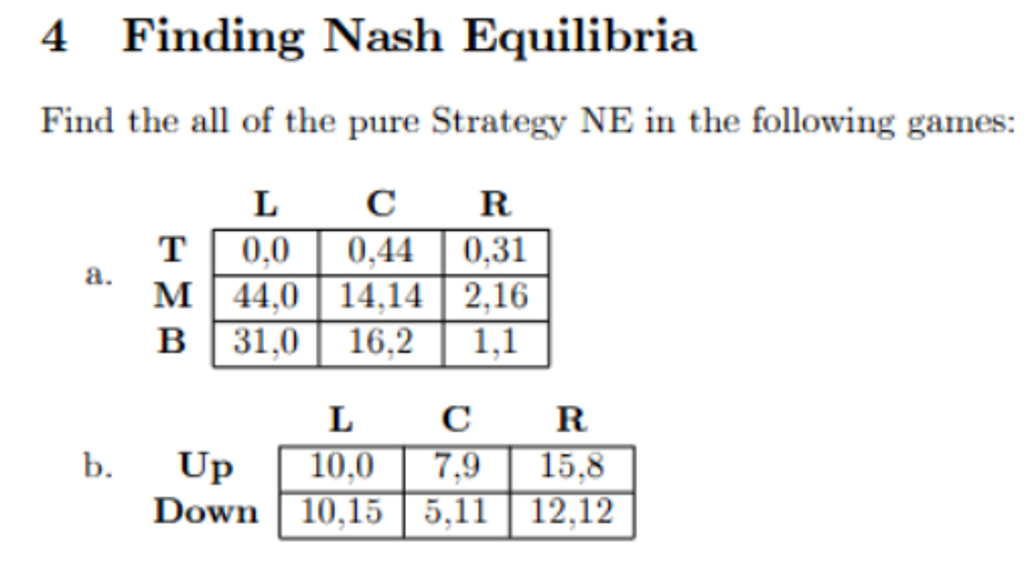
Once you have your answers, you can check them against the solutions below.
Click here to see the solution for Game (a).
Let's analyze Game (a):
| L | C | R | |
|---|---|---|---|
| T | (2, 2) | (0, 3) | (1, 2) |
| M | (3, 1) | (1, 1) | (0, 0) |
| B | (0, 0) | (0, 0) | (0, 1) |
-
Player 1's Best Responses (Rows):
- If P2 plays L: P1 gets payoffs 2, 3, 0. Best is M (3).
- If P2 plays C: P1 gets payoffs 0, 1, 0. Best is M (1).
- If P2 plays R: P1 gets payoffs 1, 0, 0. Best is T (1).
-
Player 2's Best Responses (Columns):
- If P1 plays T: P2 gets payoffs 2, 3, 2. Best is C (3).
- If P1 plays M: P2 gets payoffs 1, 1, 0. Best are L (1) and C (1).
- If P1 plays B: P2 gets payoffs 0, 0, 1. Best is R (1).
The marked-up matrix:
| L | C | R | |
|---|---|---|---|
| T | (2, 2) | (0, 3) | (1, 2) |
| M | (3, 1) | (1, 1) | (0, 0) |
| B | (0, 0) | (0, 0) | (0, 1) |
The only cell where both payoffs are marked is (M, C).
Therefore, the unique pure-strategy Nash equilibrium is (M, C) with payoffs (1, 1).
Click here to see the solution for Game (b).
Let's analyze Game (b):
| L | C | R | |
|---|---|---|---|
| Up | (3, 1) | (0, 1) | (1, 2) |
| Down | (1, 2) | (2, 3) | (0, 0) |
-
Player 1's Best Responses (Rows):
- If P2 plays L: P1 gets payoffs 3, 1. Best is Up (3).
- If P2 plays C: P1 gets payoffs 0, 2. Best is Down (2).
- If P2 plays R: P1 gets payoffs 1, 0. Best is Up (1).
-
Player 2's Best Responses (Columns):
- If P1 plays Up: P2 gets payoffs 1, 1, 2. Best is R (2).
- If P1 plays Down: P2 gets payoffs 2, 3, 0. Best is C (3).
The marked-up matrix:
| L | C | R | |
|---|---|---|---|
| Up | (3, 1) | (0, 1) | (1, 2) |
| Down | (1, 2) | (2, 3) | (0, 0) |
We have two cells where both payoffs are marked: (Up, R) and (Down, C).
Therefore, this game has two pure-strategy Nash equilibria:
- (Up, R) with payoffs (1, 2).
- (Down, C) with payoffs (2, 3).
Conclusion
Today you've mastered a fundamental skill: finding pure-strategy Nash equilibria in normal-form games. This systematic method of best response analysis provides a reliable way to predict stable outcomes where no player has an incentive to unilaterally deviate.
Key Takeaways:
- A Pure-Strategy Nash Equilibrium (PSNE) is a cell in a payoff matrix where each player's strategy is a best response to the other's.
- The "underlining" or "circling" method is a systematic algorithm to find all PSNEs by marking each player's best response for every possible strategy of their opponent.
- A game can have one, multiple, or even zero pure-strategy Nash equilibria. We saw an example with two equilibria in our guided practice.
The existence of multiple equilibria raises an important question: if there are several stable outcomes, which one should players expect to occur? This is a problem of coordination. Our next lesson will dive into this issue by analyzing a famous coordination game: the Stag Hunt. We will see how players might reason about which equilibrium to aim for.