Introduction
Hello! In our last lesson, you mastered the technique of best response analysis to systematically find all pure-strategy Nash equilibria (PSNE) in a game. We saw that while some games have one unique equilibrium, others can have multiple stable outcomes.
This immediately raises a crucial question for strategic thinking: If rational play can lead to several different results, how should players coordinate on one? Which equilibrium is "better," and how can players be sure they're aiming for the same one?
This lesson delves into this exact problem by analyzing the Stag Hunt, a classic game that serves as a powerful model for coordination. Unlike the Prisoner's Dilemma where there's a conflict between individual and collective good, the Stag Hunt presents a conflict between a high-reward, high-risk cooperative outcome and a low-reward, low-risk safe outcome. Analyzing it will give us deeper insights into trust, risk, and the challenges of achieving cooperation.
The Stag Hunt: Story and Payoffs
The Stag Hunt game, originally described by the philosopher Jean-Jacques Rousseau, tells a simple story of two hunters. They can individually choose to hunt a hare, which is an almost guaranteed but small meal. Alternatively, they can cooperate to hunt a stag, a much larger prize that requires both of them to succeed. If one hunter tries for the stag while the other goes for a hare, the stag-hunter fails and gets nothing, while the hare-hunter succeeds.
Let's see how this narrative is formally represented as a game.
The Mathematics of Trust // How Game Theory Explains Cooperation
To begin, let's watch a segment from a video by Dr. Trefor Bazett that clearly explains the story of the Stag Hunt and how to translate it into a payoff matrix.
Starting at the 44-second mark, watch the Stag Hunt scenario. Focus on how the narrative of cooperation and individual action translates into numerical payoffs for each outcome.
The video uses one possible set of payoffs. Another common representation, which we'll use for our analysis, is this:
| Player 2: Stag | Player 2: Hare | |
|---|---|---|
| P1: Stag | (3, 3) | (0, 2) |
| P1: Hare | (2, 0) | (1, 1) |
Here's the logic:
- (Stag, Stag): They cooperate and succeed, sharing the large prize (payoff of 3 each).
- (Hare, Hare): They both play it safe, each catching their own small prize (payoff of 1 each).
- (Stag, Hare): Player 1 attempts to hunt the stag alone and fails (payoff 0), while Player 2 secures a hare (payoff 2).
- (Hare, Stag): The reverse of the above. Player 1 gets a hare (2), while Player 2 gets nothing (0).
Finding the Equilibria
Now, let's apply the best response analysis method you learned in the previous lesson to this payoff matrix.
-
Find Player 1's Best Responses:
- If Player 2 chooses Stag, Player 1 can get 3 (from Stag) or 2 (from Hare). Player 1's best response is Stag.
- If Player 2 chooses Hare, Player 1 can get 0 (from Stag) or 1 (from Hare). Player 1's best response is Hare.
-
Find Player 2's Best Responses:
- If Player 1 chooses Stag, Player 2 can get 3 (from Stag) or 2 (from Hare). Player 2's best response is Stag.
- If Player 1 chooses Hare, Player 2 can get 0 (from Stag) or 1 (from Hare). Player 2's best response is Hare.
Let's mark these on our matrix (marking best responses with underlines):
| Player 2: Stag | Player 2: Hare | |
|---|---|---|
| P1: Stag | (3, 3) | (0, 2) |
| P1: Hare | (2, 0) | (1, 1) |
As you can see, we have two cells where both payoffs are underlined. This means the Stag Hunt has two pure-strategy Nash equilibria:
- (Stag, Stag)
- (Hare, Hare)
This finding is the core of the coordination problem. Both outcomes are stable—if players expect to end up at one of them, they have no incentive to unilaterally change their strategy.
The Trust Dilemma: Payoff vs. Risk
Having two equilibria forces us to a more nuanced analysis. Which one is "better"? And which is more likely?
The Mathematics of Trust // How Game Theory Explains Cooperation
Let's return to Dr. Bazett's video, where he discusses the implications of these two equilibria and frames the game as a 'trust dilemma'.
Watch Stag Hunt equilibria. Pay close attention to the distinction between the payoff-maximizing equilibrium and the risk-minimizing equilibrium, and how this applies to real-world scenarios.
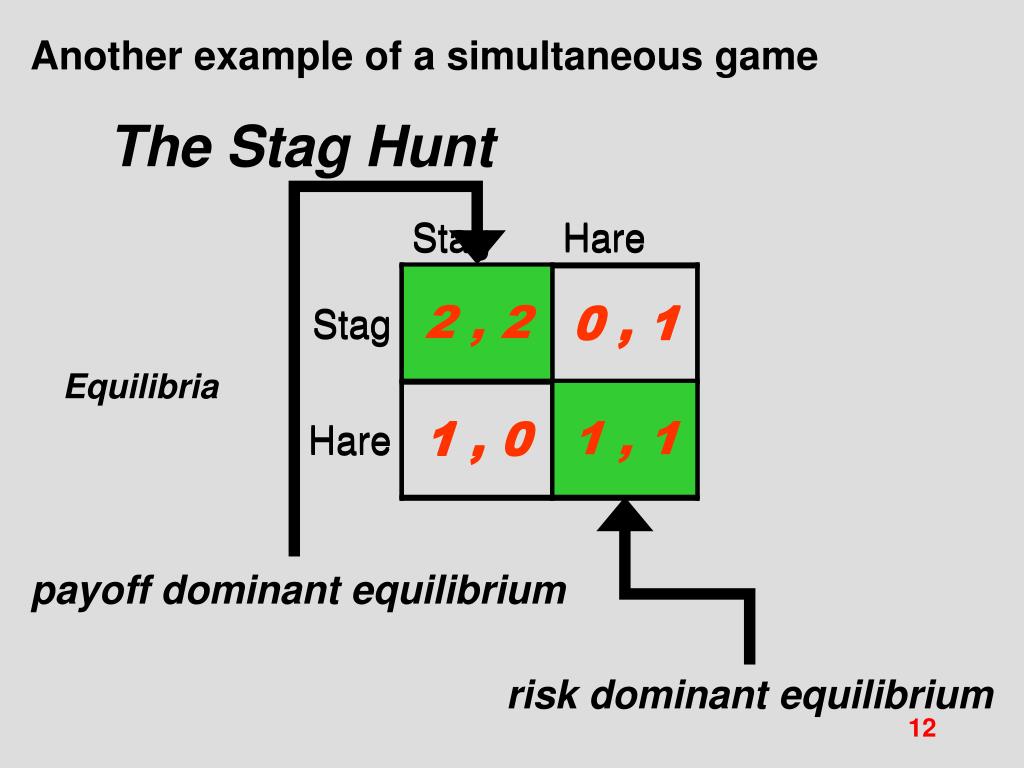
The video introduces a critical distinction between the two equilibria, which we can formalize with some important terminology.
-
(Stag, Stag) is the Payoff Dominant Equilibrium:
This equilibrium is Pareto superior to the other, meaning it's strictly better for every player. Both players prefer the (3, 3) outcome to the (1, 1) outcome. If players could coordinate and trust each other, this is the outcome they would choose. It represents the rewards of successful social cooperation. -
(Hare, Hare) is the Risk Dominant Equilibrium:
This equilibrium is safer. By choosing 'Hare', a player guarantees themselves a payoff of at least 1, regardless of what the other player does. If you choose 'Stag', you risk getting a payoff of 0 if your partner doesn't cooperate. The (Hare, Hare) equilibrium minimizes a player's potential losses. It represents the appeal of self-reliance when trust is low.
As the textbook chapter Nash Equilibrium: Theory notes, the fact that (Stag, Stag) is better for both players has no bearing on the equilibrium status of (Hare, Hare). An equilibrium only requires that no single player can do better by unilaterally deviating. Coordinated deviations are not considered in the Nash equilibrium definition. This is a crucial point that reinforces why the less-good outcome can still be a stable one.
A Deeper Look at Risk Dominance
Since you appreciate mathematical rigor, let's explore risk dominance more formally.
An equilibrium is risk-dominant if its strategy is a best response to the other player choosing their strategy with a 50% probability. More generally, it's the equilibrium that has the larger "basin of attraction" in the space of beliefs.
Let's find the tipping point. Assume Player 2 plays Stag with probability and Hare with probability . When is it rational for Player 1 to play Stag?
Player 1's expected payoff from playing Stag is:
Player 1's expected payoff from playing Hare is:
Player 1 should play Stag if .
This calculation reveals the essence of the coordination problem. For you to risk playing 'Stag', you must believe there's a greater than 50% chance your partner will also play 'Stag'. If you believe the probability is less than 50%, your rational choice is to play it safe and hunt a hare. The (Hare, Hare) equilibrium is "risk dominant" because it remains the best response over a wider range of uncertainty about the other's actions (any belief ).
Conclusion
Today we moved beyond simply finding Nash equilibria to analyzing what happens when a game has more than one. The Stag Hunt provides a perfect model for understanding the tension between cooperation and safety.
Key Takeaways:
- The Stag Hunt is a coordination game with two pure-strategy Nash equilibria: a cooperative, high-payoff outcome and a safe, low-payoff outcome.
- The cooperative equilibrium, (Stag, Stag), is payoff dominant because it is Pareto superior (better for all players).
- The safe equilibrium, (Hare, Hare), is risk dominant because it minimizes potential losses and is the best response to a wider range of uncertainty about the other player's actions.
- The choice between these equilibria depends critically on players' beliefs, trust, and ability to communicate, themes central to applying game theory to real-world planning.
In all the games we've analyzed so far, we have been able to find at least one pure-strategy Nash equilibrium. But what happens if a game has no PSNE? In our next lesson, we will explore this possibility and introduce the concept of mixed strategies, where players randomize their actions to keep opponents guessing.