Introduction
Welcome to your third lesson. In our last session, you learned how to construct a payoff matrix, the standard tool for representing a two-player, simultaneous-move game. We established the conventions for rows, columns, and payoff pairs , translating a game's description into a formal, analyzable structure.
Today, we will apply this tool to one of the most famous and influential games in all of game theory: the Prisoner's Dilemma. This lesson will guide you through its structure and solution. More importantly, it will reveal the central paradox of the game: the profound conflict between what is rational for an individual to do and what is best for the group as a whole. This concept is fundamental to understanding many strategic challenges you see in the world, aligning with your goal of using game theory for meaningful planning.
The Classic Dilemma
The Prisoner's Dilemma is typically introduced with a story about two suspected criminals. This narrative provides an intuitive entry point before we move to the formal analysis.
Game Theory 101: The Prisoner's Dilemma
This video by William Spaniel provides a concise and clear explanation of the classic Prisoner's Dilemma scenario, the construction of its payoff matrix, and the logical steps that lead to its perplexing outcome.
Watch the entire video (around 3 minutes). Pay close attention to: The setup of the story and the 'deal' offered to each prisoner (0:01-0:32). How the outcomes (prison sentences) are mapped onto a payoff matrix (0:32-1:22). The step-by-step reasoning each player uses to make their decision (1:22-2:53). The final outcome and why it is considered a 'dilemma' (2:53-3:13).
As the video explained, the police create a situation where each prisoner must make a choice without knowing the other's decision. Let's formalize the actions and outcomes. The two strategies are:
- Cooperate (with the other prisoner) by remaining silent.
- Defect (from the pact with the other prisoner) by confessing.
The outcomes, represented as years in prison (negative payoffs), create the following matrix. Note that 'Lie' corresponds to Cooperate, and 'Confess' corresponds to Defect.
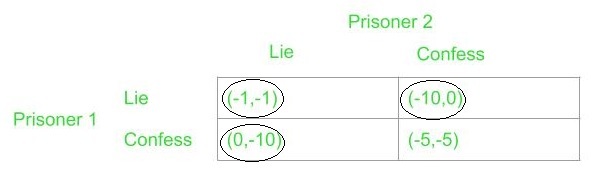
Formal Analysis: Dominance and Rationality
The video walked through the logic informally. Now, let's formalize it, which I know you'll appreciate given your interest in mathematical rigor.
The structure of the Prisoner's Dilemma is not defined by the specific story, but by the ranking of its payoffs. Let's use variables to represent the ordinal payoffs:
- = Temptation: The payoff for being the sole defector.
- = Reward: The payoff for mutual cooperation.
- = Punishment: The payoff for mutual defection.
- = Sucker: The payoff for being the sole cooperator.
A game is a Prisoner's Dilemma if and only if the payoffs satisfy this inequality:
Let's check this with the matrix from the video (using positive values where 0 years is best, e.g., mapping 0 years to 10 points, -1 to 9, -5 to 5, -10 to 0):
- (0 years)
- (-1 year)
- (-5 years)
- (-10 years)
The inequality holds.
Now, let's analyze the choice of a rational player, say Player 1.
- Assume Player 2 Cooperates. Player 1 can either Cooperate for a payoff of or Defect for a payoff of . Since , Player 1 is better off defecting.
- Assume Player 2 Defects. Player 1 can either Cooperate for a payoff of or Defect for a payoff of . Since , Player 1 is again better off defecting.
In both cases, regardless of what the other player does, defecting yields a strictly higher payoff. When one strategy is always better than another, it is called a strictly dominant strategy.
For a rational player, playing a strictly dominant strategy is the only logical choice. Because the game is symmetric, Defect is also the strictly dominant strategy for Player 2. Consequently, the only rational outcome is , where both players receive the punishment payoff .
The Conflict: Individual vs. Collective Rationality
This brings us to the heart of the dilemma. The outcome reached through individually rational choices is with payoff . However, there is another outcome, with payoff , which both players prefer, since .
This is the central conflict:
The pursuit of individual self-interest by all players leads to an outcome that is worse for everyone than if they had all cooperated.
The outcome is Pareto optimal—meaning there is no other outcome that makes at least one player better off without making another player worse off. The equilibrium outcome is Pareto inefficient because the outcome is better for both players.
To deepen your understanding of this formal structure, please read the following text from the Stanford Encyclopedia of Philosophy.
Prisoner's Dilemma - Stanford Encyclopedia of Philosophy
This entry formally defines the symmetric 2x2 Prisoner's Dilemma, explains the payoff structure, and rigorously defines the concepts of strict dominance and Nash Equilibrium in this context.
Read Section 1, 'Symmetric 2×2 PD With Ordinal Payoffs'. Focus on the inequality condition (PD1), the definition of strict dominance, and how these elements lead to a suboptimal Nash equilibrium.
The Prisoner's Dilemma in the Real World
The Prisoner's Dilemma is not just a theoretical puzzle. It serves as a powerful model for countless real-world situations where cooperation is difficult to achieve, even when it's in everyone's best interest. These are often called collective action problems or social dilemmas.
Some classic examples include:
- Arms races: Two countries would be better off not spending on weapons (Cooperate), but each fears being at a disadvantage if the other builds up its arsenal (Defect).
- Climate change: All countries would benefit from a stable climate (mutual cooperation by reducing emissions), but each has an individual incentive to continue polluting (Defect) to boost its economy, free-riding on the efforts of others.
- Price wars: Two competing firms would be better off keeping prices high (Cooperate), but each has an incentive to cut prices (Defect) to steal market share.
The video below gives an excellent overview of how the Prisoner's Dilemma scales up to model these broader societal challenges.
Collective Action Game Theory | Multi-Player Prisoner’s Dilemma
This video from Ashley Hodgson introduces the concept of a multi-player Prisoner's Dilemma and lists numerous real-world examples that fit this framework.
Watch the first 1 minute and 22 seconds of the video. The goal is to see the wide range of societal issues that can be understood through the lens of a collective action game.
The Stanford Encyclopedia of Philosophy article you looked at earlier also extends this idea to public goods and the Tragedy of the Commons in its section on multi-player games (Section 5). These models are central to economics, political science, and environmental studies.
A Deeper Mathematical Analysis
Given your preference for mathematical rigor, you might find the previous logical analysis straightforward but perhaps not fully satisfying. The following resource provides a more algebraic treatment of the dilemma. It formulates an expected value function and uses it to prove the conditions under which defection is the dominant choice.
This approach introduces probabilistic thinking, which will become essential when we study mixed strategies in a later module.
[PDF] The Prisoner's Dilemma: A Mathematical Analysis
This document provides a detailed mathematical analysis, deriving the conditions for the dilemma using algebra and expected value calculations.
Read 'b. Equilibrium' on pages 2-3. Notice how the problem is formalized with constants A, B, C, D, and the inequality A>B>C>D is established as the condition for the dilemma. Read the 'Mathematics' section from pages 4-7. Focus on how the expected value function z is constructed (equation 1) and then analyzed. Pay particular attention to the derivation leading to equation (8), which algebraically expresses the condition under which a player might consider joining (cooperating). This formalizes the trade-offs in the game.
This mathematical perspective confirms what our logical analysis showed: the structure of the payoffs, defined by , locks rational players into a suboptimal outcome.
Conclusion
In this lesson, we dissected the Prisoner's Dilemma, moving from its narrative form to a rigorous analysis of its strategic structure.
Here are the key takeaways:
- The Prisoner's Dilemma is defined by the payoff preference ranking: Temptation > Reward > Punishment > Sucker ().
- In this structure, Defection is a strictly dominant strategy for both players.
- Rational, self-interested players will both defect, leading to the outcome. This outcome is Pareto inefficient because both players would have preferred the outcome from mutual cooperation.
- This conflict between individual rationality and collective rationality is the core of the dilemma and models many real-world social and economic problems.
You've now analyzed your first, and arguably most important, game. In the next lesson, we will broaden our analytical toolkit by learning to classify games based on their properties. We will explore distinctions like zero-sum vs. non-zero-sum and symmetric vs. asymmetric games, which will help us categorize and better understand the strategic environments we encounter.