Hello! Welcome to your first lesson in our course on the basics of game theory.
Your goal is to use game theory for strategic planning. To do that, we first need to learn the fundamental language used to describe any strategic situation. This lesson is the very first step: we will define the three essential components that make up a "game" in the formal sense: the players, their strategies, and their payoffs. Mastering this foundational vocabulary will allow us to build and analyze the models you'll need for strategic decision-making.
What Makes a Situation "Strategic"?
Before we break down the components of a game, let's clarify what we mean by a "strategic situation." In many of your physics or chemistry studies, you analyze systems where the outcome is determined by natural laws and initial conditions. In game theory, the outcome is also determined by the choices of other rational decision-makers.
To get a better sense of this, watch the first couple of minutes of this introductory lecture from a Yale course on game theory. The professor contrasts non-strategic scenarios (like a monopoly) with strategic ones where players must anticipate and react to each other's actions.
1. Introduction: five first lessons
In this clip from YaleCourses, Professor Ben Polak explains what makes a situation strategic.
Watch from 00:49 to 02:16. Focus on the core distinction: a situation is strategic when the outcomes that affect you depend not just on your own actions, but on the actions of others.
As you saw, the essence of a strategic game is interdependence. Your best course of action depends on what you expect others to do, and their best course of action depends on what they expect you to do.
The Three Pillars of a Game
Every strategic game, from a simple coin toss to complex international negotiations, can be broken down into three core components.
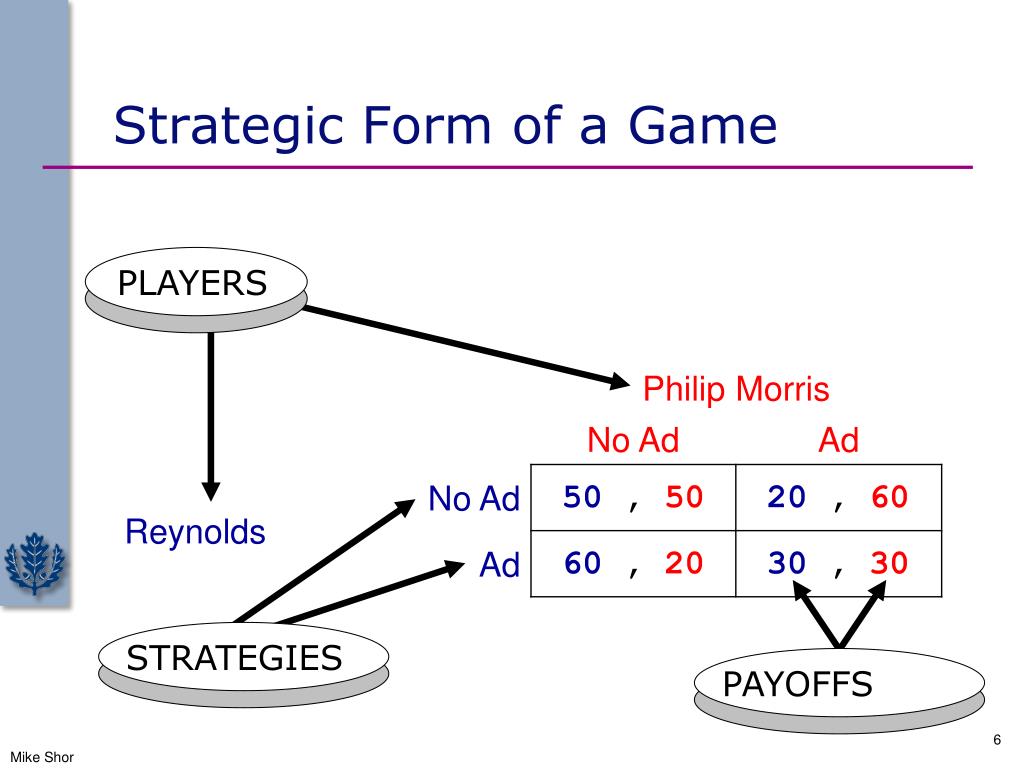
Let's define each component formally. We will use a running example from the same Yale lecture to make these ideas concrete.
1. Players
The players are the rational decision-makers in a strategic situation. A player can be an individual, a company, a country, or even a biological organism. The key assumption is that each player acts to maximize their own outcome according to their preferences.
In formal terms, we denote the set of players as . If there are players in the game, we can write this set as:
2. Strategies
Each player has a set of possible actions they can take. A strategy is a complete plan of action for a player in a game. For the simple, simultaneous-move games we're starting with, a strategy is simply one of the available choices a player can make.
The set of all strategies available to player is denoted by . When every player chooses a strategy, the combination of their choices is called a strategy profile. A strategy profile for an game is a collection of strategies, one for each player:
3. Payoffs
For any given strategy profile, each player receives an outcome. The payoff is a numerical representation of the value, or utility, that a player associates with that outcome. It's crucial to understand that payoffs are not always the physical outcomes themselves (like money or grades), but rather a measure of a player's preference for those outcomes. A rational player's goal is to choose a strategy that maximizes their expected payoff.
The payoff for player is determined by a payoff function, . This function takes a strategy profile as its input and outputs a single real number representing that player's utility.
Tying It All Together: An Example
The abstract definitions above become much clearer with an example. The following video introduces a "grade game" and then methodically identifies its players, strategies, and outcomes. Most importantly, it highlights the critical difference between an outcome (the grade you get) and a payoff (how much you value that grade).
1. Introduction: five first lessons
Let's return to Professor Polak's lecture. He will introduce a game, represent its outcomes, and then explain why we must define payoffs to complete the model.
Watch from 11:15 to 15:53 and then from 20:02 to 23:47. In the first part (11:15-15:53), identify the players and their strategies. Notice how he organizes the outcomes (grades) into a matrix. In the second part (20:02-23:47), listen for his key point: the outcome matrix is not a 'game' until we define the payoffs. He then introduces numerical payoffs that represent one possible set of preferences (people who only care about their own grade).
This example perfectly illustrates why we need all three components. Without knowing the players' objectives (their payoffs), we can describe the situation, but we cannot analyze or predict their behavior.
The Formal Definition of a Game
Since you appreciate mathematical rigor, let's put these pieces into a formal structure. What we have been describing is known as a normal-form game (or strategic-form game). It is the standard way to represent simultaneous-move games, where players choose their actions without knowing what others have chosen.
For a deeper, formal definition, please read the first two sections of the following document by Michael Levet.
Game Theory: Normal Form Games
This document provides a concise, formal definition of a normal-form game, which is the mathematical structure we use to model these strategic situations.
Read Section 1 ('Introduction') and Section 2 ('Model'), stopping at the start of 'Example 1'. Focus on 'Definition 1', which formally defines a normal-form game as a three-tuple. Connect each part of the tuple back to the components we just discussed.
As you read, you saw that a normal-form game is formally defined as a three-tuple:
- : The set of players.
- : The family of strategy sets, one for each player in .
- : The family of payoff functions, one for each player in .
This compact notation contains everything we need to define a game. The assumption is that this entire structure—all players, all possible strategies, and all payoff functions—is known to every player in the game.
A Deeper Look at Payoffs and Utility
The most subtle of the three components is the payoff. As Professor Polak mentioned, game theory doesn't tell you what your payoffs should be. It takes them as a given. These payoffs are derived from a player's underlying preferences, which can include not only self-interest but also factors like fairness, altruism, or spite.
The formal link is through the concept of a utility function, which you may have encountered in economics or decision theory. The physical outcome of a game (e.g., getting an 'A' grade) is mapped to a player's subjective utility for that outcome. The number we see in the payoff matrix is this utility value.
This distinction is important for your goal of understanding "meaningful planning in a chaotic world," because it acknowledges that different people can be in the exact same situation (same players, same strategies, same outcomes) but play it differently because they have different preferences, and thus different payoffs.
Conclusion
In this lesson, we established the fundamental vocabulary of game theory. You learned that any strategic game can be formally described by three core components:
- Players (): The set of decision-makers.
- Strategies (): The set of actions available to each player.
- Payoffs (): The utility each player receives for a given combination of strategies (a strategy profile).
Together, these components form the structure , known as a normal-form game.
In our next lesson, we will build directly on this foundation. We will focus on the most common tool for representing two-player normal-form games: the payoff matrix. You've already seen it used in our examples, and next time, you will learn how to construct one systematically from a game's description.