Introduction
Welcome to the final lesson of our course. Over the last twelve lessons, you have built a comprehensive toolkit for analyzing strategic situations, culminating in our previous session where we developed a framework for selecting and justifying the right game-theoretic model for a complex scenario.
This lesson represents the final, crucial step in that process: critically evaluating the model you've built. Your goal is to use game theory for "meaningful planning in a chaotic world," and this requires more than just finding a Nash equilibrium. It demands that we question the very foundation of our analysis—our assumptions—and understand precisely how they shape the results. By the end of this lesson, you will be able to dissect a model, assess its underlying assumptions, and interpret its strategic implications with the nuance and skepticism of an expert practitioner.
The Art of Abstraction: Simplicity vs. Realism
At its heart, a game-theoretic model is a purposeful simplification of reality. As we discussed in the last lesson, we deconstruct a messy situation to isolate its core strategic elements. This process inevitably involves a trade-off. A model that is too realistic becomes mathematically intractable, while a model that is too simple fails to capture the essence of the problem. The art of modeling lies in striking the right balance.
The following video provides an excellent perspective on this fundamental challenge.
12. General Assumptions and Methodology (Game Theory Playlist 1)
Every model is a simplification. The key is to capture the essential strategic elements without getting lost in irrelevant details. This video discusses the fundamental trade-off between realism and simplicity that every game theorist faces.
Please watch the segment from 05:22 to 08:35. Pay close attention to the idea of extracting the 'core' of a puzzle to create a model that is both analyzable and insightful.
As the video suggests, our job as critical analysts is to be aware of the "ignored pieces" of the puzzle. We must understand what our model leaves out and how those omissions might affect our conclusions. This requires scrutinizing the foundational assumptions that underpin almost all of classical game theory.
The Pillars and Pitfalls: Evaluating Core Assumptions
Two assumptions are so fundamental to game theory that they are often made implicitly. Critically evaluating any model must begin with them.
1. Rationality
First, let's refine our understanding of what game theorists mean by "rationality." It is a technical term, not a judgment of character. It does not necessarily mean being selfish, emotionless, or hyper-intelligent. It means that a player's behavior is consistent with their preferences.
12. General Assumptions and Methodology (Game Theory Playlist 1)
To evaluate the rationality assumption, we first need to be precise about its meaning. It's about consistency of choice, which allows us to represent preferences with a utility function. This allows for motivations like altruism or spite, as long as they are applied consistently.
Watch from 00:21 to 02:22. The key insight is that seemingly 'irrational' behaviors, like hurting an opponent at your own expense, can be perfectly rational within the model if that desire is part of the player's utility function.
- To Critically Evaluate: When you assume players are rational, you are assuming they have stable preferences and will act to maximize their own utility. The critical question is: Have I correctly specified their utility function? Does my model's payoff structure accurately reflect what the players truly care about? (e.g., market share, personal reputation, fairness, national security, etc.).
2. Common Knowledge
The assumption of "common knowledge" is far stronger and has more profound consequences. It means that all players know the structure of the game (players, strategies, payoffs), and they all know that all other players know it, and they all know that they all know that they all know it, and so on, ad infinitum.
12. General Assumptions and Methodology (Game Theory Playlist 1)
The assumption of 'common knowledge' is much stronger than simple mutual knowledge and has profound implications. It's the theoretical bedrock that allows for powerful solution concepts like backward induction.
Watch from 02:14 to 04:22. Focus on the recursive nature of this definition and the distinction between 'common knowledge of the game structure' and 'everyone knows everything'.
- To Critically Evaluate: Is it plausible that this infinite chain of knowledge exists in the real-world scenario? In highly structured environments with experienced players (like a professional chess match or a government auction with clear rules), this might be a reasonable approximation. In messy, novel, or chaotic situations, it is almost certainly not. The failure of this assumption is often why theoretical predictions diverge from reality.
When Assumptions Lead to Paradox
The best way to understand the power of assumptions is to see how they can lead to logically sound but practically absurd conclusions. These paradoxes are not failures of game theory; they are its greatest successes, as they reveal the hidden tensions in our concept of rationality.
Case 1: The Prisoner's Dilemma and Individual Rationality
You are very familiar with the Prisoner's Dilemma. It is the classic example of how individual incentives can undermine collective well-being.
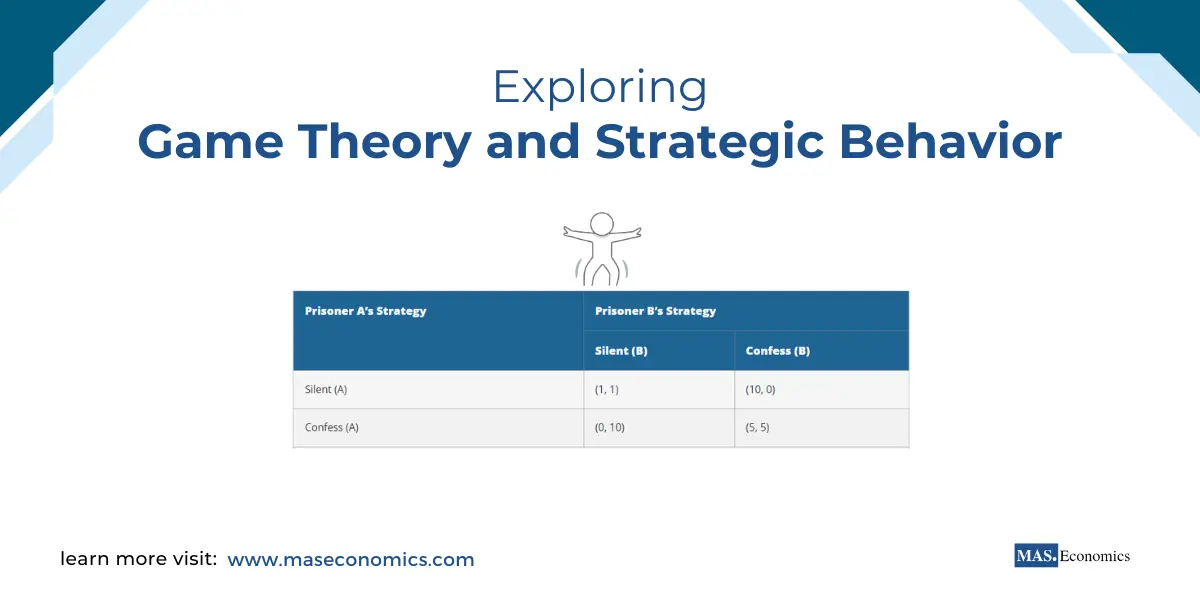
The prediction that both players will confess is a direct implication of assuming they are rational actors in a one-shot game.
- Strategic Implication: Individual rationality can lead to collective irrationality.
- Critical Evaluation: The key assumption driving this dismal outcome is that the game is one-shot and there is no external enforcement. If we change these assumptions, the implications change entirely.
- As we saw in Module 5, if the game is repeated infinitely, cooperation can be sustained.
- As described in the provided text from Princeton University, if we add an external enforcement mechanism (a "mafia" that punishes those who confess), the payoffs change, and "Silent" can become the dominant strategy. This demonstrates how a model's prediction is critically sensitive to its assumed "rules of the game."
Case 2: The Centipede Game and Common Knowledge of Rationality
The Centipede Game provides a stark illustration of the limits of backward induction when the common knowledge of rationality assumption is taken to its extreme.
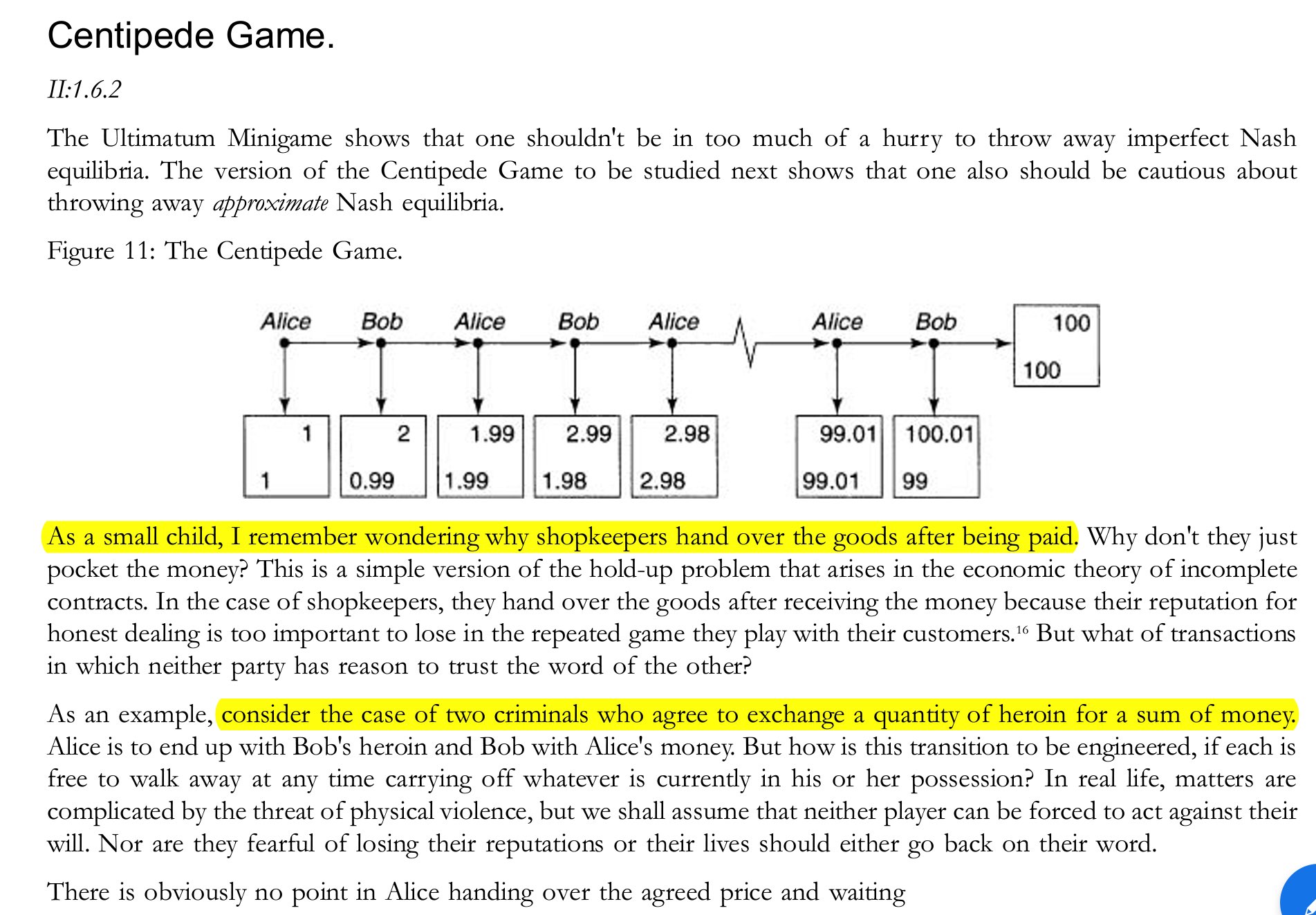
The logic is as follows: At the last node, Bob would choose 'Stop' to get 101 instead of 100. Knowing this, Alice at the second-to-last node would choose 'Stop' to get 99 instead of 98. This logic unravels all the way back to the start, predicting that Alice will stop the game on the first move, leading to a (2, 0) payoff.
- Strategic Implication: The assumption of common knowledge of rationality can lead to a prediction of extreme, inefficient unravelling of cooperation.
- Critical Evaluation: This prediction is almost never observed in experiments. The paradox forces us to question the common knowledge assumption. If there is even a tiny belief in Alice's mind that Bob might not be perfectly rational and might
Continueat his last move, then it can become rational for her toContinueat the start. The model's extreme prediction is fragile and depends entirely on the absolute purity of the common knowledge assumption.
Case 3: The Beauty Contest and Levels of Rationality
Perhaps no game better illustrates the need to evaluate assumptions about others' thinking than the "p-Beauty Contest" game.
Dangerous Math That Predicts Human Behavior
The 'p-Beauty Contest' game is a powerful example of the gap between a purely mathematical solution and real-world strategic thinking. It forces us to ask not 'What is the perfectly rational choice?' but 'How rational do I expect my opponents to be?'
Watch from 07:51 to 10:15. This section brilliantly demonstrates how the winning strategy depends on correctly assessing the level of reasoning of other players, not just on applying the mathematical logic of the game to its theoretical endpoint.
As the video explains, if rationality and the game structure were common knowledge, everyone would apply iterated elimination of dominated strategies infinitely and guess 0. But this is not the winning strategy. The actual winning guesses suggest that most people perform only one or two levels of this reasoning.
- Strategic Implication: Your optimal strategy is not the one dictated by pure mathematical logic, but the one that best anticipates the actual cognitive limits and psychological tendencies of your opponents.
- Critical Evaluation: This is the essence of today's lesson. A "good" model for the Beauty Contest game isn't the one that assumes infinite levels of reasoning. It is a behavioral model (like the Level-k model we briefly discussed in M11L3) that assumes players have bounded rationality. Choosing the right model requires a hypothesis about the psychology of the other players.
A Framework for Critical Evaluation
When you analyze a scenario, don't stop after finding the equilibrium. Apply this checklist to deepen your understanding and temper your conclusions.
-
Identify Assumptions: What are the model's explicit and implicit assumptions?
- Players: Who is included and excluded?
- Payoffs: What are they assumed to value? Is this realistic?
- Information: Is it complete or incomplete? Is common knowledge assumed?
- Rationality: Are players assumed to be perfectly rational? Is this plausible?
-
Stress-Test Assumptions: For the most important assumptions, ask "What if this is wrong?"
- How would the outcome change if players had different goals (e.g., cared about fairness)?
- How would the outcome change if players had cognitive biases or limited foresight?
- How would it change if the interaction was repeated?
-
Define the Core Insight: What is the fundamental strategic tension the model reveals?
- Often, this core insight is more valuable than the specific equilibrium prediction. In the Prisoner's Dilemma, the insight is the conflict between individual and collective interests. In the Beauty Contest, it's the need to anticipate others' reasoning. These insights often hold even when the model's assumptions are not perfectly met.
-
State Your Confidence and Caveats: Based on your evaluation, how much confidence do you have in the model's prediction?
- Clearly state the conditions under which your analysis holds and when it might break down. This is the hallmark of a sophisticated strategic thinker.
Conclusion
In this final lesson, we have moved beyond model-building to model-critique. This is the skill that transforms game theory from an academic exercise into a practical tool for strategic thinking. The goal is not to find the one "true" model but to use models as a lens to understand the strategic landscape, identify key drivers of behavior, and recognize the inherent uncertainties.
Key Takeaways:
- A model's predictions are direct consequences of its assumptions. To trust the prediction, you must believe the assumptions.
- The assumptions of rationality and especially common knowledge are incredibly powerful, but they are also the most fragile and deserving of scrutiny.
- Paradoxes like the Centipede Game and real-world results from the Beauty Contest game reveal the crucial gap between pure mathematical rationality and human psychology.
- The most valuable output of a game-theoretic analysis is not a single equilibrium point, but a deep understanding of the strategic tensions and the sensitivity of outcomes to underlying assumptions.
You began this course seeking a framework for "meaningful planning in a chaotic world." That framework is not a single equation, but a process: Deconstruct, Select, Justify, and Critically Evaluate. By mastering this process, you learn not just to predict outcomes, but to understand the forces that shape them, allowing you to navigate complex interactions with greater clarity and foresight.
This concludes our course on the basics of game theory. You have built an impressive foundation. Should you wish to continue your studies, you are now well-prepared to explore advanced topics like Cooperative Game Theory, which analyzes how coalitions form; Mechanism Design, which focuses on designing the rules of a game to achieve desired outcomes; and Behavioral Game Theory, which delves deeper into the psychological and neurological basis of strategic choice. I hope this journey has sparked a lasting interest in this endlessly fascinating field.