Introduction
Welcome to a new module! In our previous discussions, particularly on bargaining, we modeled players as hyper-rational agents who consciously choose strategies to maximize their payoffs. We analyzed how a player's patience or outside options would logically dictate their actions in a negotiation.
Today, we shift our perspective from individual rational choice to population dynamics. We will explore Evolutionary Game Theory, a framework inspired by biology. Here, strategies are not chosen; they are genetically hard-wired behaviors. Players are organisms, and payoffs represent reproductive fitness—the more successful a strategy, the more it proliferates in the next generation.
This lesson addresses our first learning outcome in this new module: to define an Evolutionarily Stable Strategy (ESS) and its mathematical conditions. An ESS is a strategy that, once it becomes dominant in a population, is immune to invasion by any small group of "mutants" playing a different strategy. It's a powerful concept for understanding the emergence of stable behaviors in biological and social systems.
The Core Idea: Stability Against Invasion
In classical game theory, a Nash Equilibrium is stable because no single rational player has an incentive to deviate. In evolutionary game theory, an ESS is stable because no small group of mutants can successfully invade.
Let's begin by building an intuition for this concept.
[PDF] Handout on Evolutionary Stability in pure strategies
This handout from a Yale Open Course provides a very clear, non-technical introduction to the idea of evolutionary stability.
Please read the section titled '1. Ideas and Examples', stopping before 'Example 1'. Focus on the 'very loose definition' of an ESS.
The key idea is that a strategy is evolutionarily stable if a small mutation playing a different strategy would "die out." To make this more concrete, let's formalize the concept of invasion and fitness.
Imagine a large population where almost everyone uses strategy S (the "incumbents"). A small fraction of the population, x, are "mutants" who use strategy T. An organism's fitness is its expected payoff from a random interaction.
- The fitness of an incumbent (
S) is its expected payoff against this mixed population. - The fitness of a mutant (
T) is its expected payoff against the same population.
For strategy S to be evolutionarily stable, the incumbents must have a strictly higher fitness than the mutants. If Fitness(S) > Fitness(T), the incumbents will have more offspring, and the mutant strategy T will be driven out of the population over time.
Let's see this in action with an example.
[PDF] Chapter 7 Evolutionary Game Theory
This chapter from the book Networks, Crowds, and Markets provides a detailed walkthrough of the ESS concept using an example of beetles competing for food.
Please read the first part of Section 7.2, up to the subsection 'Interpreting the Evolutionarily Stable Strategy in our Example'. Pay close attention to how the expected payoffs (fitness) are calculated for the 'Small' and 'Large' beetle strategies when one invades the other.
As you saw in the reading, we can express fitness mathematically. If an x fraction of the population plays T and 1-x plays S, the fitness of each type is:
- Fitness of S:
- Fitness of T:
Where is the payoff to a player using strategy A against a player using strategy B. The condition for S to be stable against an invasion by T is that for any sufficiently small x > 0, we must have .
The Mathematical Conditions for an ESS
The inequality gives us a direct but sometimes cumbersome way to check for stability. Fortunately, we can distill this into a more elegant set of conditions that connect directly to the concept of Nash Equilibrium you're already familiar with.
Given your preference for mathematical rigor, you'll appreciate these two formal definitions of an ESS. They look different at first, but are entirely equivalent.
[PDF] Handout on Evolutionary Stability in pure strategies
Let's return to the Yale handout, which provides two concise, formal definitions of an ESS. The second definition is particularly useful for practical application.
Read '2. Formal definitions' and the explanatory paragraphs that follow, ending before the 'nerd' proof. Focus on understanding the two conditions in 'Formal Definition 2' and how they relate to a strict vs. non-strict Nash Equilibrium.
Let's summarize the crucial insight from "Formal Definition 2." For a pure strategy S to be an Evolutionarily Stable Strategy, it must satisfy two conditions when compared against any possible mutant strategy T:
Condition 1 (Nash Equilibrium Condition):S must be a best response to itself. In a population of S players, a mutant T cannot do better than an incumbent S.
This is our "first line of defense." If a mutant does strictly better against the incumbent population (), it will immediately have higher fitness and the invasion will succeed. Therefore, S must be a Nash Equilibrium strategy in a symmetric game against itself.
Condition 2 (Stability Condition):
If a mutant T does just as well against the incumbents as the incumbents do against themselves (i.e., if Condition 1 holds with equality, ), then we need a tie-breaker. The incumbent strategy S must do strictly better against the mutant T than the mutant T does against itself.
This is our "second line of defense." If the mutants fare equally well against the incumbents, their relative success depends on how they fare when interacting with each other. For the incumbent population to be stable, it must have an advantage in these encounters.
In summary, S is an ESS if for every other strategy T ≠ S, one of the following holds:
(S is a strict Nash Equilibrium)- and
(S is a weak Nash Equilibrium, but is more robust against mutants)
To see how this derives from the fitness inequality, let's look at the general algebraic proof.

[PDF] Chapter 7 Evolutionary Game Theory
The Cornell chapter provides a formal derivation of these two conditions using a general symmetric payoff matrix.
Please read Section 7.3, 'A General Description of Evolutionarily Stable Strategies'. Follow the algebra that transforms the fitness inequality a(1−x) + bx > c(1−x) + dx into the two conditions we've just discussed.
Visualizing Stability
These mathematical conditions define a static equilibrium. But the term "stable" implies a dynamic process. What happens when a population is slightly perturbed from equilibrium? Does it return, or does it fly apart?
Evolutionarily Stable Nash Equilibrium (vs. Unstable)
This video from economist Ashley Hodgson gives a great visual and intuitive explanation of the difference between a stable and an unstable equilibrium in an evolutionary context.
Please watch from 03:00 to 05:58. The video describes what happens when a population is 'bumped' away from a Nash equilibrium and whether it naturally returns or diverges to an extreme.
The video beautifully illustrates the core dynamic:
- A stable equilibrium acts like a point of attraction. If random chance pushes the population slightly away from the equilibrium mix, the evolutionary pressures (i.e., the relative fitness of the strategies) will push it back.
- An unstable equilibrium is a knife-edge. The population can only remain there by chance. Any small perturbation will create an advantage for one strategy, leading to a cascade that pushes the population to a completely different state (an "all-Hawk" or "all-Dove" population in the video's example).
This dynamic can also be represented graphically by plotting strategy payoffs against their frequency in the population.
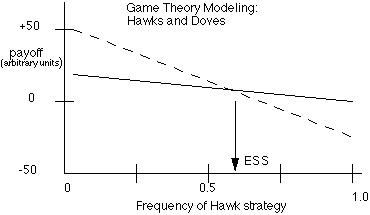
In the graph above, the ESS is at a frequency of about 0.6 Hawks.
- If the frequency of Hawks drops below 0.6 (move left on the x-axis), the Hawk payoff line is above the Dove payoff line. Hawks have higher fitness, so their population grows, pushing the frequency back towards 0.6.
- If the frequency of Hawks rises above 0.6 (move right on the x-axis), the Dove payoff line is now higher. Doves have better fitness, their population grows, and the frequency of Hawks is pushed back down towards 0.6.
This is the visual signature of an Evolutionarily Stable Strategy.
Conclusion
In this lesson, we introduced a new way of thinking about strategic equilibrium, grounded in population dynamics rather than individual rationality. We defined the central concept of an Evolutionarily Stable Strategy and established its precise mathematical meaning.
Key Takeaways:
- Evolutionary Game Theory models strategies as inherited traits and payoffs as reproductive fitness.
- An Evolutionarily Stable Strategy (ESS) is a strategy that, once adopted by a population, is robust to invasion by any small group of mutants.
- The fitness of a strategy is its expected payoff when interacting with a random member of the population. For an incumbent strategy
Sto be stable against a mutantT, its fitness must be higher: . - For a strategy
Sto be an ESS, it must satisfy one of two conditions for any alternative strategyT:- (It's a strict Nash Equilibrium).
- and (It's a Nash Equilibrium that's more robust against mutants).
You have now mastered the definition and mathematical underpinnings of an ESS. In our next lesson, we will put this knowledge to work. Our goal will be to determine whether a given symmetric strategy is an ESS by applying these conditions to concrete examples. We'll also begin our analysis of the classic Hawk-Dove game, a cornerstone model in evolutionary game theory.