Introduction
Welcome back! In our last lesson, we established the theoretical foundation for Evolutionary Game Theory. We defined an Evolutionarily Stable Strategy (ESS) as a strategy that, once dominant in a population, is immune to invasion by any small group of "mutants." We also derived the two crucial mathematical conditions for a strategy to be evolutionarily stable.
As a brief recap, for a strategy S to be an ESS, one of these two conditions must hold for any alternative "mutant" strategy T:
- Strict Nash Condition:
- Weak Nash + Stability Condition: and
Today, our goal is to put this theory into practice. We will move from defining to applying, focusing on how to determine whether a given symmetric strategy is an ESS. We'll develop a systematic method and work through concrete examples to solidify your understanding.
A General Method for Identifying a Pure-Strategy ESS
Given your interest in mathematical structure, let's formalize a repeatable method. Consider a general symmetric game with two strategies, S (the incumbent) and T (the mutant). The payoff matrix for Player 1 (the row player) is:
| Player 2 plays S | Player 2 plays T | |
|---|---|---|
| Player 1 plays S | a |
b |
| Player 1 plays T | c |
d |
Here, a = u(S,S), b = u(S,T), c = u(T,S), and d = u(T,T). Our two conditions for S being an ESS can be written directly using these payoffs:
- Is ? If yes,
Sis an ESS. We are done. - If , then we check the second condition: Is ? If yes,
Sis an ESS. - If neither of these holds,
Sis not an ESS.
This gives us a simple, two-step algorithm to test any pure strategy. Let's see it derived and applied.
[PDF] Chapter 7 Evolutionary Game Theory
The following text from the Networks, Crowds, and Markets textbook formalizes this exact algorithm and then applies it to a 'Body-Size Game' between beetles. This is an excellent, clear application of the method.
First, read Section 7.3, 'A General Description of Evolutionarily Stable Strategies,' to see how the conditions a > c or (a = c and b > d) are derived. Then, read the first part of Section 7.2, specifically the subsection 'Evolutionarily Stable Strategies in our First Example,' to see these conditions applied to the strategies 'Small' and 'Large'.
The reading demonstrates the process perfectly:
- To check if 'Small' is an ESS, they test it against the mutant 'Large'. They find that , so the first condition fails. 'Small' is not an ESS.
- To check if 'Large' is an ESS, they test it against the mutant 'Small'. They find that . The first condition holds, so 'Large' is an ESS.
Your Turn: A Practice Problem
Now, let's have you apply this algorithm.
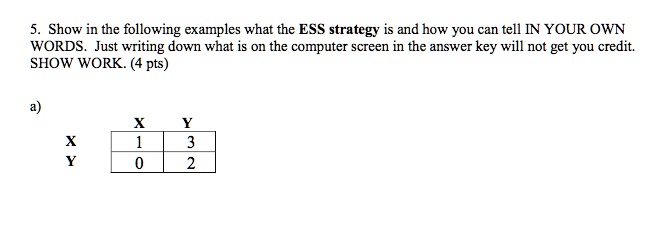
Take a moment to analyze this game. Use the two-condition test to check both strategy X and strategy Y.
Analysis of Strategy X
Let's test if X is an ESS.
- Incumbent strategy
Sis X. - Mutant strategy
Tis Y.
From the matrix, we identify our payoffs:
Now, apply the test:
- Is ? Yes, .
The first condition is met. Therefore, X is an Evolutionarily Stable Strategy. A population of X-strategists cannot be invaded by Y-strategists because the incumbents do strictly better against themselves than the mutants do.
Analysis of Strategy Y
Now, let's test if Y is an ESS.
- Incumbent strategy
Sis Y. - Mutant strategy
Tis X.
We identify the relevant payoffs from the matrix:
Now, apply the test:
- Is ? No, .
The first condition fails. A mutant X-strategist does strictly better against a population of Y-strategists () than the Y-strategists do against themselves (). The invasion would be successful. Therefore, Y is not an Evolutionarily Stable Strategy.
When No Pure Strategy is Stable
In the previous problem, we found one pure strategy that was an ESS. But what happens when neither pure strategy is stable? This is a common and fascinating scenario in evolutionary dynamics.
The classic example is the Hawk-Dove game. We touched on this in the last lesson. A population of all Doves is easily invaded by aggressive Hawks. But a population of all Hawks, who are constantly injuring each other, can be invaded by peaceful Doves who avoid costly fights. Neither pure strategy is stable on its own.
Let's see how to analyze the stability of such a system by looking at the population dynamics.
Evolutionarily Stable Nash Equilibrium (vs. Unstable)
This video provides a clear mathematical walkthrough of how to check for stability. It uses a version of the Hawk-Dove game. The presenter shows what happens when the population is slightly away from the equilibrium point.
Please watch from 05:58 to 10:11. The presenter tests two scenarios: one where the population is 50% Hawks, and another where it's 90% Hawks. Pay close attention to how she calculates the expected payoff for each strategy and uses the result to determine the direction of evolutionary pressure.
The analysis in the video reveals a crucial dynamic:
- When there are fewer Hawks than the equilibrium amount (e.g., at 50%), the Hawk strategy has a higher payoff. This selective pressure increases the proportion of Hawks.
- When there are more Hawks than the equilibrium amount (e.g., at 90%), the Dove strategy has a higher payoff. This pressure pushes the proportion of Hawks back down.
This is the dynamic signature of a stable equilibrium. Any deviation from the equilibrium point creates forces that push the population back towards it. In this case, since neither pure strategy is stable, the population is driven towards a state where both strategies coexist. This is a powerful intuition that we will formalize in our next lesson.
Conclusion
In this lesson, we transitioned from theory to application. You learned and applied a concrete, mathematical method for testing whether a pure strategy is evolutionarily stable.
Key Takeaways:
- A pure strategy
Scan be tested for evolutionary stability against a mutantTusing a two-step check on the game's payoffs. - Step 1: Check if
Sis a strict best response to itself (). If so, it's an ESS. - Step 2: If , check if
Sperforms better against the mutantTthanTdoes against itself (). If so, it's an ESS. - Some games, like the Hawk-Dove game, have no pure-strategy ESS. In these cases, evolutionary pressure pushes the population towards a state of coexistence rather than a single dominant strategy.
You are now equipped to analyze any symmetric 2x2 game for pure-strategy evolutionary stability. In our next lesson, we will delve deeper into the Hawk-Dove game. We will formulate its payoff matrix from its narrative description and formally analyze why it leads to a stable mixture of strategies, introducing the concept of a mixed ESS.