Introduction
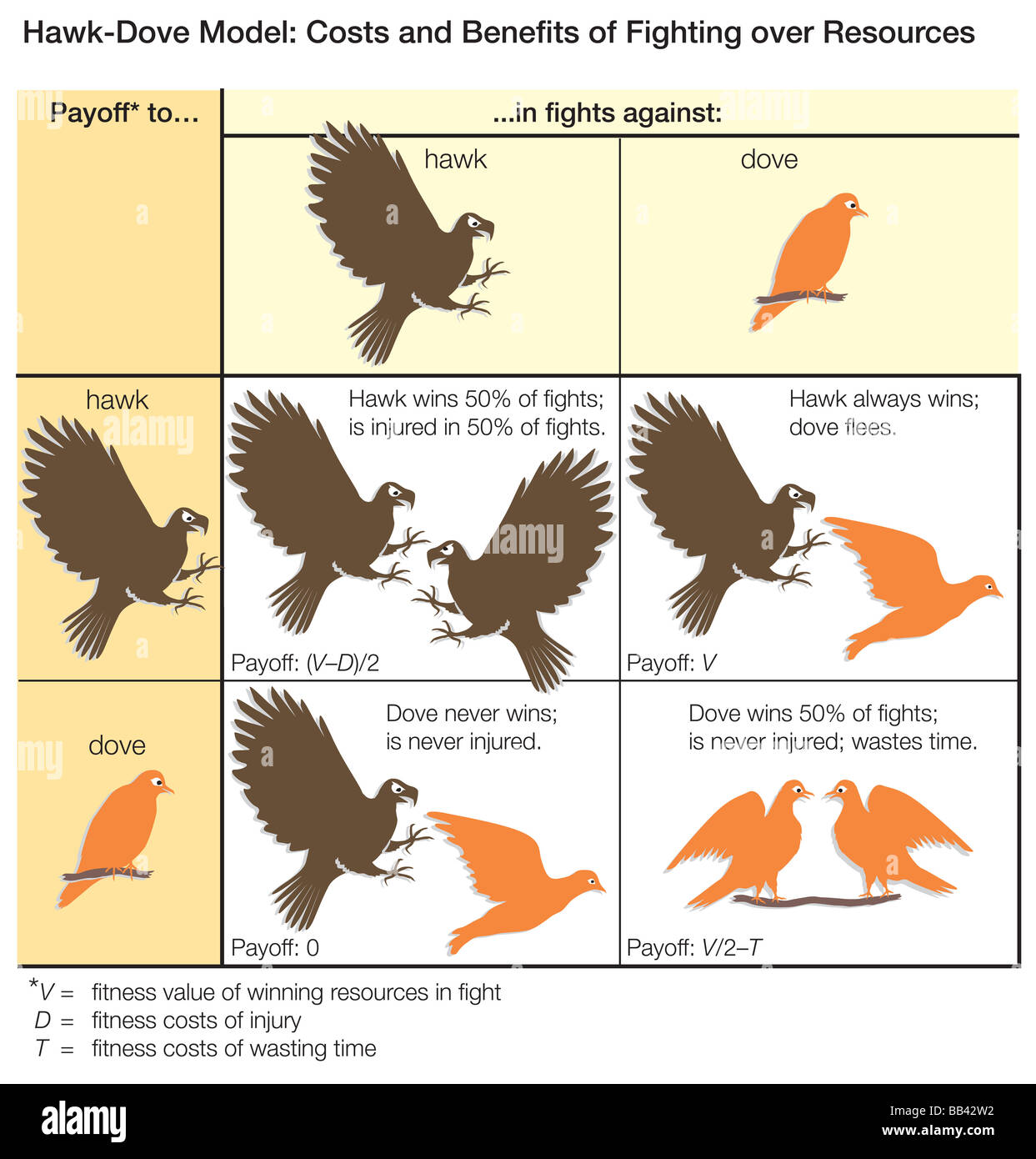
Welcome to the next lesson in our exploration of evolutionary game theory. In the previous session, we successfully translated the narrative of the Hawk-Dove conflict into a formal payoff matrix. We established that for a resource of value and a fighting cost , the payoffs to the row player are:
| Opponent plays Hawk | Opponent plays Dove | |
|---|---|---|
| You play Hawk | ||
| You play Dove |
Our goal today is to use this matrix to analyze the Nash Equilibria and the Evolutionarily Stable Strategy (ESS) of the Hawk-Dove game. We will see how the relationship between and determines whether the stable outcome is a population of pure aggressors or a mixed population of Hawks and Doves, and we'll interpret what this means for the population's overall fitness.
Analysis Part 1: When the Prize Outweighs the Cost ()
Let's first consider the scenario where the value of the resource is greater than or equal to the cost of fighting. Intuitively, this is a world where aggression seems "worth it."
To understand the analysis, please read the relevant section from Professor Ben Polak's lecture notes from Yale.
ECON 159 - Lecture 12 - Evolutionary Stability
This reading walks through the analysis of the Hawk-Dove game. We will focus on the first part, which covers the case where V is at least as large as C.
Please read from the beginning of 'Chapter 2. Monomorphic and Polymorphic Populations Theory: Hawk vs. Dove' until the line '...then it will turn out that it be evolutionarily stable for all the animals to fight.' This covers the analysis for V > C and V = C.
As the text explains, we can break this down into two sub-cases:
-
Strictly Worth It ():
- In this case, the payoff to a Hawk meeting a Hawk, , is positive.
- Let's check if (Hawk, Hawk) is a Nash Equilibrium. If your opponent plays Hawk, your payoff for playing Hawk is . Your payoff for playing Dove is 0. Since , you strictly prefer to play Hawk.
- Therefore, (Hawk, Hawk) is a strict symmetric Nash Equilibrium.
- Recall from our previous lesson that any strict symmetric Nash Equilibrium is an ESS. The intuition is clear: in a population of Hawks, any Dove mutant would get a payoff of 0, while the Hawks are getting a positive payoff. The Dove strategy is strictly worse and cannot invade.
- The result is a monomorphic population, consisting entirely of Hawks.
-
A Close Call ():
- Here, the payoff for (Hawk, Hawk) is .
- If your opponent plays Hawk, you are now indifferent between playing Hawk (payoff 0) and playing Dove (payoff 0). So, (Hawk, Hawk) is a Nash Equilibrium, but it is not strict.
- Because it's not a strict NE, we must check the second condition for an ESS: If a mutant (Dove) does just as well against the incumbent (Hawk) as the incumbent does against itself, does the incumbent do better against the mutant than the mutant does against itself?
- We need to check if .
- From our matrix, and .
- Since (as ), the condition holds.
- Even when , Hawk is an ESS. A Dove mutant that appears in a Hawk population might not do worse initially, but the Hawks will exploit the Doves much more effectively than Doves exploit each other, preventing the invasion.
In summary, if the prize is at least as valuable as the cost of fighting (), the only Evolutionarily Stable Strategy is for every individual to be a Hawk.
Analysis Part 2: When the Cost Outweighs the Prize ()
This is the more fascinating and common scenario, where a fight is a risky proposition with an expected net loss. What is the stable outcome now?
Pure Strategy Nash Equilibria
Let's first check for pure strategy equilibria.
- Is (Dove, Dove) a NE? No. In a population of Doves, each gets . A Hawk mutant would get against a Dove, so it would invade.
- Is (Hawk, Hawk) a NE? No. In a population of Hawks, each gets , which is negative since . A Dove mutant would get 0, which is better. The Dove strategy would invade.
So, there is no symmetric pure strategy Nash Equilibrium. This means no monomorphic population (all Hawks or all Doves) can be stable.
However, there are two asymmetric pure strategy equilibria: (Hawk, Dove) and (Dove, Hawk). To see why, watch the following short clip which uses arrows to show the players' best responses.
Simulating the Evolution of Aggression
This simulation video from Primer provides a clear visual analysis of the best responses and Nash Equilibria in the Hawk-Dove game.
Watch from 05:03 to 07:16. The video uses a specific numerical example, but the logic of the arrows applies to our general V and C case when C > V. Notice where the arrows point to stable outcomes where neither player wants to switch.
The video confirms that (You Play Hawk, Opponent Plays Dove) and (You Play Dove, Opponent Plays Hawk) are equilibria. However, in an evolutionary context with random matching, these asymmetric equilibria are not meaningful. There's no pre-assigned "row player" or "column player"; any individual can be matched with any other. Thus, we can't have a stable state where one is "assigned" to be the Hawk and the other the Dove.
Mixed Strategy Nash Equilibrium
Since no pure strategy provides a symmetric, stable outcome, we must look for a mixed strategy Nash Equilibrium. Let's find the probability of playing Hawk that would make the opponent indifferent between playing Hawk and Dove.
The expected payoff of playing Hawk against an opponent who plays Hawk with probability is:
The expected payoff of playing Dove against this same opponent is:
For a mixed strategy equilibrium, these must be equal: .
Multiplying by 2 to clear the fractions:
So, the unique symmetric Nash Equilibrium is a mixed strategy where each individual plays Hawk with probability .
Is the Mixed Equilibrium an ESS?
We have found a Nash Equilibrium, but is it evolutionarily stable? An ESS must be "uninvadable." This means if the population is at the equilibrium mix and a small group of mutants with a different strategy appears, the original population must achieve a higher fitness (payoff) than the mutants, causing the mutants to die out.
A formal proof is quite involved, but we can gain a powerful intuition by analyzing the population dynamics. The following video demonstrates this by considering what happens when the population "drifts" slightly away from the equilibrium point.
Evolutionarily Stable Nash Equilibrium (vs. Unstable)
This video from Ashley Hodgson provides an excellent, intuitive explanation of stability. It checks what happens to the population if the proportion of Hawks is slightly above or below the equilibrium level.
Please watch from 03:29 to 10:11. The video uses a numerical example where the equilibrium is 75% Hawks. It tests what happens at 50% Hawks (below equilibrium) and 90% Hawks (above equilibrium) to see which strategy has the advantage and how the population moves.
The video demonstrates the core principle of stability:
- If the proportion of Hawks is below the equilibrium , Hawks do better than Doves on average. This causes the proportion of Hawks to increase, pushing the population back toward equilibrium.
- If the proportion of Hawks is above the equilibrium , Doves do better than Hawks on average. Fights between Hawks are too frequent and costly. This causes the proportion of Hawks to decrease, again pushing the population back toward equilibrium.
Because any deviation from creates evolutionary pressure that corrects the deviation, this mixed Nash Equilibrium is indeed an Evolutionarily Stable Strategy.
This ESS can be interpreted in two ways:
- Monomorphic population: Every individual in the species randomizes its strategy, playing Hawk with probability .
- Polymorphic population: The population consists of a stable mix of individuals. A fraction are pure Hawks, and a fraction are pure Doves. This is often the more compelling biological interpretation.
Strategic Implications of the Hawk-Dove ESS
What does the result tell us about the world?
-
Comparative Statics:
- As increases (the resource becomes more valuable), the proportion of Hawks () in the population increases.
- As increases (fighting becomes more costly/dangerous), the proportion of Hawks () decreases.
This aligns perfectly with our intuition: more valuable prizes encourage aggression, while higher risks discourage it.
-
The Paradox of Fitness:
What is the average payoff (fitness) for an individual in this stable population? Since everyone in the mixed equilibrium gets the same expected payoff, we can just calculate the payoff for a Dove:
Now, consider what happens as the cost of fighting, , increases. The term gets larger (since gets smaller). This means that as goes up, the average fitness of the population also goes up!This is a fascinating and counter-intuitive result. A world where fighting is more dangerous ( is high) leads to a more peaceful population (fewer Hawks) with a higher overall fitness. This demonstrates the power of game-theoretic modeling to reveal non-obvious dynamics.
Conclusion
In this lesson, we have fully analyzed the Hawk-Dove game. We've seen how the strategic landscape changes based on the costs and benefits of conflict.
Key Takeaways:
- If the value of a resource is greater than or equal to the cost of fighting (), the only ESS is a monomorphic population of Hawks.
- If the cost of fighting exceeds the value (), there is no pure ESS. The only stable outcome is a polymorphic population with a fraction of Hawks and of Doves.
- This mixed equilibrium is stable because deviations are self-correcting: an excess of Hawks makes it profitable to be a Dove, and an excess of Doves makes it profitable to be a Hawk.
- Paradoxically, higher fighting costs can lead to a higher average fitness for the population, as it forces the equilibrium towards a more peaceful mix.
This analysis of the Hawk-Dove game is a classic result in evolutionary game theory and provides a powerful model for understanding the emergence of aggression and cooperation in both biological and social systems.
In the next module, we will shift our focus from a single strategic interaction to what happens when players interact repeatedly over time. We will start by distinguishing between finitely and infinitely repeated games and explore how the shadow of the future can change everything.