Welcome to the third and final lesson of our "Product Definition & Scoping" module. In the previous lessons, we established our product's "who" and "why" by creating a user persona and vision statement, and then we detailed the "what" by writing user stories and acceptance criteria for a range of potential features. You now have a solid list of what our task management app could do.
Today, we'll make the critical decisions about what it will do for its first release. This lesson is about defining the scope of our Minimum Viable Product (MVP). We'll explore frameworks that help distinguish essential features from those that can wait, ensuring we can launch a valuable product quickly and efficiently. This step finalizes our initial product requirements, clearing the way for us to begin system architecture in the next module.
The Philosophy of "Minimum Viable"
Before we start prioritizing, it's crucial to align on what an MVP truly is. It's not just a product with fewer features; it's a strategic tool for learning. The goal is to build the smallest possible version of your product that still delivers core value and allows you to test your main assumptions with real users.
How To Identify A Minimum Viable Product Or MVP? | #8
The YouTube channel Vibhor Chandel provides an excellent explanation of the MVP concept, grounding it in the principles of "The Lean Startup."
Watch the first two minutes to understand the formal definition of an MVP, focusing on the goal of "validated learning with the least effort." Then, pay close attention to the segment explaining why a simple prioritized list of features might not constitute a true MVP. The key insight here is that an MVP must provide a complete, end-to-end user experience, even if that experience is very basic.
As the video explains, simply building the top few features from a backlog might result in a disjointed or incomplete product. A true MVP allows a user to complete a core job, like creating and managing a basic task from start to finish.
A Framework for Prioritization: The MoSCoW Method
To systematically decide what goes into our MVP, we need a prioritization framework. One of the most effective and straightforward methods is called MoSCoW. It's an acronym that helps categorize features to create clarity and consensus.
The four categories are:
- M - Must Have: Non-negotiable features. Without these, the product is not viable and doesn't solve the user's core problem.
- S - Should Have: Important features that add significant value, but the product can still function without them. These are often the first candidates for the second release.
- C - Could Have: Desirable "nice-to-have" features that have a smaller impact. They will be included only if time and resources permit.
- W - Won't Have (this time): Features that are explicitly out of scope for the current release. This category is vital for managing expectations and preventing scope creep.
What is MoSCoW Prioritization Method? Definition, Overview, and Best Practices
The team at ProductPlan offers a concise and clear overview of the MoSCoW method and how to apply it.
Watch the video to get a solid grasp of the framework. Pay attention to the breakdown of each category: Must-have, Should-have, Could-have, and the crucial Will not have category. The questions provided for evaluating "Must-have" initiatives are particularly helpful.
To give you a visual anchor for these categories, here is a well-structured example. While the features are for a food delivery app, the definitions for each quadrant are universal.

From Theory to Practice: Scoping Our Task App
Now, let's apply this framework to our own project. The process involves taking the feature list you've already defined with user stories and sorting them into the MoSCoW buckets. The key question at each step is: "If we don't build this, can the user still accomplish their primary goal?"
How to Write a Product Requirements Document for Your MVP
This article from Smartware Advisors details how to structure a Product Requirements Document (PRD) for an MVP and provides a direct example of applying MoSCoW to a task management application.
First, read the section that details the MoSCoW method under the heading "Features". Then, study the concrete Product Requirement Examples for a task management app. This will help you see how features like "user registration" and "task creation" are classified as Must-Haves, while "task categorization" might be a Should-Have.
The process of deciding is itself a critical skill. It forces you to be disciplined and focused on the core value proposition. The following flowchart illustrates where this decision-making fits into a rapid development process.
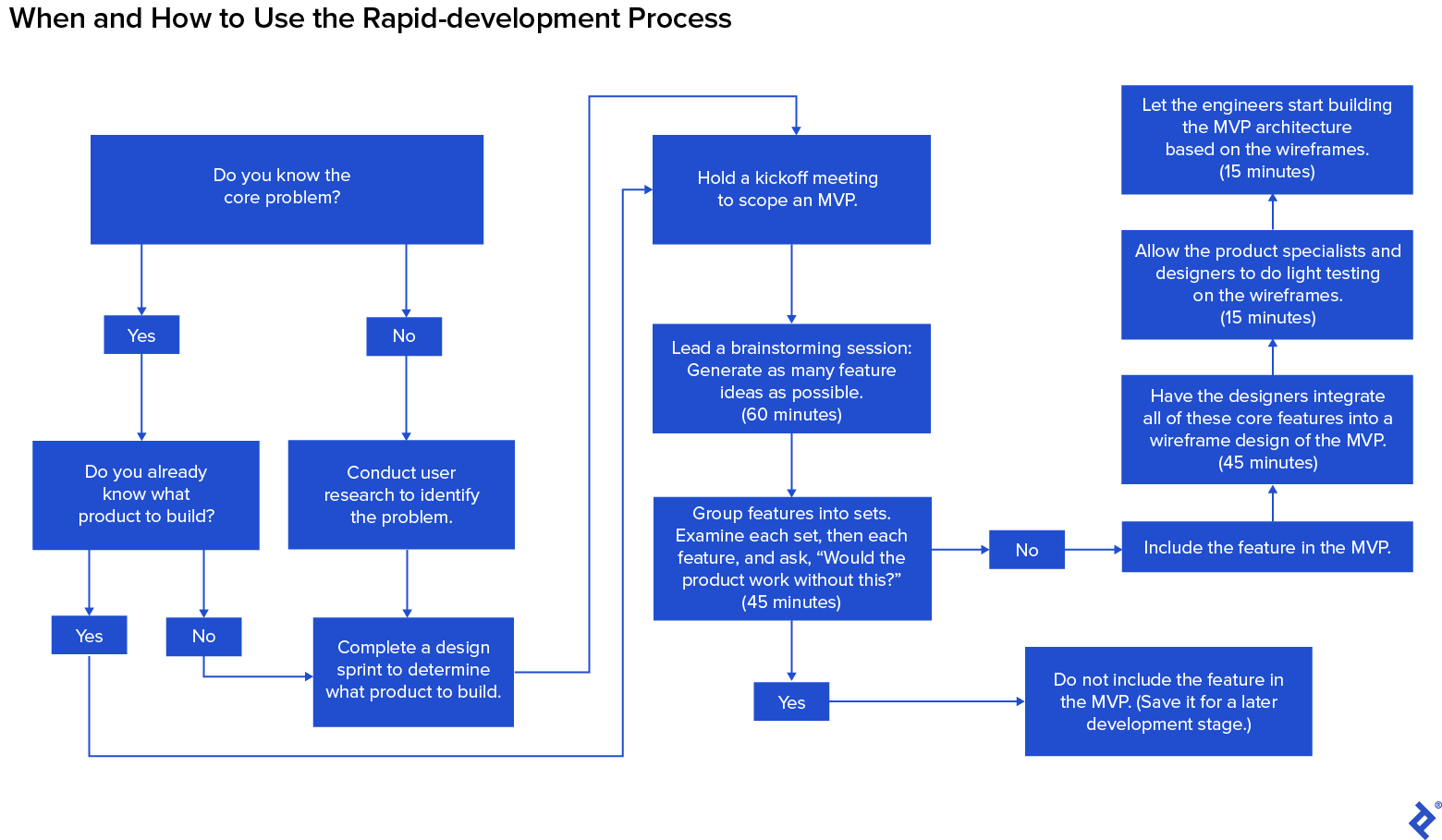
This iterative questioning is how you trim the feature list down to its essential core.
How to Define an MVP Scope in 3 Hours
The author of this Toptal article, Phillip Wood, describes a practical workshop for scoping. The principles he uses are directly applicable to our work.
Focus on the section titled Essential features. The key takeaway here is the filtering question: "If this were omitted, would the product still work?" If the answer is yes, the feature is deferred. This disciplined approach ensures you build only what is truly required for the product to be functional.
Activity: Define and Document the MVP Scope
Your task is to finalize the product definition phase by creating the MVP scoping document. This will be a new section in your Product Requirements Document (PRD) that you've been building over the last two lessons.
- Create a New Section: In your PRD, create a top-level heading titled "MVP Scope".
- Set Up MoSCoW Categories: Under this heading, create four subheadings: "Must-Have," "Should-Have," "Could-Have," and "Won't-Have (for MVP)."
- Categorize Your User Stories: Review the user stories you wrote in the previous lesson for Task CRUD, Categorization, Prioritization, and Due Dates.
- Populate the Categories: For each user story, make a deliberate decision on its priority. Place the title of the user story under the appropriate MoSCoW category.
- Must-Have: These are the stories that will form the scope of our first build. Be strict. This should probably include basic user registration/login and the most fundamental task CRUD operations.
- Should-Have / Could-Have: These features (e.g., advanced filtering, different views, reminders) will form the basis of your prioritized backlog for future versions.
- Won't-Have: Be explicit about what you are not building. For example: "As a user, I want to collaborate on tasks with my team." This is a great feature, but it's clearly beyond the scope of a personal task manager MVP.
Your final output for this lesson will be a clearly documented list that tells your "development team" (you!) exactly what to build first.
Conclusion
You have now completed the product definition for our task management application. By moving from a broad vision to detailed user stories and finally to a tightly defined MVP scope, you've laid a robust foundation for development. This disciplined, front-loaded thinking is what separates successful projects from those that suffer from scope creep and delays.
Key Takeaways:
- An MVP is the smallest version of a product that can provide end-to-end value and generate validated learning.
- The MoSCoW method provides a clear framework (Must, Should, Could, Won't) for prioritizing features.
- Defining what you won't build is just as important as defining what you will build.
- The core question for scoping is always: "Is this absolutely essential for the product to solve the user's core problem?"
With our product scope now finalized, we are ready to transition from "what" to "how." In the next lesson, we will begin the Full-Stack System Architecture module, starting with the design of the database schema that will support the "Must-Have" features you've just defined.