Hello! In our last lesson, we learned the crucial first step of database design: identifying entities, attributes, and relationships to create a conceptual model. We saw how to translate a real-world problem into a blueprint, like an Entity-Relationship Diagram (ERD).
But a blueprint alone doesn't guarantee a sound structure. It's possible to design a model that captures all the necessary information but is inefficient, prone to errors, and difficult to maintain. This lesson addresses that very issue. We'll explore the purpose of normalization, a systematic process for refining our database design. Your learning outcome is to explain the purpose of normalization and the problems it solves, such as data redundancy.
This lesson directly addresses your interest in the "logical and deeper level" of databases. We're moving from "what" data to store to "how" to store it for maximum integrity and efficiency.
The Core Problem: Data Redundancy
Imagine we are designing a database for a company. In our first pass, after identifying entities, we might be tempted to lump related information into a single, large table. For example, a table that stores information about staff members and the branches they work in.
Look at the Staff Branch table in the image below.
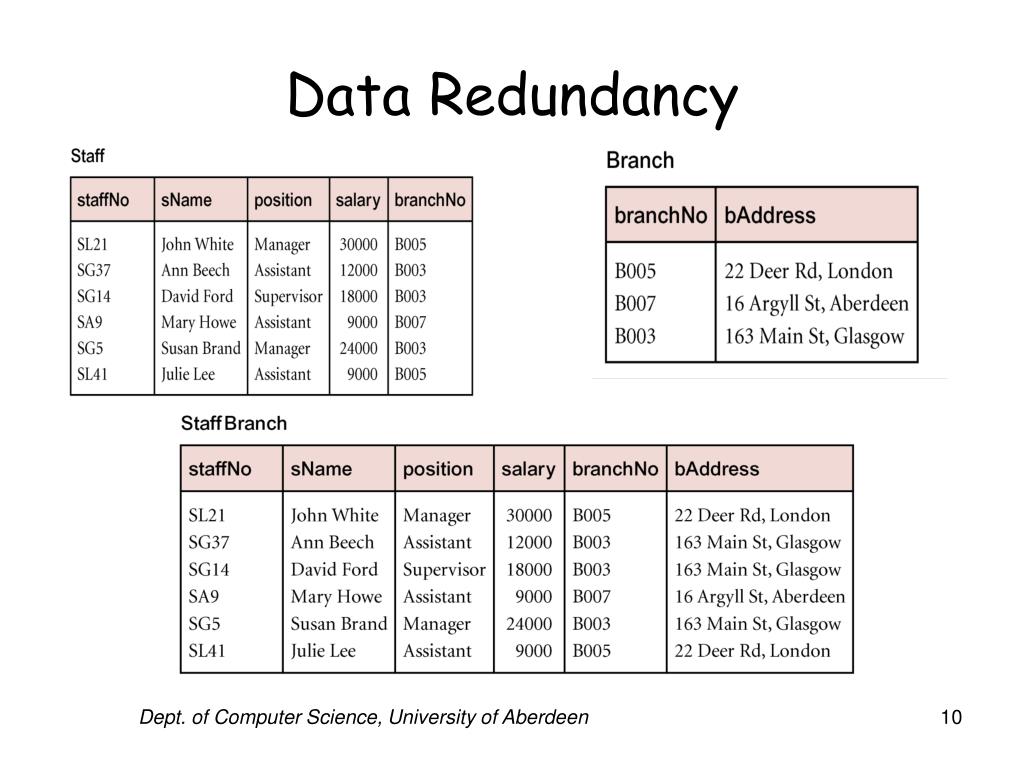
Notice how the branch address (e.g., '163 Main St, Glasgow') is repeated for every employee who works at that branch. This repetition is called data redundancy.
At first glance, this might seem like a minor issue of wasted storage space. But the real danger lies in maintaining the data. What happens if the Glasgow branch moves to a new address? You would need to find and update every single record for every employee at that branch. If you miss even one, the database now contains conflicting information. It has lost its integrity.
This is analogous to hardcoding a configuration value in multiple places in a program instead of defining it as a single constant. A change requires hunting down every instance, and missing one leads to bugs and inconsistent behavior.
The Consequences: Data Anomalies
Data redundancy creates a set of problems known as modification anomalies. These are logical errors that can occur when you try to insert, update, or delete data. There are three main types.
To get a clear understanding with practical examples, please read the following section from an article on database normalization.
Database Normalization (Foundation and Benefits)
This article provides clear, practical examples of the three main types of 'data anomalies' that arise from a poorly designed, non-normalized database.
Please read the section titled 'Types of Anomalies in Denormalized Databases'. Focus on understanding the examples for Update Anomaly, Insert Anomaly, and Delete Anomaly. For each one, try to articulate the core problem in your own words.
Let's summarize and solidify these concepts:
-
Update Anomaly: As we saw with our branch address example, redundancy can cause inconsistencies when updating data. You have to change the same piece of information in multiple rows, risking a partial, inconsistent update.
-
Insert Anomaly: This occurs when you can't add a new record because some other piece of data is missing. The article's example is perfect: you can't add a new student to the system until they enroll in a course. The database structure improperly forces a dependency between two separate concepts (students and course enrollments).
-
Delete Anomaly: This is the unintentional loss of data. If you delete one record, you might accidentally wipe out the only copy of some other related information. In the article's example, deleting a customer's only purchase record might also delete the customer's entire existence from the database. This is like a function in a program having an undocumented and destructive side effect.
To see these anomalies explained in a different context, the following video segment is very helpful.
Learn Database Normalization - 1NF, 2NF, 3NF, 4NF, 5NF
This video uses a game inventory scenario to provide another clear illustration of how redundancy leads to insertion, update, and deletion anomalies.
Watch the segment from 10:25 to 13:40. Notice how adding the Player_Rating column to the Player_Inventory table introduces redundancy and creates the three anomalies. The root cause is that a player's rating is a property of the player, not their inventory.
Test your understanding!
Consider a single table called Project_Assignments with columns: ProjectID, ProjectName, EmployeeID, EmployeeName, and HoursWorked.
An employee can work on multiple projects. A project can have multiple employees.
Which of the three anomalies would occur if you tried to delete all records for a project that has just been canceled? What data would be unintentionally lost?
Show answer
This would cause a deletion anomaly.
If you delete all rows associated with a particular ProjectID, and an employee assigned to that project was only working on that single project, you would lose all information about that employee (EmployeeID and EmployeeName) from the database. The database should be structured to store employee information separately from project assignments.
The Solution: The Purpose of Normalization
We've established the problems; now let's define the solution. Normalization is the formal, systematic process of organizing the columns and tables in a relational database to minimize data redundancy and, therefore, prevent these modification anomalies.
The primary goal is to ensure that data is stored logically and that dependencies make sense. Let's read a concise summary of the objectives of this process.
Database Normalization: 1NF, 2NF, 3NF & BCNF Examples
This article from DigitalOcean provides a clear and concise summary of the 'why' behind normalization, outlining its primary goals.
Read the sections 'Objectives of Database Normalization' and 'What is the Requirement for Database Normalization?'. This will solidify your understanding of the purpose of the normalization process.
As the article explains, the core purpose of normalization is to:
- Eliminate Data Redundancy: Store each piece of data in only one place.
- Ensure Data Integrity: Guarantee the accuracy and consistency of data.
- Prevent Anomalies: Systematically remove the structural flaws that cause insert, update, and delete issues.
- Optimize and Simplify Data Management: A well-structured database is easier to query, maintain, and scale.
Normalization isn't an all-or-nothing affair. It's a series of progressive levels called Normal Forms (NF). Each form represents a stricter set of rules to achieve a higher level of data integrity.
The video we watched earlier offers an excellent analogy for this concept.
Learn Database Normalization - 1NF, 2NF, 3NF, 4NF, 5NF
To build a mental model for the upcoming lessons, let's watch a short segment that compares normal forms to bridge safety levels. This abstract comparison aligns well with a logical, structured approach to learning.
Watch the segment from 02:23 to 04:02.
Just as a bridge is assessed for different levels of safety (pedestrians, cars, trucks), a database design is assessed against different normal forms (1NF, 2NF, 3NF, etc.). In the upcoming lessons, we will learn the specific rules for each of these forms.
Conclusion
In this lesson, we've explored the fundamental "why" behind database normalization. You've learned that a good database design is about more than just capturing all the required data; it's about structuring that data to be robust, consistent, and free from logical errors. This is a high-ROI skill, as getting the design right from the start saves countless hours of debugging and data-cleaning down the line.
Key Takeaways:
- A "good" database design aims to minimize data redundancy.
- Data redundancy is dangerous because it leads to update, insertion, and deletion anomalies, which compromise data integrity.
- Normalization is the formal process of structuring tables to eliminate these anomalies by reducing redundancy.
- The Normal Forms (1NF, 2NF, 3NF) are a series of rules that serve as a quality checklist for our database design.
Preview of the Next Lesson:
Now that we understand why we need to normalize, we can begin to learn how. In the next lesson, we will tackle the first and most fundamental rule: First Normal Form (1NF). You will learn how to apply it to eliminate repeating groups and ensure your data is "atomic."