Hello! Welcome back.
In our last lesson, we explored the significant limitations of using simple file systems for data management. We saw how they struggle with data inconsistency, difficulty in access, and especially the hard problems of ensuring data integrity, managing simultaneous user access, and recovering from crashes.
Today, we'll see the solution. This lesson focuses on how a Database Management System (DBMS) is specifically designed to solve these problems. We'll introduce the concept of a transaction and the four critical guarantees that make databases reliable: the ACID properties. By the end of this lesson, you'll be able to describe how a DBMS handles data integrity, concurrent access, and recovery.
The Central Idea: Transactions and ACID Guarantees
The core difference between a DBMS and a simple file system is how it handles changes. A DBMS groups operations into a single logical unit of work called a transaction.
A classic example is transferring money between bank accounts:
- Read account A's balance.
- Subtract $100 from account A's balance.
- Write the new balance to account A.
- Read account B's balance.
- Add $100 to account B's balance.
- Write the new balance to account B.
For the database to remain correct, this entire sequence must happen as one single, unbreakable operation. A DBMS ensures this by providing four guarantees for every transaction, collectively known as ACID.
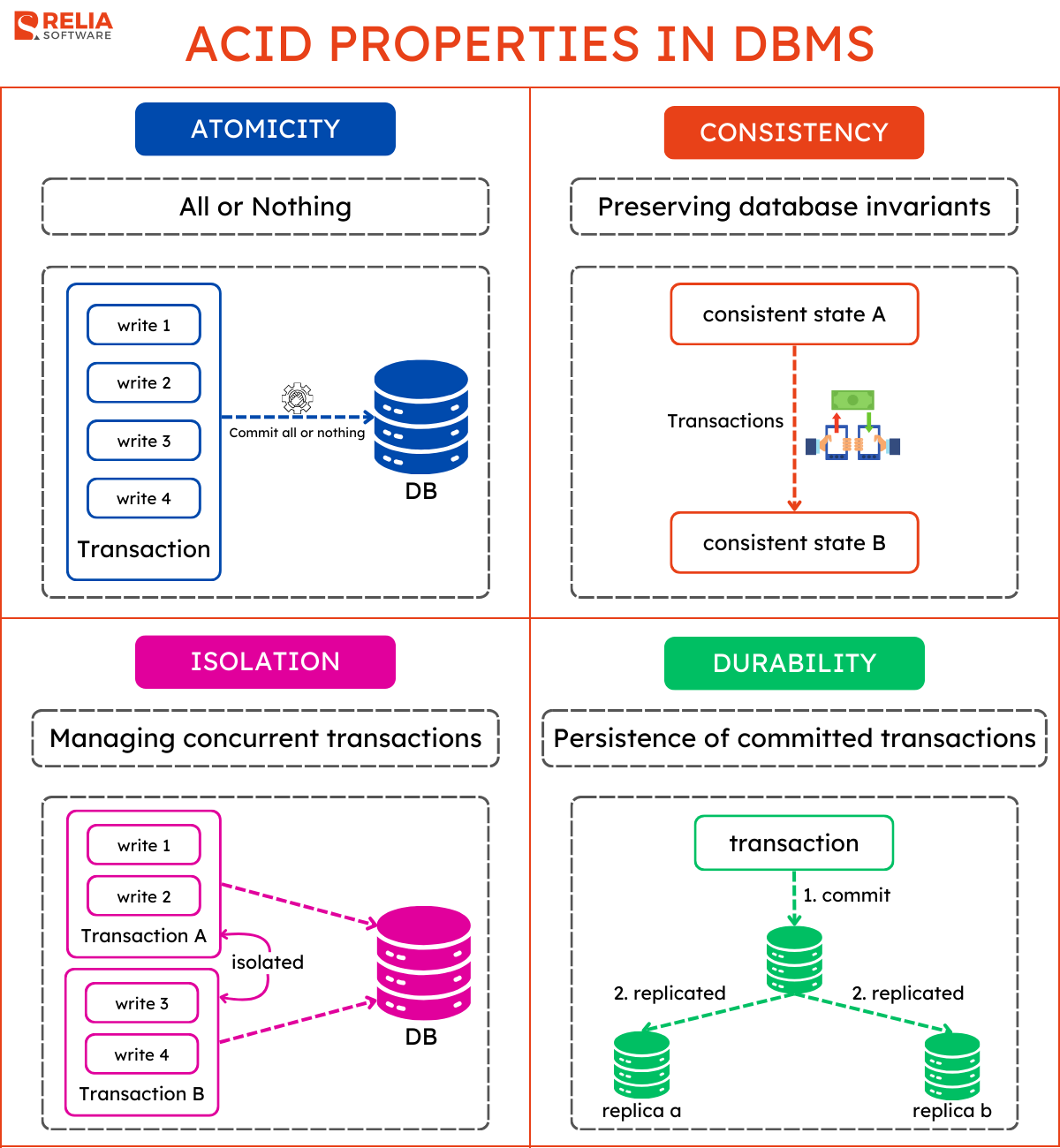
To get a solid overview of these four properties, please read the following article from GeeksforGeeks.
This article provides a clear, textual explanation of each ACID property with simple examples. It will serve as a great reference.
Read the entire article. Pay attention to the simple examples used to illustrate Atomicity, Consistency, Isolation, and Durability.
Now that you have a textual foundation, let's watch a short video that animates and summarizes these concepts.
ACID Properties in Databases With Examples
This video from ByteByteGo offers a concise and engaging visual explanation of the ACID properties, which will help solidify your understanding.
Watch the entire video from the beginning to the end (00:00 - 04:41). Notice how it connects each property to a specific problem, like a system crash or simultaneous access.
Deep Dive 1: Solving Concurrent Access with Isolation
In the last lesson, we discussed "concurrent access anomalies," where multiple users trying to modify the same data at the same time can lead to corruption. This is often called a race condition. Given your experience with APIs, you can imagine this as two API calls arriving almost simultaneously to update the same resource.
Without a DBMS, this is incredibly hard to solve correctly. A DBMS, however, handles it through its Isolation property.
To see just how serious and real this problem is, let's watch a practical demonstration.
This is why understanding database concurrency control is important
The following video by Web Dev Cody demonstrates a classic race condition. He uses a simple Node.js application to send 100 concurrent requests to an endpoint that increments a counter. You'll see how file system-like logic fails dramatically.
Watch from the beginning to 03:13. Pay close attention to how he sets up the problem and how the final count in the database is completely wrong, even though 100 requests were sent.
As you saw, the naive read-modify-write logic resulted in a counter of 2 instead of 100. This is because multiple requests read the same initial value (0), incremented it to 1, and then overwrote each other's work.
How does a DBMS solve this?
The DBMS's Concurrency Control Manager uses several techniques, most commonly locking. When a transaction needs to modify a piece of data, it can acquire a lock on it. This forces other transactions trying to modify the same data to wait until the first transaction is finished.
The video you just watched goes on to show some of these solutions.
- Atomic SQL Update: Using a single SQL statement like
UPDATE counter SET value = value + 1leverages the database's built-in atomicity for that single operation. - Pessimistic Locking (
FOR UPDATE): The code explicitly tells the database to lock the selected rows for the duration of the transaction. - Transaction Isolation Levels: The database provides different levels of isolation (e.g.,
READ COMMITTED,SERIALIZABLE), which trade off performance for stricter consistency guarantees. At the strictest level,SERIALIZABLE, the database ensures that the end result is the same as if the transactions had run one by one.
These mechanisms are what make the Isolation property a reality, ensuring that concurrent operations don't corrupt your data.
Deep Dive 2: Solving Failures with Atomicity and Durability
What happens if the power cord is pulled from your server mid-transaction? This is where Atomicity (all or nothing) and Durability (once committed, it's permanent) become critical. Together, they provide recovery.
The DBMS's Recovery Manager is responsible for this. Its primary tool, and a concept you'll appreciate given your interest in low-level systems, is the Write-Ahead Log (WAL).
The principle is simple but powerful:
- Before a change is made to the actual database files on disk, a record describing the change is written to a separate file, the log.
- This log record contains the old value ("before image") and the new value ("after image").
- The log is written to durable storage (like a hard disk) sequentially, which is very fast.
How does the WAL ensure Atomicity and Durability?
Imagine the system crashes and restarts. The recovery manager reads the log:
- To ensure Durability: For any transaction that has a
COMMITrecord in the log, the manager uses the "after images" to make sure all its changes are applied to the database files, even if they hadn't been written before the crash. This is called a REDO operation. - To ensure Atomicity: For any transaction that was started but does not have a
COMMITrecord, the manager uses the "before images" to reverse any changes that might have made it to the database files. This is called an UNDO operation, effectively rolling the transaction back.
The following presentation slides provide a more formal look at how concurrency control and recovery work, focusing on the Write-Ahead Log.
Concurrency Control and Recovery: based on transactions
These lecture slides from Portland State University offer a deeper, more technical view of transactions and recovery. We'll focus on the section that explains the role of the Write-Ahead Log.
Read slides 33 through 41. Start with 'The Recovery System' (Slide 33) and go through 'Use a log' (Slide 41). This section explains the problems the recovery manager faces and how the WAL with its UNDO/REDO logic solves them.
Test your understanding!
Consider the following sequence of events recorded in a Write-Ahead Log:
T1, A, update, 100, 200(Transaction 1 updates item A from 100 to 200)T2, C, update, 500, 400(Transaction 2 updates item C from 500 to 400)T1, B, update, 80, 90(Transaction 1 updates item B from 80 to 90)T2, commit(Transaction 2 commits)--- CRASH ---
When the DBMS restarts, what will the recovery manager do for Transaction 1 (T1) and Transaction 2 (T2)? Which operations (REDO/UNDO) will be applied and why?
Show answer
-
Transaction 2 (T2): The log contains a
commitrecord for T2. To ensure Durability, the recovery manager will perform a REDO on T2's operations. It will make sure that item C's value is 400. -
Transaction 1 (T1): The log does not contain a
commitorabortrecord for T1; it was in-flight when the crash happened. To ensure Atomicity, the recovery manager will perform an UNDO on T1's operations. It will use the "before images" to revert item A back to 100 and item B back to 80, as if the transaction never started.
Conclusion
Today, we've seen how a DBMS moves beyond the simple file-based model to provide a robust, reliable platform for data management. The core of this reliability lies in the concept of a transaction and its ACID guarantees.
Key Takeaways:
- A transaction is an all-or-nothing sequence of operations that a DBMS treats as a single, logical unit.
- Consistency rules (like constraints) are enforced by the DBMS, ensuring the database only transitions between valid states. This solves the data integrity problem.
- Isolation manages how transactions execute concurrently, using mechanisms like locking to prevent race conditions. This solves the concurrent access problem.
- Atomicity and Durability work together to provide recovery. By using a Write-Ahead Log (WAL), the DBMS can UNDO incomplete transactions and REDO committed transactions after a crash, ensuring data is never lost or left in a partial state.
Understanding these concepts is crucial because they explain why developers trust databases with critical data. They are not just storage bins; they are sophisticated systems designed for correctness and resilience.
Preview of the Next Lesson:
We've now established why we need a DBMS. The next logical question is, how do we talk to it? In the next lesson, we will explore the fundamental difference between the languages we use to interact with databases (like SQL) and the languages we use for general programming (like C or Python). This will lead us to distinguish between declarative and procedural programming paradigms, a concept that is key to mastering SQL.