Hello! Welcome back to our course.
In our previous lessons, we have dissected the SN2 and SN1 reactions individually, exploring their mechanisms, kinetics, and stereochemical outcomes in detail. We've seen how the SN2 reaction involves a single, concerted step with backside attack, while the SN1 reaction proceeds through a stepwise mechanism involving a carbocation intermediate and complex ion-pair dynamics.
Now, we will synthesize this knowledge. The real challenge in organic chemistry isn't just knowing what these reactions are, but predicting when they occur. Today's lesson is dedicated to building a predictive framework. Our goal is to analyze a given set of reactants and conditions to determine if a nucleophilic substitution reaction will proceed primarily via the SN1 or SN2 pathway. We will examine four key factors—substrate, nucleophile, leaving group, and solvent—and learn how they work in concert to dictate the reaction's mechanism.
A Quick Recap
- SN2 Reaction: Bimolecular, one step. Rate = k[Substrate][Nucleophile]. Requires an unhindered substrate for backside attack. Leads to inversion of stereochemistry.
- SN1 Reaction: Unimolecular, multiple steps. Rate = k[Substrate]. Requires a stable carbocation intermediate. Leads to racemization (often incomplete).
Let's begin our integrated analysis.
The Four Factors Influencing the Pathway
Predicting the outcome of a nucleophilic substitution is like solving a puzzle. You have four main pieces of evidence to consider:
- The Substrate (Electrophile): The structure of the molecule containing the leaving group.
- The Nucleophile: The species that attacks the electrophilic carbon.
- The Leaving Group: The group that is displaced.
- The Solvent: The medium in which the reaction occurs.
We'll see that the substrate structure is often the most decisive factor, but the others are crucial for resolving ambiguous cases.
1. The Substrate: Steric Hindrance vs. Carbocation Stability
The structure of the alkyl halide is the single most important factor in determining the reaction pathway. The two mechanisms have opposing steric and electronic requirements.
- SN2 reactions demand an unhindered path for the nucleophile to perform a backside attack on the C-LG orbital. Steric bulk on or near the electrophilic carbon physically blocks this approach.
- SN1 reactions depend on the formation of a carbocation in the rate-determining step. The stability of this carbocation is paramount.
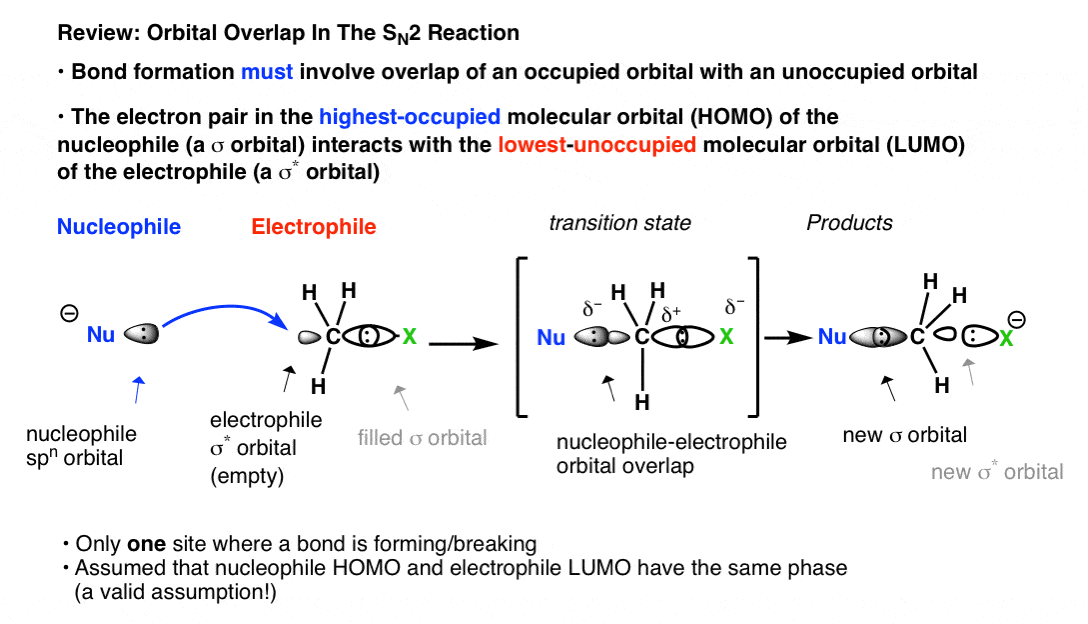
This leads to opposite reactivity trends for the two mechanisms.
Reactions of Haloalkanes, Alcohols, and Amines
The following text directly compares the SN1 and SN2 mechanisms, focusing on how substrate structure (methyl, 1°, 2°, 3°) affects reaction rates due to steric hindrance and carbocation stability. The tables of relative rates are particularly illustrative.
Read the section 'SN1 versus SN2 Mechanisms' (7.2). Pay close attention to Tables 7.1 and 7.1a, which quantify the dramatic effect of alkyl substitution on SN2 and SN1 rates, respectively. Understand why these opposite trends exist.
Based on the reading, we can establish our primary decision-making rule:
- Methyl (CH₃X) and Primary (RCH₂X) substrates: The carbocations are too unstable for the SN1 pathway. These substrates are also unhindered, making them ideal for SN2. Prediction: SN2 only.
- Tertiary (R₃CX) substrates: These are too sterically hindered for backside SN2 attack. However, they form the most stable carbocations. Prediction: SN1 only.
- Secondary (R₂CHX) substrates: This is the "battleground." They are moderately hindered (slowing SN2) and can form a moderately stable carbocation (allowing SN1). The outcome depends on the other three factors.
- Allylic (C=C-C-X) and Benzylic (Ph-C-X) substrates: These are special cases. They can form resonance-stabilized carbocations, making the SN1 pathway accessible even for primary and secondary systems. They are also relatively unhindered, so SN2 is also possible. This is another battleground.
To deepen your understanding of the electronic factors that stabilize carbocations (a key concept from your quantum chemistry interest), the following reading explains hyperconjugation and resonance in this context.
CHAPTER 9. SUBSTITUTION REACTIONS
To truly grasp why tertiary, allylic, and benzylic substrates favor SN1, we must understand carbocation stability from a molecular orbital perspective. This resource explains stability through hyperconjugation and resonance effects.
Read the section 'Carbocation Stability' (9.5.2). Focus on the explanations for why more substituted carbocations are more stable (hyperconjugation) and how resonance stabilizes benzylic and allylic carbocations. Notice the destabilizing effect of nearby electron-withdrawing groups.
2. The Nucleophile: Strong vs. Weak
If the substrate is secondary, allylic, or benzylic, the nucleophile becomes a critical deciding factor.
- Strong Nucleophiles favor the SN2 pathway. Since the SN2 rate depends on the nucleophile's concentration and identity, a powerful nucleophile will accelerate the reaction, making it win out over the SN1 alternative. Strong nucleophiles are typically species with a negative charge (e.g., HO⁻, RO⁻, CN⁻, I⁻) and are eager to attack the substrate directly.
- Weak Nucleophiles favor the SN1 pathway. These nucleophiles (e.g., H₂O, ROH) are not reactive enough to displace the leaving group in a concerted SN2 fashion. Instead, they wait for the substrate to ionize on its own to form a carbocation, which is a much stronger electrophile, and then they attack. Reactions with weak, neutral nucleophiles that also serve as the solvent are called solvolysis reactions.
CHAPTER 9. SUBSTITUTION REACTIONS
What makes a nucleophile 'strong' or 'weak'? This is a kinetic property related to several structural factors. The following text provides a systematic breakdown of nucleophilicity.
Read the section 'NUCLEOPHILES' (9.4). Focus on the factors that influence nucleophilicity: protonation state (e.g., OH⁻ vs H₂O), periodic trends, resonance, and steric effects. This will give you the tools to classify nucleophiles as strong or weak.
Summary of Nucleophile Strength:
- Strong: I⁻, Br⁻, RS⁻, CN⁻, N₃⁻, HO⁻, RO⁻
- Moderate: Cl⁻, RCO₂⁻, RNH₂
- Weak: H₂O, ROH, RCOOH
3. The Leaving Group: Good vs. Poor
A good leaving group is required for both SN1 and SN2 reactions, as the C-LG bond is broken in the rate-determining step of both mechanisms.
A good leaving group is a weak base. This is because weak bases are stable on their own and do not have a strong tendency to re-bond to the carbon. We can predict leaving group ability by looking at the pKₐ of the conjugate acid (H-LG). The stronger the acid, the weaker its conjugate base, and the better the leaving group.
- Excellent Leaving Groups: I⁻, Br⁻, TsO⁻ (tosylate), MsO⁻ (mesylate), H₂O (from a protonated alcohol)
- Good Leaving Group: Cl⁻
- Poor Leaving Groups: F⁻, HO⁻, RO⁻, NH₂⁻
While a good leaving group speeds up both reactions, it doesn't strongly differentiate between them. Its main role is to determine if a substitution reaction is feasible at all. Poor leaving groups like -OH or -NH₂ must first be converted into good leaving groups (e.g., by protonation to -OH₂⁺ or -NH₃⁺) for a reaction to proceed.
Reactions of Haloalkanes, Alcohols, and Amines
The following text provides a summary of good and poor leaving groups and explicitly connects their leaving ability to the pKₐ values of their conjugate acids.
Read the section 'A Summary of Leaving Groups' (7.7D). Study Tables 7.6 and 7.7 and note the correlation between 'good' leaving groups and high Kₐ (low pKₐ) values for their conjugate acids.
4. The Solvent: Protic vs. Aprotic
The solvent plays a subtle but powerful role, primarily by stabilizing or destabilizing the key species in each pathway.
-
Polar Protic Solvents (e.g., water, methanol, ethanol). These solvents have O-H or N-H bonds and can act as hydrogen bond donors.
- They are excellent at stabilizing the transition state of the SN1 reaction because they can solvate both the carbocation and the leaving group anion.
- They hinder SN2 reactions by forming a "cage" of hydrogen bonds around the nucleophile, lowering its energy and making it less reactive.
- Conclusion: Polar protic solvents strongly favor SN1.
-
Polar Aprotic Solvents (e.g., acetone, DMSO, DMF, acetonitrile). These solvents have dipoles but lack O-H or N-H bonds.
- They cannot act as hydrogen bond donors. They can solvate cations well but are poor at solvating anions.
- This leaves anionic nucleophiles "naked" and highly reactive, which is perfect for SN2 reactions.
- They are not polar enough to effectively stabilize the separated ions of the SN1 pathway.
- Conclusion: Polar aprotic solvents strongly favor SN2.
Reactions of Haloalkanes, Alcohols, and Amines
To understand the solvent's role, we need to examine how different solvent types interact with charged species. This text explains the critical distinction between polar protic and polar aprotic solvents.
Read the sections 'Solvent Dependence of Nucleophilicity' (7.8A) and 'Polar Aprotic Solvents' (7.8B). Focus on how hydroxylic (protic) solvents solvate anions via hydrogen bonding, reducing nucleophilicity, and why polar aprotic solvents accelerate SN2 reactions.
Synthesizing the Factors: A Predictive Framework
Now, let's put it all together. Here is a step-by-step guide to predicting the mechanism.

The Prediction Algorithm:
-
Analyze the substrate first.
- Methyl or 1°? → SN2. (Unless a strong, bulky base is used, which favors elimination - a topic for our next module!)
- 3°? → SN1. (The SN2 pathway is blocked. Strong bases will cause elimination.)
- 2°, allylic, or benzylic? → It's a competition. Proceed to step 2.
-
For competitive cases, analyze the nucleophile and solvent.
- Strong nucleophile and/or polar aprotic solvent? → The conditions push the reaction toward SN2.
- Weak nucleophile and/or polar protic solvent? → The conditions push the reaction toward SN1.
-
Finally, check the leaving group.
- Is it a weak base (I⁻, Br⁻, Cl⁻, TsO⁻, H₂O)? → The reaction is likely to proceed.
- Is it a strong base (F⁻, HO⁻, RO⁻, NH₂⁻)? → The reaction is unlikely to occur unless the leaving group is activated (e.g., by acid).
Test your understanding!
Let's apply the framework. Predict the major substitution mechanism (SN1 or SN2) for the reaction of 2-bromopropane with sodium ethoxide (NaOCH₂CH₃) in ethanol (CH₃CH₂OH).
- Substrate: 2-bromopropane is a 2° alkyl halide. It's a competition.
- Nucleophile & Solvent: The nucleophile is ethoxide (CH₃CH₂O⁻), a strong nucleophile. The solvent is ethanol, a polar protic solvent.
What's your prediction?
Show answer
This is a classic ambiguous case. We have a secondary substrate.
- The strong nucleophile (ethoxide) argues for SN2.
- The polar protic solvent (ethanol) argues for SN1.
In such cases, multiple pathways often occur simultaneously. However, a strong nucleophile is a very powerful driving force for SN2. The SN2 reaction will likely be a significant pathway. But we can't rule out SN1. Furthermore, since ethoxide is a strong base, the E2 elimination reaction (forming propene) will also be a major competitor. For now, based purely on substitution, we would expect a mixture of SN2 and SN1, with SN2 likely being significant due to the strong nucleophile. This highlights the reality that these are not always all-or-nothing choices.
Conclusion
You have now built a comprehensive toolkit for analyzing nucleophilic substitution reactions. By systematically evaluating the substrate, nucleophile, leaving group, and solvent, you can make well-reasoned predictions about the dominant reaction mechanism.
Key Takeaways:
- Substrate is king: Methyl/1° favors SN2; 3° favors SN1. Secondary, allylic, and benzylic substrates are competitive.
- Nucleophile is the tie-breaker: Strong nucleophiles push competitive substrates toward SN2. Weak nucleophiles allow the SN1 pathway to dominate.
- Solvent creates the environment: Polar protic solvents stabilize ions and favor SN1. Polar aprotic solvents enhance nucleophilicity and favor SN2.
- Leaving group is a prerequisite: A good leaving group (a weak base) is necessary for either reaction to be efficient.
Preview of the Next Lesson:
We have alluded several times to a competing set of reactions: eliminations. Many nucleophiles are also strong bases, and under the right conditions, they can abstract a proton from a carbon adjacent to the leaving group, forming a double bond. In the first lesson of our next module, we will introduce the E2 reaction, compare its requirements to the SN2 reaction, and begin building an even more complete picture of alkyl halide reactivity.