Hello! Welcome to our next lesson.
In our last session, we built a framework to predict whether a nucleophilic substitution reaction would proceed via an SN1 or SN2 pathway. We noted that strong nucleophiles are often also strong bases, and this can lead to a competing reaction: elimination. Today, we delve into the most common elimination mechanism, the E2 reaction.
Our goal is to describe the detailed mechanism of E2 reactions and, crucially, to explain the requirement for a specific three-dimensional arrangement known as anti-periplanar geometry. Your interest in the quantum mechanical "why" behind chemical behavior will be particularly relevant here, as this geometric constraint is a direct consequence of orbital interactions during the reaction.
The E2 Mechanism: A Bimolecular, Concerted Process
The E2 reaction—Elimination, 2 for bimolecular—is a single-step process, much like its substitution counterpart, the SN2 reaction. In this reaction, a base removes a proton from a carbon adjacent to the one bearing the leaving group (the β-carbon), and in a single, concerted motion, a double bond is formed and the leaving group is expelled.

To understand the evidence for this concerted mechanism and the factors that influence it, let's turn to a foundational reading.
11.8: The E2 Reaction and Mechanism
This text introduces the E2 mechanism, its second-order kinetics, and a key piece of experimental evidence that supports the concerted model.
Please read the 'Introduction' and 'E2 Mechanism' sections, up to but not including 'Periplanar Geometry'. Pay close attention to two key points: The rate law: rate = k[RX][Base], which confirms that both the substrate and the base are involved in the single rate-determining step. The deuterium isotope effect: This is a sophisticated piece of evidence. Focus on understanding why replacing a C-H bond with a stronger C-D bond at the β-position slows the reaction, and what this implies about which bonds are broken in the rate-determining step.
As you read, the deuterium isotope effect provides a powerful confirmation of the E2 model. Since the C-H bond is broken in the rate-determining step, changing the mass of that hydrogen to deuterium has a measurable impact on the reaction rate. If the leaving group departed first (as in an E1 reaction), this isotopic substitution would have no effect on the rate-determining step.
This concerted dance of electrons is beautifully visualized in the following animation.
How E2 Elimination Reactions Work (Animation) | Mechanism & Orbitals | Organic Chemistry
This video from Total Synthesis provides an excellent animation of the E2 mechanism, focusing on the orbital interactions that drive the reaction.
Watch the segment from the beginning until 01:19. The animation visually demonstrates how the deprotonation by the base, the formation of the π-system, and the departure of the leaving group all occur simultaneously in a single, concerted step. Notice the contrast drawn with the E1 mechanism, which involves intermediates.
The Stereoelectronic Requirement: Anti-Periplanar Geometry
Now we arrive at the core of the E2 mechanism's stereochemistry. The reaction is not just concerted; it is highly specific about the required 3D arrangement of the atoms involved. For an E2 reaction to occur efficiently, the β-hydrogen and the leaving group must be anti-periplanar.
- Periplanar means "in the same plane."
- Anti means "on opposite sides."
So, the H—C—C—LG atoms must lie in a single plane, with the H and LG positioned at a dihedral angle of approximately 180°.
Why is this geometry so critical? The answer lies in orbital overlap—a concept fundamental to your interest in quantum chemistry. This is what chemists refer to as a stereoelectronic effect: an effect on reactivity that has its origin in the spatial arrangement of orbitals.
-
Optimal Orbital Overlap: The E2 transition state involves the transformation of two sigma orbitals (the C-H and C-LG bonds) into a new orbital that forms the π bond. For this to happen smoothly, the electron density from the C-H σ bonding orbital must flow into the C-LG σ* (sigma-star) antibonding orbital. This overlap is maximized when the orbitals are aligned in an anti-periplanar arrangement, analogous to the backside attack in an SN2 reaction.
-
Energetic Stability: This anti-periplanar arrangement corresponds to a staggered conformation along the Cα—Cβ bond. This is energetically more favorable than the eclipsed conformation that would be required for the alternative, a syn-periplanar elimination.
The following resources provide a deeper explanation of this critical requirement.
This reading formally introduces the concept of stereoelectronic factors and uses the E2 reaction as a classic example. It frames the anti-periplanar requirement not just as a rule, but as a fundamental principle of orbital interaction.
Read the first two paragraphs of this article. It will connect the E2 mechanism to the broader concept of stereoelectronic effects and provide a comparison to the SN2 reaction's stereoelectronic requirement, reinforcing the importance of orbital alignment.
Now, let's watch a video that illustrates exactly how this geometry facilitates the reaction.
7.7c The Stereospecificity of E2 Reactions Anti periplanar
This video from Chad's Prep clearly defines anti-periplanar geometry and shows its consequences in acyclic systems.
Watch the first part of the video (00:00 - 01:35). The presenter clearly explains the meaning of anti-periplanar and distinguishes it from the older term 'anti-coplanar.' This section sets the stage for understanding the reaction's stereospecificity.
Consequences of Anti-Periplanar Geometry
This strict geometric requirement is not just a theoretical detail; it has profound and predictable consequences for the products of E2 reactions.
1. Stereospecificity in Acyclic Systems
In an open-chain molecule, single bonds can rotate. However, the E2 reaction can only occur when the molecule adopts a conformation that places a β-hydrogen anti-periplanar to the leaving group.
- If a β-carbon has two hydrogens, bond rotation can bring each one into the anti-periplanar position, potentially leading to a mixture of E and Z alkene products. The more stable E isomer usually predominates.
- If a β-carbon has only one hydrogen, rotation is still possible, but only one specific conformation allows for elimination. This means the reaction is stereospecific: a given stereoisomer of the starting material will yield only one specific stereoisomer of the product.
Newman projections are the ideal tool for visualizing this. You orient the molecule looking down the Cα-Cβ bond and rotate the back carbon until the H and the leaving group are anti (180° apart). The positions of the other substituents in that conformation are then "locked in" to the resulting alkene.
How E2 Elimination Reactions Work (Animation) | Mechanism & Orbitals | Organic Chemistry
This next segment demonstrates precisely how to use the anti-periplanar rule to predict the stereochemical outcome in open-chain molecules.
Watch the segment from 03:09 to 04:35. It shows how two different diastereomers give stereospecifically different alkene products (E vs. Z) because of the anti-periplanar requirement. The use of Newman projections makes the relationship between reactant conformation and product stereochemistry very clear.
Test your understanding!
Consider (2S, 3S)-2-bromo-3-phenylbutane reacting with a strong base. Draw the Newman projection looking down the C2-C3 bond. Rotate the molecule into its reactive, anti-periplanar conformation. What is the stereochemistry (E or Z) of the resulting alkene, 1-phenyl-2-butene?
Show answer
- Draw the molecule: On C2, we have Br, H, and a methyl group. On C3, we have H, a phenyl group, and a methyl group.
- Set up the Newman Projection: Let's put C2 in front. In the anti-periplanar conformation, the Br on the front carbon must be 180° away from the H on the back carbon.
- Position Substituents: When you draw the (2S, 3S) isomer and rotate it so that H(C3) and Br(C2) are anti, you will find that the methyl group on C2 and the phenyl group on C3 are on the same side of the molecule (gauche). The other two groups (H on C2 and methyl on C3) are also on the same side.
- Form the Alkene: When the elimination occurs, the groups that were on the same side in the Newman projection end up on the same side of the double bond. The two high-priority groups (phenyl on C3 and the C2-carbon group attached to C3) will be on the same side of the double bond. Therefore, the product is the (Z)-alkene.
2. The Rigid Case: Cyclohexane Rings
In cyclohexane rings, the stereoelectronic requirement for E2 is even more dramatic because bond rotation is severely restricted. The anti-periplanar geometry can only be achieved if both the leaving group and the β-hydrogen are in axial positions. This is often called a trans-diaxial arrangement.
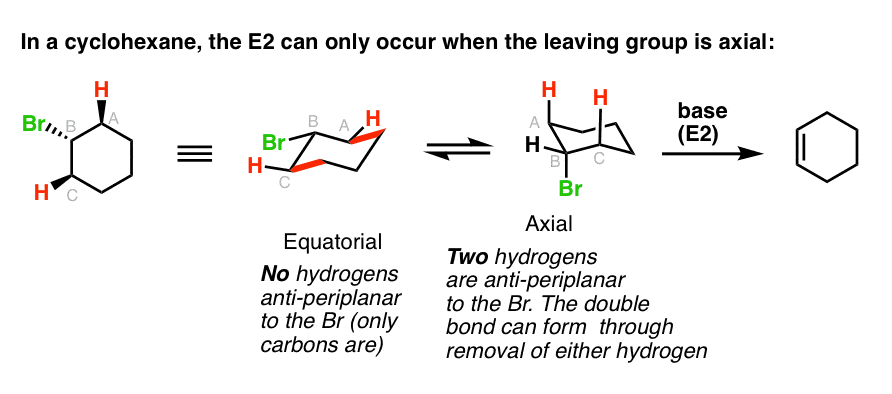
This has major implications:
- If the leaving group is locked in an equatorial position (for example, by a bulky t-butyl group elsewhere on the ring), the E2 reaction may be extremely slow or may not occur at all.
- The reaction will only proceed through the chair conformation that places the leaving group in an axial position, even if that conformation is less stable.
7.7c The Stereospecificity of E2 Reactions Anti periplanar
The final videos for this lesson illustrate this crucial rule for cyclohexane systems.
First, watch from 07:21 to 10:38 in the Chad's Prep video. It explains why a trans-diaxial arrangement is necessary and walks through a chair conformation to show the orbital alignment.
How E2 Elimination Reactions Work (Animation) | Mechanism & Orbitals | Organic Chemistry
Now, let's see another example that highlights the energetic consequences of this requirement.
Finally, watch the segment from 04:45 to 05:52 in the Total Synthesis video. It uses a di-substituted cyclohexane to show how the need for an axial leaving group can make one stereoisomer react hundreds of times slower than another. This is a powerful demonstration of the stereoelectronic effect in action.
Conclusion
Today, we have explored the E2 reaction in depth, moving from its general mechanism to the nuanced stereoelectronic reasons that govern its outcome.
Key Takeaways:
- The E2 reaction is a concerted, bimolecular elimination process, evidenced by its second-order kinetics and the deuterium isotope effect.
- The reaction has a strict stereoelectronic requirement for anti-periplanar geometry, where the β-hydrogen and the leaving group have a dihedral angle of ~180°.
- This requirement arises from the need for optimal overlap between the C-H σ bonding orbital and the C-LG σ* antibonding orbital in the transition state.
- In acyclic systems, this requirement leads to stereospecificity, where the stereochemistry of the starting material determines the stereochemistry of the alkene product.
- In cyclohexane rings, E2 elimination requires a trans-diaxial arrangement of the hydrogen and leaving group, meaning both must be in axial positions.
Preview of the Next Lesson:
We have answered the how of the E2 mechanism. But what happens when a substrate has multiple, non-equivalent β-hydrogens? Which one is removed? This question of regioselectivity will be the focus of our next lesson. We will explore Zaitsev's and Hofmann's rules, which help predict the major alkene product by analyzing the stability of the E2 transition state.