Hello! Welcome to our lesson.
In our last session, we established a quantitative framework for understanding acid-base reactions, focusing on basicity as a thermodynamic property. We saw how pKa values allow us to predict the position of equilibrium based on the relative stability of reactants and products (). A base's strength is a measure of its conjugate acid's pKa, reflecting an equilibrium.
Today, we pivot from thermodynamics to kinetics. A chemical species can donate its electron pair to a proton (acting as a base) or to another electrophilic atom, typically carbon (acting as a nucleophile). While related, the tendency to do one versus the other, and the rate at which it happens, are not the same. Our goal is to distinguish between nucleophilicity and basicity, explaining the roles of charge, electronegativity, polarizability, and solvent. This distinction is fundamental to predicting the outcomes of a vast number of organic reactions.
1. The Fundamental Distinction: Thermodynamics vs. Kinetics
The most critical difference to grasp is that basicity is a thermodynamic concept, while nucleophilicity is a kinetic one.
- Basicity measures the position of an equilibrium. It reflects the stability of the products relative to the reactants. A stronger base forms a more stable bond with a proton, shifting the equilibrium further. We measure it with pKa.
- Nucleophilicity measures the rate of a reaction. It reflects how quickly a nucleophile attacks an electrophilic atom. We are concerned with the activation energy () of the reaction, not the overall energy change.
This document from OChemTutor provides an excellent conceptual framework for this distinction. Focus on its introduction to thermodynamics versus kinetics and its analogies.
Read pages 2-4 of the PDF. Start with the section 'Basicity measures a thermodynamic quality while nucleophilicity measures a kinetic quality' and continue through 'What is nucleophilicity?'. Pay close attention to the energy diagram and the 'arm length' (polarizability) vs. 'fist strength' (basicity) analogy. We will build on this throughout the lesson.
As the document explains, both concepts involve a Lewis base donating an electron pair. The key difference is the target:
- Base attacks a proton (H⁺).
- Nucleophile attacks an electrophilic atom (usually C).
A species like hydroxide, , can do both. The question is which role it prefers and how fast it reacts in a given situation.
2. The Four Key Factors
Let's dissect the factors that govern these two properties. The best way to understand the distinction is to see where the trends for basicity and nucleophilicity align and where they diverge.
Basicity vs Nucleophilicity - Steric Hindrance
This video from The Organic Chemistry Tutor provides a comprehensive walkthrough of the factors influencing basicity and nucleophilicity. We will use it as our primary guide for this section.
We will break this video down section by section. For now, you can keep it ready. The total watch time will be around 12 minutes.
A. Charge
For the same attacking atom, a negative charge makes a species both a stronger base and a better nucleophile. The extra electron density makes the lone pair more available for donation.
- Example: is a stronger base AND a better nucleophile than . is stronger and more nucleophilic than .
Basicity vs Nucleophilicity - Steric Hindrance
Watch this short segment from the video to see this principle explained.
Watch from 02:11 to 03:14.
B. Electronegativity (Trends Across a Period)
Moving from left to right across a period (e.g., C to N to O to F), electronegativity increases. The atom holds its valence electrons more tightly, making them less available for donation.
- Trend: Both basicity and nucleophilicity decrease as electronegativity increases.
- Order: (for both properties).
In this case, where the attacking atoms are in the same row and thus have similar sizes, basicity and nucleophilicity run parallel.
C. Polarizability and the Role of Solvent (Trends Down a Group)
This is where basicity and nucleophilicity dramatically diverge.
- Basicity: Decreases down a group. For example, is a much stronger base than . This is because is a large ion that disperses its negative charge over a large volume, making it more stable (and thus, its conjugate acid, HI, is very strong).
- Nucleophilicity: The trend depends entirely on the solvent.
Let's watch the explanation first, and then we'll analyze the quantum mechanical reason.
Basicity vs Nucleophilicity - Steric Hindrance
This part of the video is crucial. It explains how protic and aprotic solvents invert the trend of nucleophilicity for halides.
Watch from 03:14 to 10:08. Focus on: (1) The definition of polar protic vs. aprotic solvents. (2) The concept of the solvent 'caging' or solvating smaller anions more effectively in protic solvents.
Let's summarize this pivotal concept:
1. In Polar Protic Solvents (e.g., water, methanol):
These solvents have H atoms bonded to O or N, allowing for strong hydrogen bonding.
- Small, "hard" anions with high charge density (like ) are heavily solvated (caged) by the solvent molecules. This shell of solvent impedes the nucleophile from reaching the electrophile.
- Large, "soft" anions (like ) are larger and more polarizable. Their electron clouds are diffuse and easily distorted. They are less tightly solvated and can more effectively use their higher-energy, diffuse valence orbitals to overlap with the electrophile's LUMO.
- Result: Nucleophilicity increases down the group: . This is the opposite of the basicity trend.
2. In Polar Aprotic Solvents (e.g., DMSO, acetone):
These solvents lack H-bond donating capability. Anions are not strongly solvated; they are effectively "naked".
- Without the interference of a solvent shell, the intrinsic reactivity of the anion takes over. The species with the highest charge density (the strongest base) is also the fastest nucleophile.
- Result: Nucleophilicity parallels basicity: .

D. Steric Hindrance
Basicity is largely unaffected by steric bulk. The proton is small and always accessible. Nucleophilicity, however, is very sensitive to sterics. A bulky nucleophile cannot easily approach a crowded electrophilic carbon.
- Result: Bulky species are often strong bases but poor nucleophiles.
- Classic Example: Methoxide () vs. tert-Butoxide (). Both are strong bases. However, methoxide is a good nucleophile, while the bulky tert-butoxide is a very poor nucleophile.
Basicity vs Nucleophilicity - Steric Hindrance
Finally, watch this segment explaining the effect of steric bulk.
Watch from 10:08 to 13:40. The comparison between methoxide and tert-butoxide is a classic illustration of this principle.
Test your understanding!
For each pair, identify the better nucleophile in an SN2 reaction with methyl iodide (). Explain your reasoning.
- vs. in methanol ()
- vs. in water ()
- vs. in DMSO
- vs. in DMSO
Show answer
- is the better nucleophile. Methanol is a polar protic solvent. Nucleophilicity increases down a group in protic solvents due to polarizability and weaker solvation.
- is the better nucleophile. Water is a polar protic solvent. Sulfur is below oxygen in the periodic table, making it larger, more polarizable, and less strongly solvated than oxygen. Thus, is more nucleophilic than in water.
- is the better nucleophile. DMSO is a polar aprotic solvent. For the same attacking atom (N), the negatively charged species is always more nucleophilic than the neutral one.
- is the better nucleophile. While tert-butoxide is a stronger base, its extreme steric bulk makes it a very poor nucleophile. The less hindered methoxide can approach the electrophilic carbon of much more easily.
3. A Deeper Look: Orbitals, HSAB, and Reaction Energetics
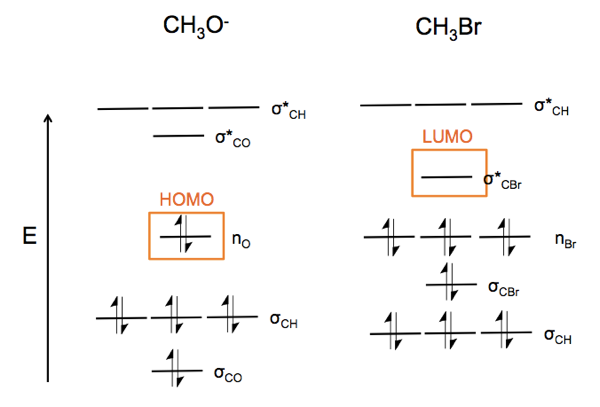
Given your interest in the quantum mechanical "why," we can frame this discussion using Frontier Molecular Orbital (FMO) theory and the Hard-Soft Acid-Base (HSAB) principle.
The rate of a reaction is influenced by the energy of its transition state. According to the Klopman-Salem equation, the energy change upon bringing a nucleophile and electrophile together has two main components:
- An electrostatic term: Attraction between charges/dipoles.
- An orbital interaction term: The stabilizing interaction between the nucleophile's HOMO and the electrophile's LUMO.
Basicity, the affinity for a proton (H⁺), is dominated by the electrostatic term. The proton is a tiny, non-polarizable point of positive charge—a "hard" acid. It interacts best with "hard" bases: small, highly electronegative species with high charge density (e.g., ).
Nucleophilicity toward a carbon atom, however, has a significant orbital interaction component. A typical electrophilic carbon (like in ) has a LUMO and is considered a "soft" acid. It reacts best with "soft" bases: large, polarizable species whose high-energy, diffuse HOMO has a smaller energy gap and better overlap with the LUMO (e.g., ). This is why polarizability is so crucial for nucleophilicity.
So why does the trend reverse in aprotic solvents? Shouldn't the superior orbital interaction of still make it a better nucleophile?
Explanation for the trends in nucleophilicity—Orbital ...
This discussion on Chemistry Stack Exchange provides a sophisticated answer that will appeal to your desire for a deeper explanation. It goes beyond the standard textbook reasoning.
Read the sections titled 'Affirming your viewpoint' and 'How does thermodynamics even influence kinetics?'. Don't worry about the full derivation of the Klopman-Salem equation. Focus on the core idea: the strength of the partially formed C-X bond in the transition state affects the activation energy. This is a subtle link between thermodynamics (bond strength) and kinetics (rate).
The key insight from that post is that in the absence of interfering solvent, the reaction rate is also influenced by the strength of the bond that is beginning to form in the transition state. The C–F bond is much stronger than the C–I bond. In an aprotic solvent, this thermodynamic factor (a more stable forming bond) lowers the energy of the transition state for the reaction with fluoride, making it kinetically faster. This is a beautiful example of Hammond's postulate, where the character of the product (a strong bond) is reflected in the transition state.
Conclusion
You have now unpacked one of the most subtle but important concepts in reactivity. While often used interchangeably by beginners, basicity and nucleophilicity describe different phenomena governed by different factors.
Key Takeaways:
- Basicity is thermodynamic (equilibrium affinity for H⁺), measured by pKa.
- Nucleophilicity is kinetic (rate of attack on an electrophile, usually C), measured by reaction rates.
- The trends for basicity and nucleophilicity diverge due to three main factors:
| Factor | Stronger Base | Better Nucleophile | Reason for Difference |
|---|---|---|---|
| Atomic Size (Polarizability) | Smaller atom (up a group) | Larger atom (down a group, in protic solvent) | Soft-soft (orbital) interactions favor large nucleophiles. |
| Solvent | Less affected | Strongly affected | Protic solvents 'cage' small, hard nucleophiles. |
| Steric Hindrance | Largely unaffected | Less hindered species | Nucleophilic attack requires approach to a specific atom. |
Preview of the Next Lesson:
We have touched upon the ideas of "hard" and "soft" acids and bases. In our next lesson, we will formalize this. We will apply hard-soft acid-base (HSAB) theory to predict the outcome of competitive reactions, giving you another powerful predictive tool rooted in the electronic properties of molecules.