Hello! Welcome to our next lesson.
In our previous session, we developed a qualitative framework for comparing the strengths of acids and bases using structural and electronic effects like resonance, induction, and hybridization. You learned to predict, for instance, that a carboxylic acid is stronger than an alcohol, and aniline is a weaker base than cyclohexylamine.
Today, we will elevate this understanding from qualitative comparison to quantitative prediction. The goal of this lesson is to master how to predict the position of acid-base equilibria using pKa values and calculate the corresponding equilibrium constants from the difference in pKa (ΔpKa). This bridges our structural intuition with the powerful, predictive language of thermodynamics, directly addressing your interest in the mathematical underpinnings of chemical behavior.
1. From Acid Strength (Ka) to a Logarithmic Scale (pKa)
You know that an acid's strength is measured by its acidity constant, , which is the equilibrium constant for its dissociation in water.
The range of values is enormous, spanning many orders of magnitude.
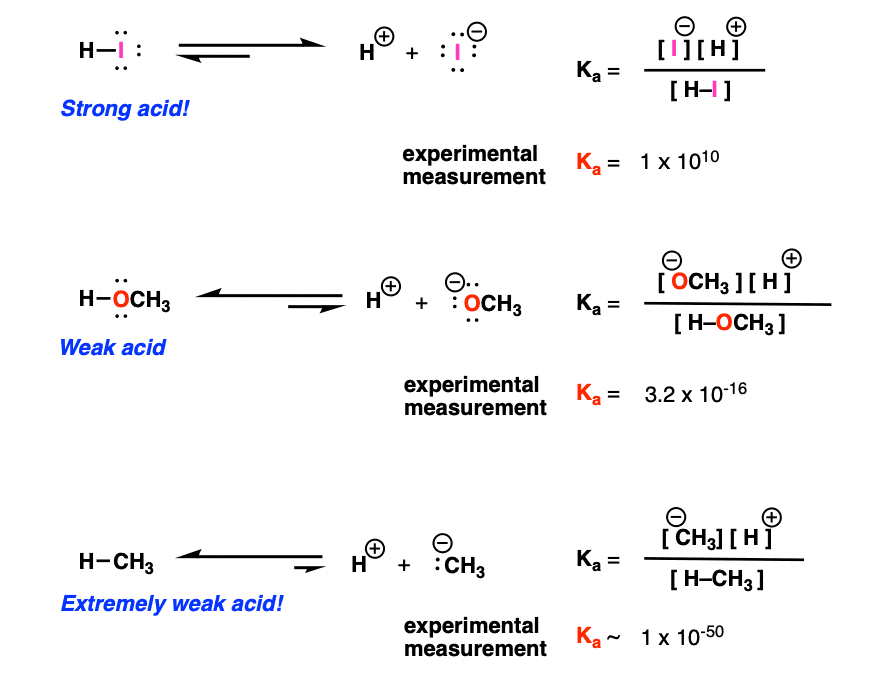
To make these numbers more manageable, chemists use the pKa scale, defined as:
Due to the negative sign, this creates an inverse relationship:
- A stronger acid has a larger and a lower pKa.
- A weaker acid has a smaller and a higher pKa.
This logarithmic scale is crucial; a difference of one pKa unit corresponds to a tenfold difference in acidity.
Chapter 7: Acid-base reactions
For a concise review of this concept and a very useful table of approximate pKa values for common functional groups, please review the first two sections of this chapter from UCSD.
Read 'Section 7.2: The acidity constant' and '7.2A: Defining the acidity constant'. Pay special attention to the table of 'Typical pKa values'. Committing these approximate values to memory is a key skill in organic chemistry.
2. Predicting the Position of Equilibrium
An acid-base reaction is a competition for a proton. The equilibrium will always lie on the side of the more stable species—the weaker acid and the weaker base.
Consider a general reaction:
The Rule: The equilibrium favors the formation of the acid with the higher pKa value.
This is because a higher pKa signifies a weaker, more stable acid that is less inclined to donate its proton.
The following videos provide excellent demonstrations of this principle and how to apply it.
Predicting The Position of Equilibrium Using pKa values - Acids and Bases
First, watch this segment from The Organic Chemistry Tutor. It introduces the core idea with a helpful analogy: reactions, like a ball rolling down a hill, proceed to a lower, more stable energy state, which in this case is the weaker acid.
Watch from 2:46 to 5:34. Focus on the connection between stability and the direction of equilibrium.
Using pKa values to predict the position of equilibrium | Organic chemistry | Khan Academy
Now, let's see this principle applied with a quantitative calculation in this Khan Academy video. It also introduces the 'fast way' of just comparing pKa values.
Watch from 3:55 to 4:31 and then from 6:54 to 7:51. These segments explicitly state and apply the rule that equilibrium favors the formation of the weaker acid (higher pKa).
3. Calculating the Equilibrium Constant (Keq)
Simply knowing which side is favored is useful, but calculating the equilibrium constant, , tells us by how much. We can derive a simple and powerful formula to do this.
For our general reaction HA + B⁻ ⇌ A⁻ + HB, the equilibrium expression is:
We can cleverly rearrange this by multiplying the numerator and denominator by :
You should recognize the first term as and the second term as . Therefore:
Taking the base-10 logarithm of both sides and multiplying by -1 gives:
Since , we arrive at the final, practical formula:
Or, more succinctly:
Let's watch this calculation in action.
Using pKa values to predict the position of equilibrium | Organic chemistry | Khan Academy
The same Khan Academy video provides two clear, step-by-step examples of this calculation.
Watch the segments from 0:46 to 3:55 and from 5:13 to 6:54. Observe how the formula is applied and how the sign of pKeq and the magnitude of Keq relate to the favored direction of the reaction.
4. The Thermodynamic Basis: Why pKa Predicts Equilibrium
Your interest is in the fundamental "why," so let's connect this to thermodynamics. The rule that "equilibrium favors the weaker acid" is not just a mnemonic; it is a direct consequence of the second law of thermodynamics.
A reaction is spontaneous (favored) if the change in Gibbs free energy, , is negative. is related to the equilibrium constant by the cornerstone equation:
Where is the gas constant and is the temperature in Kelvin.
By substituting our expression for in terms of values:
Since and , we can rewrite the Gibbs free energy for the dissociation of any acid as . Substituting this back into our equation for the overall reaction gives:
This simplifies to a profoundly elegant relationship:
This equation mathematically proves our rule. For a reaction to be spontaneous (), the term must be negative. This is only true if — meaning the reactant acid must be stronger (lower pKa) than the product acid.
The following paper provides exactly this derivation, which you should find satisfying as it formalizes the qualitative rules taught in most textbooks.
On the Thermodynamic Feasibility of Acid-Base Equilibria
This short paper, 'On the Thermodynamic Feasibility of Acid-Base Equilibria,' is perfect for your interests. It criticizes the superficial textbook explanations and provides the rigorous thermodynamic framework we just discussed.
Please read the 'DESCRIPTION' section, the derivation leading to Equation (12), and the example calculation that follows (Equation 17). This will solidify the link between pKa, Keq, and ΔG°.
Test your understanding!
Consider the reaction between ethyne () and sodium amide () in liquid ammonia.
The relevant pKa values are:
- Ethyne (): pKa ≈ 25
- Ammonia (): pKa ≈ 38
- Identify the reactant acid and the product acid.
- Which direction does the equilibrium favor?
- Calculate the equilibrium constant, , for this reaction.
- Based on your , would you consider this reaction to be a practical method for preparing sodium acetylide ()?
Show answer
-
Acids: The reactant acid is ethyne (). The product acid is ammonia ().
-
Direction: We compare the pKa values of the two acids. Ammonia (pKa ≈ 38) has a higher pKa than ethyne (pKa ≈ 25). The equilibrium favors the formation of the weaker acid (higher pKa), so the equilibrium lies far to the right (products).
-
Calculation: We use the formula .
-
Practicality: The equilibrium constant is enormous (). This indicates that the reaction proceeds essentially to completion. Therefore, this is an excellent and widely used method for deprotonating terminal alkynes and preparing acetylide anions.
Conclusion
Today you've made a significant leap from qualitative reasoning to quantitative prediction in acid-base chemistry. You can now use a single, powerful number—pKa—to determine not just the direction but also the magnitude of an acid-base equilibrium.
Key Takeaways:
- Acid-base equilibria always favor the side with the weaker acid and weaker base.
- The weaker acid is the one with the higher pKa value.
- The equilibrium constant can be calculated directly from the pKa values of the reactant and product acids: .
- This relationship is fundamentally grounded in thermodynamics, where the Gibbs free energy change of the reaction, , is directly proportional to the difference in the pKa values.
Preview of the Next Lesson:
We have focused on equilibrium (a thermodynamic property). However, being a strong base is not the same as being a fast-acting one. In our next lesson, we will explore this distinction by learning to distinguish between nucleophilicity and basicity, delving into the kinetic aspects of reactions and the roles of polarizability and solvent effects.