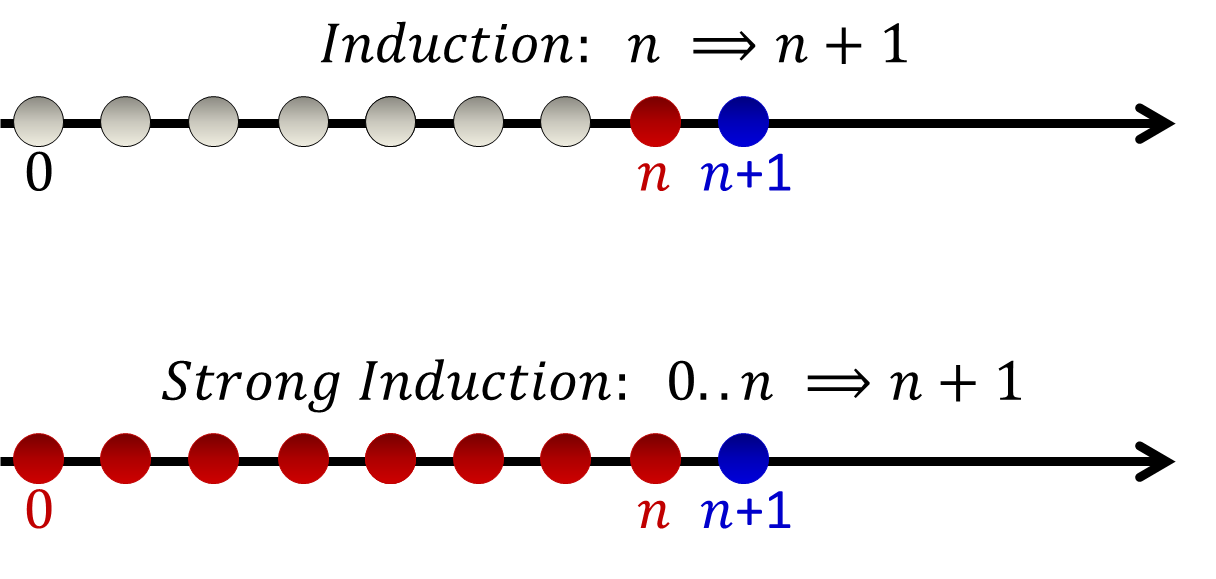
Welcome back. In our previous lessons, we have built a solid toolkit for constructing proofs, covering direct proofs, proofs by contrapositive, and most recently, proofs by contradiction. These methods are versatile, but they are not always the most natural or efficient tool for every job. We will now introduce a powerful proof technique designed specifically for statements that are indexed by the natural numbers: the principle of mathematical induction.
This lesson will guide you through the logic and application of this fundamental principle. You will learn how to formally structure an inductive proof, which involves establishing a "base case" and an "inductive step." This process is analogous to setting up a chain of dominoes and then knocking over the first one to set the entire chain in motion. We will prove several classical results using this method, and just as importantly, we will examine common pitfalls to ensure your application of this technique is always rigorous.
The Principle of Induction: From Dominoes to Axioms
Many mathematical statements are claims about all natural numbers . For example, "The sum of the first odd positive integers is ." How can we prove such a statement for an infinite number of cases without testing every single one?
The intuitive idea behind induction is that of a "domino effect." If you can prove:
- The first domino falls.
- Any domino falling causes the next one to fall.
Then you can conclude that all dominoes will fall. In mathematical terms, if we want to prove a statement for all :
- Base Case: Prove that is true.
- Inductive Step: Prove that for any , if is true, then must also be true.
The assumption "if is true" is called the inductive hypothesis.
This isn't just a handy trick; it is a rigorous theorem rooted in the fundamental properties of the natural numbers. For a learner who values a proof-heavy approach, it is essential to see why induction is a valid proof technique. The following video does an excellent job of proving the principle of induction itself. It uses the well-ordering property of the natural numbers (which states that every non-empty set of natural numbers has a least element) and proof by contradiction, connecting this lesson directly to our previous one.
Lecture 1: Sets, Set Operations and Mathematical Induction
This segment from an MIT OpenCourseWare lecture on Real Analysis formally states the principle of mathematical induction and provides a rigorous proof of its validity.
Please watch the following two segments: First, watch the introduction to the Principle of Induction, where the theorem is formally stated. Next, watch the proof of the theorem. Pay close attention to how the argument is structured as a proof by contradiction. The lecturer assumes there is a set of natural numbers for which the statement is false, and then uses the well-ordering property to find a "smallest" counterexample, leading to a logical contradiction.
The proof in the video establishes that the two-step process of induction is logically sound. You don't need to reproduce this proof every time you use induction, but understanding it solidifies why the method works.
Structuring an Inductive Proof: A First Example
Let's apply this principle to a classic problem: finding a closed-form expression for the sum of the first non-negative integers.
Proposition: For any natural number , the statement is true.
The following resource walks through this exact proof. It clearly demonstrates the two-step structure.
This document provides a concise introduction to induction and works through the proof for the sum of the first n integers.
Read the example starting from the middle of the page, where the author proves statement B. (Note: The author uses B(n) where we use P(n), and starts from the base case n=0). Focus on how the inductive hypothesis is used to transform the expression for the n+1 case.
Let's formalize the structure of that proof, as you will use this template repeatedly.
Proof. We proceed by mathematical induction.
Let be the statement .
1. Base Case: We must show that is true.
For , the left-hand side (LHS) is simply 0.
The right-hand side (RHS) is .
Since LHS = RHS, is true.
2. Inductive Step: We must show that for any integer , if is true, then is true.
Inductive Hypothesis: Assume is true for some arbitrary integer . That is, assume:
Goal: We want to prove that is true. That is, we want to show:
Now we start with the LHS of and use our inductive hypothesis.
We have successfully shown that if is true, then is true.
By the principle of mathematical induction, the statement is true for all natural numbers . □
Broadening the Application: Inequalities and Other Base Cases
Induction is not limited to summation formulas. It is widely used to prove inequalities, properties of divisibility, and results in combinatorics and geometry. Let's look at another classic example: Bernoulli's Inequality.
Lecture 1: Sets, Set Operations and Mathematical Induction
The lecturer now applies the principle of induction to prove Bernoulli's inequality. This is a great example of an inductive proof for an inequality.
Watch the segment from this example. Notice how the inductive hypothesis is used to make a substitution that preserves the "greater than or equal to" direction of the inequality. Also, note where the condition on c is critically used.
Sometimes, a statement is not true for small values of , but holds for all integers from a certain point onward. The principle of induction is easily adapted for this. Instead of using or for the base case, you simply use the first integer for which the statement is claimed to be true.
Proposition: For all integers , .
Let's check for small :
- (True)
- (False)
- (False)
- (False)
- (True)
It seems the statement holds for and then for . Let's prove the latter part.
This section explains the variation of induction where the base case starts at an integer other than 1 and provides a proof for the inequality 2^n > n^2.
Read Theorem 3.1 and then Example 3.1. The key is that the logic remains identical; only the starting point changes.
A Common Fallacy: The Flaw in the Logic
Rigorous application of induction requires that the inductive step, , holds for every integer from the base case onward. A common mistake is to have a seemingly plausible inductive step that fails for a specific value of . This can lead to absurd conclusions.
The following "proof" claims that all things in any group are the same color. Your task is to find the flaw.
This reading presents a classic fallacious proof by induction. Analyzing it is a valuable exercise for understanding the rigor required.
Read the paragraph titled "Everything in the world is of the same colour". Think carefully about the logic. Does the argument that links the "first k things" and the "last k things" work for any group of size k+1?
Did you spot the error?
The argument breaks down when we try to prove from . Let . We are trying to prove the statement for a group of things.
The proof says:
- "the first things are of the same colour" (True, this is just one thing).
- "the last things are also of the same colour" (True, this is the other thing).
- "Therefore, the things are of the same colour."
This conclusion does not follow. The "first 1" and the "last 1" are disjoint sets with no overlap. We can't conclude they are the same color. The argument about overlapping groups only works if . The inductive step fails for the very first step, , invalidating the entire proof.
Conclusion
In this lesson, we have formally introduced the principle of mathematical induction as a rigorous method for proving statements about natural numbers.
Here are the essential takeaways:
- An inductive proof consists of two parts: the base case (proving the statement for the first value, e.g., ) and the inductive step (proving that if the statement holds for an arbitrary , it must also hold for ).
- The validity of induction is guaranteed by the well-ordering property of the natural numbers.
- The base case can start at any integer , in which case the proof establishes the statement for all .
- It is critical to ensure the inductive step is valid for all values of from the base case upwards.
You have now mastered the basic form of induction. This technique is sometimes called "weak" or "standard" induction because the inductive hypothesis only assumes is true. In our next lesson, we will explore a related but even more powerful variant called strong induction, where we assume the statement holds for all values up to .