Welcome back to our study of mathematical proof. In our last lesson, you constructed your first direct proofs, learning to build a logical bridge from a hypothesis directly to a conclusion . While direct proof is a fundamental tool, some conditional statements are surprisingly difficult to prove head-on.
This lesson introduces a powerful indirect method: proof by contrapositive. You will learn how to leverage the logical equivalence between a statement and its contrapositive to construct elegant and rigorous proofs for propositions that might otherwise be cumbersome to tackle. This technique will be another essential component in your growing toolkit for navigating the landscape of pure mathematics.
The Logic of the Contrapositive
The foundation of this proof method rests on a simple principle of formal logic. A conditional statement of the form "If , then " (symbolically, ) is logically equivalent to its contrapositive, which is "If not , then not " (symbolically, ).
Logically equivalent means that the two statements always have the same truth value. If one is true, the other is true; if one is false, the other is false. We can verify this with a truth table.
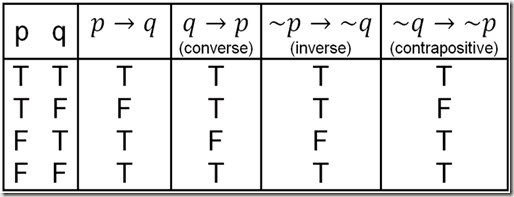
Since and are logically interchangeable, proving one is the same as proving the other. This gives us a new strategy: if proving directly is difficult, we can instead prove its contrapositive, , using a direct proof.
The Structure of a Contrapositive Proof
The procedure for a proof by contrapositive is systematic and builds directly upon the skills you developed in the last lesson. The following resource provides a concise outline of the method.
[PDF] A Guide for Making Proofs - ICR
This document outlines the standard methods for proving implications. We will focus on the second method described.
Please read the section titled Method #2. Pay close attention to the three steps involved and how they are applied in the example provided for Theorem 2.
As the text explains, the steps are:
- State the contrapositive. Clearly write down the version of the statement you intend to prove. This signals your strategy to the reader.
- Assume . This is the hypothesis of your new statement.
- Use a direct proof to show that logically follows from the assumption that is true.
- Conclude. Since you have proven the contrapositive, you can conclude that the original statement is also true.
Example 1: When Direct Proof is Awkward
Let's consider the statement: "For any integer , if is even, then is even."
Attempting a direct proof, we would assume is even. By definition, this means for some integer . Our goal is to show is even. The natural next step would be to take the square root: . This expression is not immediately helpful. It's not at all obvious that must be an even integer. This is where the direct approach becomes difficult.
Let's see how proof by contrapositive makes this problem manageable. The following video explains this motivation and then walks through the proof.
Proof by Contrapositive | Method & First Example
In this video, Dr. Trefor Bazett explains the logical basis for proof by contrapositive and applies it to the very theorem we are considering.
First, watch the brief introduction explaining the logical equivalence. Next, see why the direct proof is challenging for this specific problem. Finally, follow the demonstration of the contrapositive proof.
Let's formalize the argument from the video.
Proposition: For any integer , if is even, then is even.
Proof.
We will prove the contrapositive: "If is not even, then is not even." This is equivalent to proving: "If is odd, then is odd."
Assume is an odd integer. By the definition of an odd integer, there exists an integer such that .
Now, we square :
We want to show that is odd, so we must express it in the form for some integer . We can factor a 2 from the first two terms:
Let . Since is an integer, and integers are closed under multiplication and addition, must also be an integer.
Thus, we have shown that for some integer . By the definition of an odd integer, is odd.
Since we have proven the contrapositive, the original statement, "If is even, then is even," is true. □
Notice that the core of this proof is a direct proof of a statement you are already familiar with from our last lesson. The contrapositive method simply allowed us to transform the problem into this more convenient form.
Example 2: Proofs with "Or"
Proof by contrapositive is also extremely effective when dealing with statements involving logical disjunctions ("or"). When we negate a statement containing "or," De Morgan's laws turn it into a statement containing "and," which is often easier to work with.
The following resource from Oscar Levin's Discrete Mathematics: An Open Introduction provides an excellent series of examples. Let's focus on one.
This online textbook chapter covers various proof techniques. We will work through the section on proof by contrapositive.
First, read the brief introduction to the Proof by Contrapositive method. Then, carefully study the proof presented in Example 3.2.5, which proves the statement: "for all integers a and b, if a + b is odd, then a is odd or b is odd."
Let's break down the logic of that proof.
Proposition: For all integers and , if is odd, then is odd or is odd.
-
Original Statement ():
- : " is odd"
- : " is odd or is odd"
-
Contrapositive ():
- : "It is not the case that ( is odd or is odd))"
- By De Morgan's laws, this is equivalent to: " is not odd AND is not odd," which means " is even and is even."
- : "It is not the case that ( is odd))"
- This means " is even."
- : "It is not the case that ( is odd or is odd))"
So, the contrapositive statement is: "If is even and is even, then is even." This is much more straightforward to prove directly.
Proof.
We prove the contrapositive. Assume and are both even integers.
By definition, there exist integers and such that and .
Then their sum is:
Let . Since and are integers, their sum is also an integer.
Thus, for some integer , which means is even.
Since the contrapositive is true, the original statement is also true. □
A Note on Writing Good Proofs
As you build your repertoire of proof techniques, it's equally important to focus on clarity and structure in your writing. A proof must not only be correct, but also convincing and easy for a reader to follow. Given your goal of mastering proof-heavy mathematics, cultivating good writing habits now is essential.
[PDF] A Guide for Making Proofs - ICR
This resource concludes with excellent advice on writing clear and effective proofs.
Please read the section How to Write Good Proofs. These tips provide a valuable checklist for structuring your arguments. The point about avoiding bullying words like "clearly" and "obviously" is particularly important for maintaining rigor.
Conclusion
In this lesson, you have added proof by contrapositive to your analytical toolkit. This method provides an alternative path when a direct proof is not forthcoming.
Here are the key takeaways:
- A proof by contrapositive works by proving the logically equivalent statement .
- The structure involves stating the contrapositive, then using a direct proof to show that the assumption necessarily leads to the conclusion .
- This method is particularly powerful when the negation of the conclusion () provides a more concrete or algebraically simpler starting point than the original hypothesis .
You are now equipped with two fundamental methods for proving conditional statements. In our next lesson, we will explore a third, and perhaps most intriguing, method of indirect proof: proof by contradiction. While related to the contrapositive, it operates on a slightly different and very powerful principle.