In our previous lessons on diversionary tactics, we've examined attacks that attempt to discredit you by focusing on your identity, affiliations, or supposed motives. Today, we address the master-tactic of conversational derailment: the Red Herring. While an Appeal to Motive is a specific diversion that questions why you're arguing, the Red Herring is a broader strategy of changing the subject entirely.
Your goal in this lesson is to deconstruct and counter these arguments, which deliberately steer the conversation away from the core issue of your personal autonomy. Mastering this will allow you to hold your ground and prevent your opponent from escaping the logical consequences of their weak position by simply creating a distraction.
The Art of the Diversion
The term "red herring" is believed to have originated from the practice of using the pungent scent of a smoked and cured fish to train or distract hunting dogs. In logic and debate, it functions in precisely the same way: an irrelevant and often emotionally charged topic is introduced to throw everyone off the scent of the original argument.

A red herring is not just a tangential thought; it is a calculated maneuver. It is typically deployed when an arguer feels they cannot win the debate on its merits. By shifting the focus to something else, they hope you will either get so caught up in the new topic that you forget the original point, or appear unreasonable for refusing to engage with their "important" new subject.
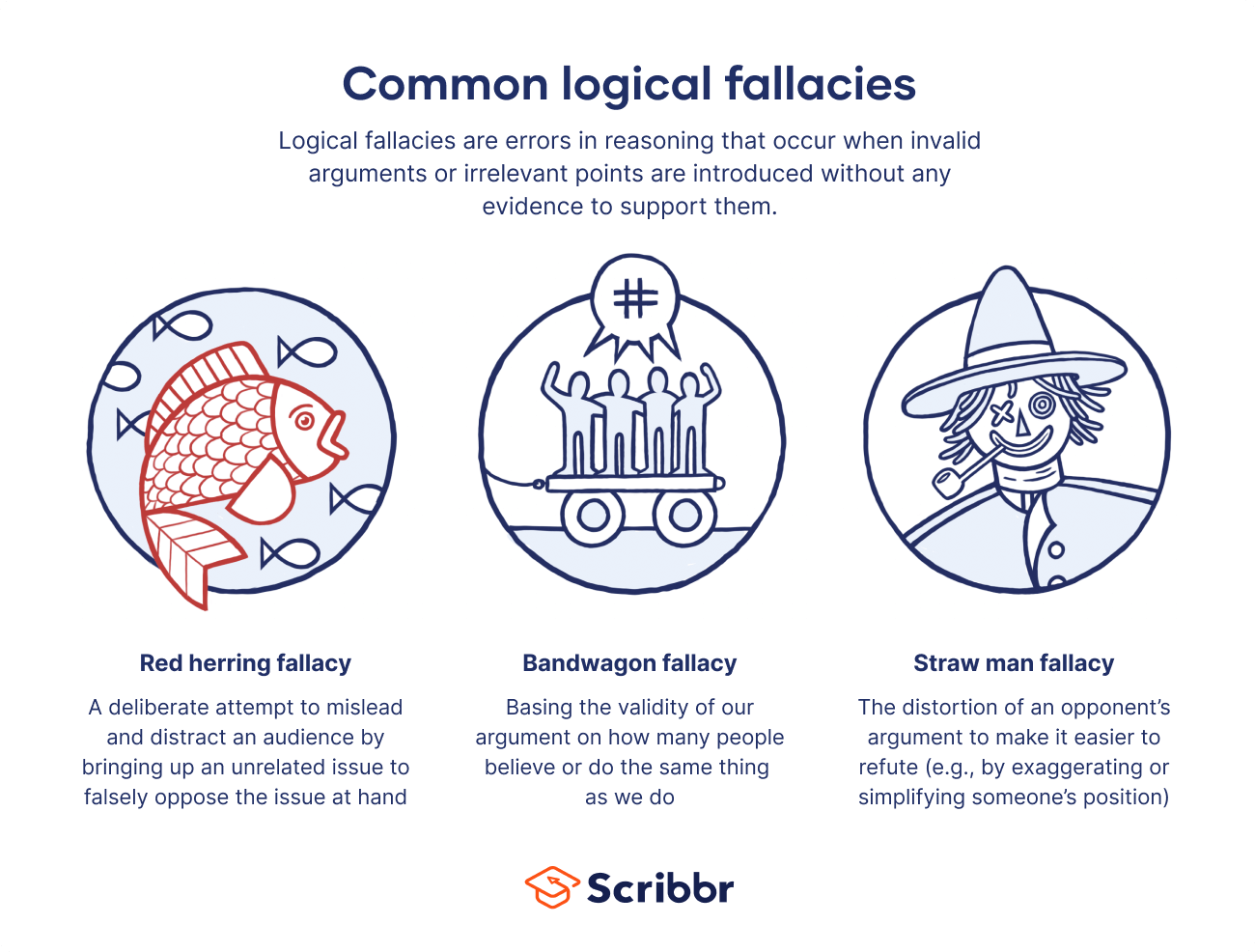
Your primary task when confronted with a red herring is to recognize it for what it is—a relevance fallacy—and refuse to take the bait.
Application 1: Style, Autonomy, and Social Decay
When a critic cannot formulate a coherent objection to your personal style, they may try to bury your argument under the weight of a much larger, unrelated social issue.
Scenario: You are in a discussion about fashion, and you state that you chose your low-cut top because you appreciate its aesthetic and feel confident in it.
- Fallacious Argument: "You can talk about your personal feelings, but what about the effect this is having on our youth? We see a breakdown of standards everywhere. When people dress so provocatively in public, it contributes to the erosion of decency in our culture."
- Deconstruction: The original subject was your personal, autonomous choice of clothing and your reasons for it. The arguer has abruptly shifted the topic to "the youth," "breakdown of standards," and "erosion of decency." This is a classic Red Herring. The argument is no longer about you and your top; it's about the moral state of an entire culture. This diversion is designed to put you in the impossible position of defending modern society instead of your simple, valid, personal choice. They have replaced a specific, defensible argument with a vague, emotionally charged societal panic.
- Witty, Sharp Rebuttal: "That's a very broad and serious topic. For a moment I thought we were discussing my blouse. If you're conceding you have no specific objection to my outfit, I'm happy to schedule a separate conversation about cultural trends. Which is it?"
- Why it works: This response does two things perfectly. First, it identifies and dismisses the diversion by contrasting its grandiosity ("broad and serious topic") with the mundane reality of the original subject ("my blouse"). Second, it frames the opponent's diversion as a concession of defeat on the original point. This forces them to either admit they were changing the subject or return to the original argument, which they were likely trying to flee.
Application 2: Relationships and Societal Woes
The Red Herring is a common tool for those who wish to condemn non-traditional relationships without engaging with their actual mechanics or ethics. They divert to a tangentially related social problem to create a false equivalence.
Scenario: You are explaining that your open "vee" relationship is founded on principles of radical honesty, consent, and deep communication between all parties.
- Fallacious Argument: "That all sounds very intellectual, but how can you justify such a lifestyle when the institution of marriage is already so fragile? Divorce rates are high enough without people actively undermining the traditional family unit."
- Deconstruction: Your argument was about the ethical framework of your relationship. The critic has introduced a red herring: the general "fragility of marriage" and high divorce rates. This is an irrelevant diversion. The high rate of divorce in monogamous marriages has no logical bearing on the stability or morality of your non-monogamous one. The arguer is attempting to associate your choice with a negative social trend (instability) to avoid addressing the substance of your claim (that your relationship is stable and ethical).
- Witty, Sharp Rebuttal: "I agree that the high rate of failure within the traditional model of marriage is a significant issue worth discussing. But that seems to be a problem with the traditional model, not mine. Are you suggesting that my relationship, which is built on a foundation you just heard me describe, is somehow responsible for the struggles of completely different ones? Or shall we return to any specific concerns you have about my own?"
- Why it works: This is a sophisticated maneuver. It agrees with the premise of the red herring ("the high rate of failure...is a significant issue") but then turns it back on the arguer by pointing out the problem lies with the very tradition they're implicitly defending. This re-frames their diversion not just as irrelevant, but as potentially self-defeating. It then sharply pivots back to the original topic, leaving them with no escape route.
Key Takeaways
The Red Herring is a tactic of avoidance. Countering it is not about winning the new, irrelevant argument; it's about refusing to play.
- Identify the Diversion: The core of the Red Herring is the introduction of an irrelevant topic to shift the conversation. Ask yourself: "Is this new point logically related to the original claim?"
- Refuse the Bait: Do not get drawn into debating the red herring. The moment you start arguing about "cultural decay" or "divorce rates," the tactic has succeeded.
- Pivot and Re-center: Explicitly point out the diversion and firmly bring the focus back to the original argument. You can do this by questioning the relevance of the new topic or by framing the diversion as a concession.
In our next lesson, we will explore Whataboutism, a particularly prevalent and potent type of red herring. It seeks to deflect criticism by accusing the original speaker of a similar or worse offense, effectively arguing that hypocrisy invalidates a legitimate point.