In our last lesson, we unpacked the Ludic Fallacy—the error of applying clean, game-like models to the messy, unpredictable nature of real life. We established that the most effective rebuttal is to attack the flawed model itself, rather than arguing within its false constraints. Today, we'll examine a tactic that often goes hand-in-hand with this error: Fake Precision.
This fallacy, also known as Overprecision, is the practice of using overly specific numbers to give a weak or fabricated argument a veneer of scientific authority. As a statistician, you are acutely aware that precision is not the same as accuracy and that genuine scientific claims are characterized by a careful statement of uncertainty, such as margins of error or confidence intervals. Fake precision does the opposite: it uses the language of mathematics to bypass rigor and create a false impression of truth. Our goal is to deconstruct this deceptive tactic and formulate sharp responses that expose its scientific emptiness.
The Allure of the Decimal Point
The fallacy of Fake Precision, or Overprecision, occurs when an argument treats information as more precise than it actually is. The numbers themselves might be technically correct in a narrow sense (like a currency conversion), or they might be completely fabricated, but in either case, their specificity is used to imply a level of scientific certainty that is entirely unjustified.
Let's begin by looking at a formal definition and some common examples.
Logical Fallacy: Overprecision
This article from The Fallacy Files clearly defines the fallacy and explains why it's so pervasive, particularly in media and pseudoscience.
First, read the brief "Exposition" section for the core definition. Then, continue to the "Exposure" section and read the two bullet points, focusing on the explanation of how polling data is misused and how pseudoscience leverages this tactic.
The key insight from the reading is that fake precision preys on a common cognitive bias: people are often intimidated by mathematics and tend to equate numerical specificity with scientific validity. When someone asserts that "X increases risk by 38.2%," it sounds far more credible than saying "X might be a bit riskier." This tactic is a hallmark of pseudoscience, not genuine inquiry.
A perfect illustration of this is the attempt by Flat-Earthers to co-opt the language of science.

This is not an argument to be engaged with on the numbers; it's an abuse of numbers that must be called out as such.
Precision, Correlation, and Confusion
Fake precision becomes particularly misleading when combined with statistical measures. As you know from your work, a correlation coefficient is a powerful tool, but it only describes the relationship between variables within a given dataset; it says nothing about whether that relationship is meaningful or causal.
Consider the following chart:
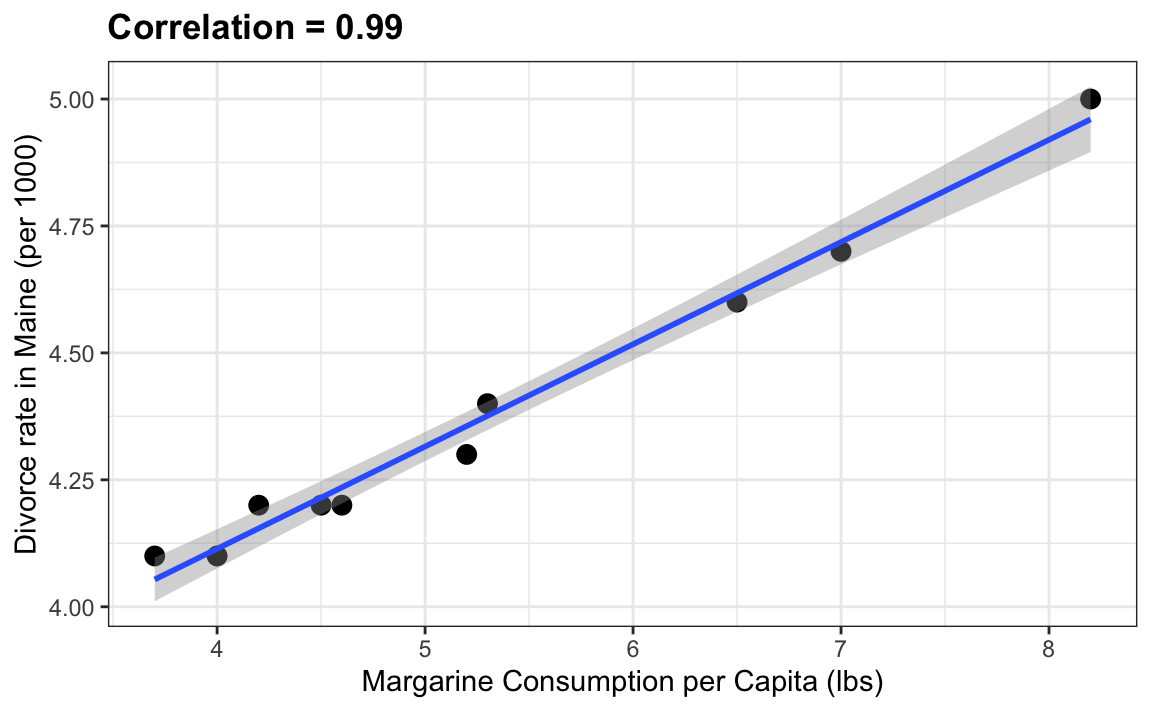
The number "0.99" is precise and statistically derived. However, using it to suggest that eating less margarine could save marriages is an absurd leap. The precision of the correlation lends false authority to a meaningless causal inference. This demonstrates how a precise-sounding number can be used to bolster other fallacies, such as Post Hoc or False Cause. The correct response is not to question the calculation of r, but to dismiss the implied causal link as unfounded.
Application 1: Judging Fashion Choices
Scenario: An acquaintance looks at the low-cut top you're wearing and says with an air of authority, "I actually read a study on this. It found that women who display 15.7% more skin than the regional baseline receive, on average, 38.2% more unwanted comments. You're statistically putting yourself in a vulnerable position."
-
Fallacy Deconstruction:
- Fabricated Specificity: The numbers are comically precise. Real sociological research on such a topic would be fraught with methodological challenges, making such exact figures virtually impossible to produce and verify. How is "skin display" measured? What defines the "regional baseline"? The precision is a giant red flag.
- False Authority: The speaker is weaponizing made-up statistics to sound knowledgeable and to transform a subjective judgment into an objective, data-driven "fact." The phrase "I read a study" combined with the decimal points is a direct appeal to a non-existent scientific authority.
- Misplaced Agency: The argument subtly shifts the blame for potential harassment onto you by framing your choice as a quantifiable "risk." This is a numerical smokescreen for victim-blaming.
-
Witty, Sharp Rebuttal:
"That's a fascinating example of fake precision. Using ridiculously specific numbers like '15.7%' to make a personal opinion sound like a scientific finding. Before I adjust my 'skin display percentage,' perhaps you could send me the link to that peer-reviewed study? I'd be very interested in their methodology."- Why it works: It names the fallacy and immediately calls their bluff in a way that highlights the absurdity of their claim. By using academic terms like "peer-reviewed" and "methodology," you turn the tables, using the standards of real science to expose their pseudoscience. It shuts down the argument by demanding evidence they cannot possibly provide.
Application 2: Judging an Open Relationship Dynamic
Scenario: Someone learns about your wife's "open vee" relationship and comments, "Be careful. A major sociological survey of 5,000 couples proved that for every additional long-term partner, the probability of a primary relationship failure increases by exactly 22.8% within 18 months. Given your wife's other partner, your marriage has a calculated failure probability of 73.4%."
-
Fallacy Deconstruction:
- Implausible Calculation: This is a prime example of what the resource called creating a "bogus impression of science." Complex human relationships cannot be plugged into a simple formula. The precision of "22.8%" and "73.4%" is pure invention, designed to sound definitive and shut down debate.
- Vague and Loaded Terms: The argument hinges on undefined concepts like "long-term partner" and "primary relationship failure." It crudely lumps ethical non-monogamy, which is based on consent and communication, in with situations that may not be comparable at all.
- Ludic Fallacy Crossover: This is where Fake Precision supports the Ludic Fallacy. The speaker has created a simplistic game-like model of relationships ("add a partner, increase failure rate") and then used fake numbers to make the model seem real.
-
Witty, Sharp Rebuttal:
"You're using fake precision to make a moral judgment sound like a math problem. Real relationships, especially ones built on open communication, can't be assessed with a 'failure probability calculator.' That kind of spurious accuracy is a classic sign of a weak argument. Our success is determined by our agreements and our trust, not your fabricated statistics."- Why it works: It names the fallacy and uses the term "spurious accuracy," which resonates with a statistician's understanding of data quality. It dismisses their entire analytical frame ("failure probability calculator") as absurd and reframes the issue around the actual components of a healthy relationship: agreements and trust.
Conclusion: Key Takeaways
Fake Precision is a rhetorical trick that abuses the public's trust in numbers. It seeks to end a conversation by presenting a conclusion as a mathematical certainty. Your expertise as a statistician makes you uniquely equipped to dismantle this tactic by exposing its lack of rigor.
- The Flaw: Fake Precision involves using overly specific numbers to lend false authority to an argument. It implies a level of knowledge and accuracy that is completely unjustified.
- The Red Flag: Be skeptical of any argument about complex human behavior that uses numbers with high decimal precision, especially when the source is vague ("a study showed...").
- The Counter-Strategies:
- Name the Fallacy: Identify it as "Fake Precision" or "spurious accuracy."
- Question the Methodology: Ask how such a precise number could have been measured. Demand the source.
- Reframe the Conversation: Shift the focus from their bogus numbers back to the complex, unquantifiable realities of the situation—agency, intent, communication, and context.
In our previous lesson, we saw how the Ludic Fallacy wrongly applies a simple model to reality. Today, we've seen how Fake Precision tries to make that flawed model look credible. In our next lesson, we will explore the closely related confusion between Probability vs. Plausibility. A story might sound plausible, but that doesn't make it statistically probable. We will delve into how to distinguish a good story from a likely outcome.