In our last lesson, we examined Fake Precision, the tactic of using hyper-specific numbers to give an argument a false air of scientific authority. We saw how this technique abuses the language of mathematics to bypass genuine rigor. Today, we'll explore a related cognitive error: the confusion between probability and plausibility. This fallacy occurs when someone presents a compelling, coherent story and treats it as a probable event, even when statistical reality suggests otherwise.
As a statistician, you are deeply familiar with the formal rules of probability. This lesson will build on that foundation, exploring the psychological traps that lead people—even intelligent ones—to substitute a "good story" for a rigorous assessment of likelihood. We will deconstruct this tendency, often called the Narrative Fallacy, and equip you with precise responses to shut down arguments that rely on it.
The Allure of a Good Story: Plausibility vs. Probability
At its heart, this fallacy exploits a fundamental feature of human cognition. Our brains are wired to find patterns and create causal stories to make sense of a complex world. A plausible narrative feels right because it's coherent, resonant, and easy to understand. A probable event, however, is a matter of mathematical and statistical reality, which is often counterintuitive and "boring."
The error lies in equating the feeling of plausibility with the fact of probability.
Let's begin by exploring this concept, known as the Narrative Fallacy.
Avoiding Falling Victim to The Narrative Fallacy - Farnam Street
This article from Farnam Street provides an excellent overview of how our minds create cause-and-effect stories that can mislead us. It lays the groundwork for understanding why we're so susceptible to this fallacy.
Start by reading the introduction, from the beginning up to the heading "The Narrative Fallacy." Pay attention to the examples of Steve Jobs and Nassim Taleb, which illustrate how easily we attribute causes in hindsight. Then, read the section under the heading "The Narrative Fallacy," which explains the deep biological basis for this mental shortcut and why it often fails us.
The article highlights a key point: we build stories from available information, but we often fail to consider the vast amount of information we don't see. How many others had the same "causal" background as a successful athlete but didn't succeed? This is a question of base rates, a concept you are very familiar with from statistics. The narrative fallacy encourages us to ignore base rates in favor of a compelling, individualized story.
This relationship can be visualized quite effectively.
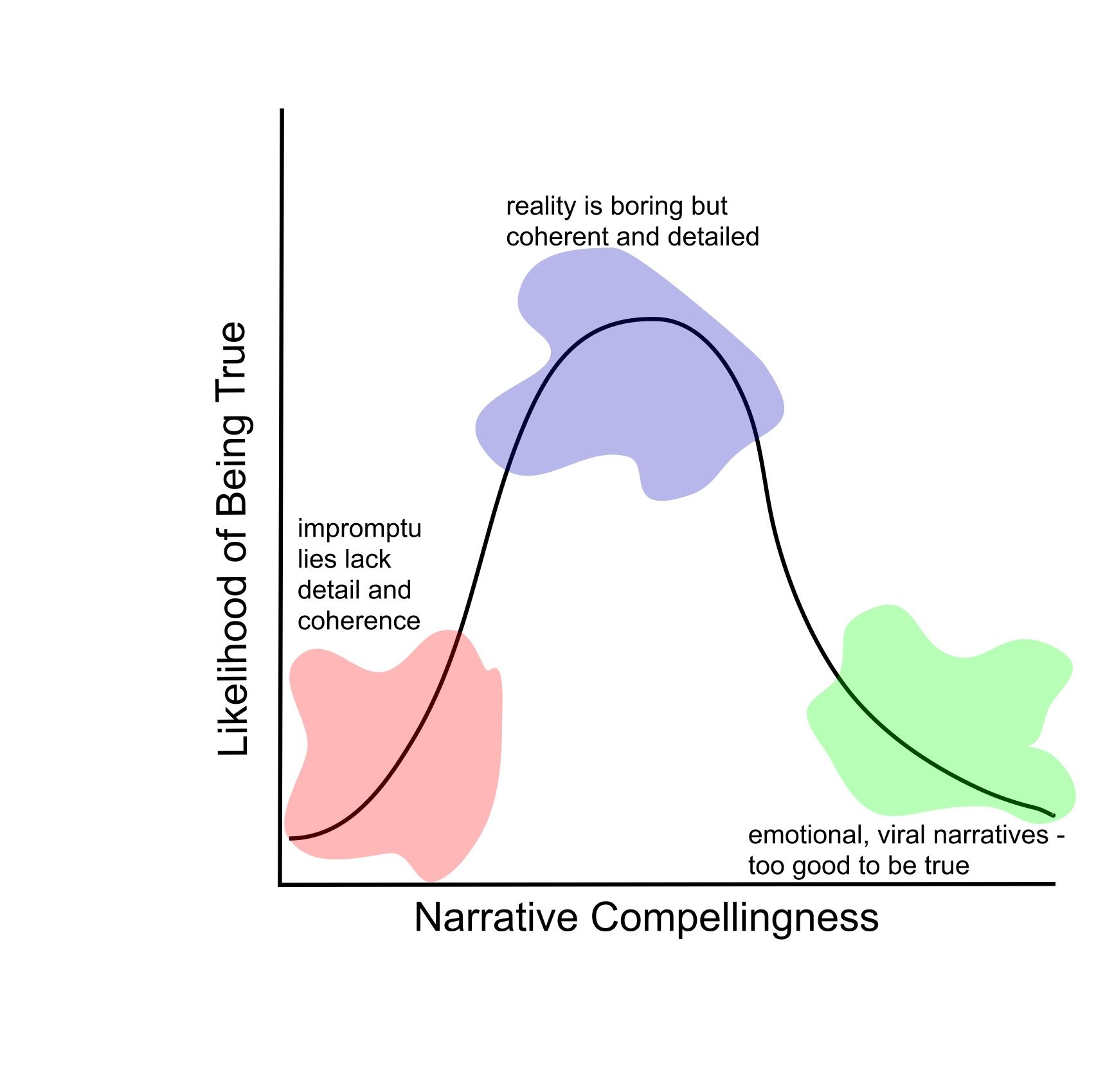
A useful way to frame this is as a hierarchy. For something to be probable, it must first be plausible, and for it to be plausible, it must be possible. The fallacy occurs when we stop climbing the ladder at "plausible" and assume we've reached "probable."

The Representativeness Heuristic and the Conjunction Fallacy
This confusion between plausibility and probability is often driven by a cognitive shortcut called the representativeness heuristic. We estimate the likelihood of something by comparing it to a stereotype or prototype we have in mind. A detailed, vivid story that fits our preconceptions feels more "representative" of reality, and thus more probable, even when it isn't.
Let's examine how this works.
Representativeness Heuristic | Example & Definition
This article from Scribbr clearly defines the representativeness heuristic and connects it directly to the conjunction fallacy, which is a perfect statistical illustration of the error.
Read the introduction for the core definition (up to the table of contents). Then, read the section "What is the representativeness heuristic?" and the short point under "Why does the representativeness heuristic occur?" that discusses ignoring base rate information. Finally, focus on the section "Representativeness heuristic example" and the related FAQ, "What is the conjunction fallacy?" This explains how adding details can make a scenario seem more plausible while making it mathematically less probable.
The classic "Linda problem" mentioned in the Farnam Street article and the "Tom" example from Scribbr are perfect illustrations of the conjunction fallacy. As a statistician, you know that the probability of two events occurring together (A and B) can never be greater than the probability of either event occurring alone (A).
Yet, when a detailed scenario (Linda is a bank teller and a feminist) seems more representative of the description, people judge it as more probable than the simpler, more general scenario (Linda is a bank teller). They are substituting plausibility for probability.
Formalizing Plausible Reasoning
The distinction between strict deductive logic and the "plausible reasoning" we use every day is crucial. E.T. Jaynes, in his foundational work Probability Theory: The Logic of Science, formalizes probability theory as an extension of logic to handle uncertainty. A brief look at his starting point will resonate with your background in probability theory.
Probability Theory: The Logic of Science Chapter 1, "Plausible reasoning"
This video discusses the first chapter of Jaynes's book. It offers a formal yet intuitive way to think about the difference between deductive proof and plausible inference.
Watch the segment from the video that contrasts deductive logic with plausible inference. Notice the key difference: Deduction: If P implies Q, and P is true, then Q is true. Plausible Inference: If P implies Q, and Q is true, then P becomes more plausible. This is the logic of science and detective work. Evidence doesn't prove a hypothesis in one step; it increases its plausibility. The fallacy we're studying occurs when someone treats a piece of evidence as definitive proof because it fits a plausible story. Optionally, you might find the discussion on the Mind Projection Fallacy interesting (view segment). This is the error of confusing a state of knowledge (an epistemological statement like "this is plausible") with a property of reality (an ontological statement like "this is true").
Application 1: Judging Fashion Choices
Scenario: An acquaintance sees you in a low-cut top and says, "You know, when a guy sees a woman dressed like that, it's just a plausible chain of events. He assumes you're advertising, that you're looking for a certain kind of attention, and that you're probably an easy target. It's not a judgment, it's just the most likely story of what's going through his head."
-
Fallacy Deconstruction:
- Narrative Fallacy: The speaker has created a linear, causal story:
Outfit -> Assumed Intent -> Man's Reaction. This narrative is plausible only if one accepts a set of stereotypical premises about how men think and why women dress. - Representativeness Heuristic: Your outfit is being matched to a "prototype" of a promiscuous woman. The speaker is judging the probability of your intent based on how well you fit this stereotype, not on any actual evidence.
- Ignoring Base Rates: The argument ignores the actual base rate probabilities: the vast majority of women who wear such outfits are doing so for reasons of personal style, confidence, or comfort, not to solicit harassment. It also likely inflates the probability of a man reacting in this predatory way. The "plausible story" is treated as the only story.
- Narrative Fallacy: The speaker has created a linear, causal story:
-
Witty, Sharp Rebuttal:
"You've confused a plausible story with a probable one. You've picked a narrative that fits your biases and presented it as the 'most likely' outcome. Statistically speaking, the most probable event is that I got dressed for myself. Your story is a fiction, and I'm not a character in it."- Why it works: It directly names the core error ("confused a plausible story with a probable one"). By using the language of statistics ("statistically speaking," "probable event"), you reclaim the intellectual high ground. The final sentence, "I'm not a character in it," powerfully reframes their narrative construction as an imposition on your reality.
Application 2: Judging an Open Relationship Dynamic
Scenario: A friend is discussing your wife's "open vee" relationship. They say, "I'm just worried because it's so easy to see how this ends. She develops feelings for this other person—that's only natural—and that emotional connection inevitably deepens. Soon, she'll prefer his company, your bond will weaken, and the relationship will fall apart. It's a sad but very plausible story."
-
Fallacy Deconstruction:
- Narrative Fallacy: This is a textbook narrative fallacy. The story
New Partner -> Deepening Feelings -> Weakening Primary Bond -> Breakupis a stock plotline from a monogamous perspective. It’s coherent and compelling if you assume a zero-sum game of affection. - Conjunction Fallacy (Implicit): The person is arguing that the specific, detailed scenario (a happy, consensual open relationship and it causing an inevitable breakup) is more likely than the general one (a happy, consensual open relationship). The added details make the story more vivid and representative of their fears, but not more probable.
- Ignoring Context: The plausible narrative completely ignores the actual principles of ethical non-monogamy, such as compersion, explicit communication, and the understanding that love and connection are not finite resources. The story's plausibility is derived from a foreign context.
- Narrative Fallacy: This is a textbook narrative fallacy. The story
-
Witty, Sharp Rebuttal:
"That's a plausible script for a movie, but it's not a probability assessment of my marriage. You're falling for the narrative fallacy—mistaking a coherent story based on monogamous stereotypes for a likely outcome in a relationship that operates on different principles. Our success is built on trust and communication, not on conforming to your preferred plotline."- Why it works: It identifies their argument as a "script" or "plotline," diminishing its connection to reality. It explicitly names the "narrative fallacy" and pinpoints the flawed premise ("monogamous stereotypes"). The rebuttal concludes by contrasting their fictional narrative with the real-world principles of your relationship.
Conclusion: Key Takeaways
Confusing plausibility with probability is a subtle but powerful fallacy. It allows people to package their biases and assumptions into a compelling story and present it as an objective assessment of risk or likelihood. Your strength as a statistician gives you a unique advantage in seeing past the narrative to the numbers—or lack thereof.
- The Flaw: A plausible story is not a probable one. Plausibility is about narrative coherence and how well a story fits our expectations; probability is a mathematical measure of likelihood.
- The Cognitive Drivers: The Narrative Fallacy and the Representativeness Heuristic cause us to favor vivid, detailed stories that match our stereotypes, even when they violate the laws of probability (as in the Conjunction Fallacy).
- The Counter-Strategies:
- Name the error: Explicitly state that they are "confusing a plausible story with a probable outcome" or "falling for the narrative fallacy."
- Challenge the narrative: Call their story what it is—a script, a fiction, a plotline.
- Re-center reality: Shift the conversation back to the actual, less-dramatic facts and base rates, contrasting them with the fictional narrative.
We have now concluded our module on statistical and probabilistic manipulation. You've learned to counter fallacies ranging from misinterpreting raw numbers to constructing misleading narratives. In our next module, we will shift our focus to a different class of fallacies: those that seek to win an argument by attacking the person rather than their logic. We will begin with one of the most common and recognizable fallacies of all: the Ad Hominem attack.