Welcome to the final lesson of our first module on Group 1 elements. In our previous lessons, we explored how atomic properties like radius and electron shielding influence ionisation energy, and how this in turn dictates the trend of increasing reactivity as we descend the group.
Today, we will examine another key physical property trend that you need to know for your exam. Our learning outcome is to state the trend in melting points down the group (decreasing) and relate it to weakening metallic bonding. We will explore the nature of the forces holding these metals together and see how atomic size, a now-familiar concept, plays the decisive role.
The Nature of Metallic Bonding
Before we can discuss melting points, we must first understand what holds a solid piece of metal together. Unlike ionic or covalent bonds, metals are held together by metallic bonding.
In a metallic structure, the outer-shell electrons are not tied to any single atom. Instead, they become delocalised, forming a mobile "sea" of electrons that surrounds a fixed lattice of positive metal ions. The substance is held together by the strong electrostatic attraction between these positive ions and the negative sea of electrons.
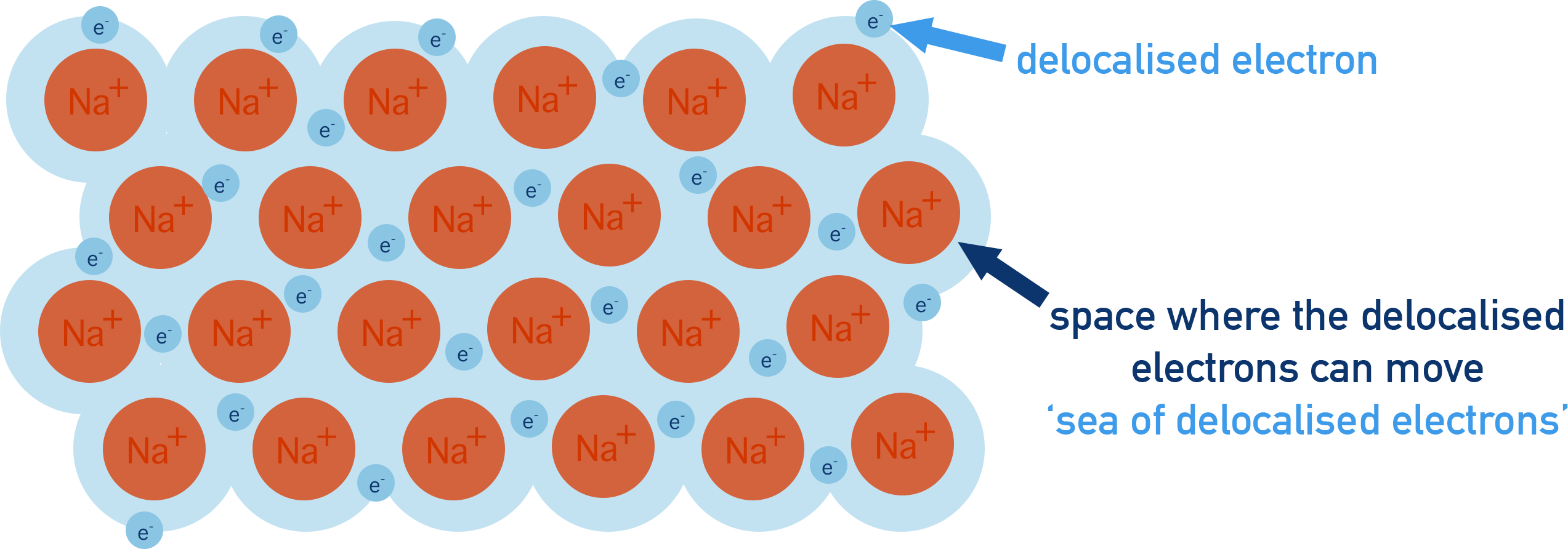
Melting a substance means providing enough energy—usually in the form of heat—to overcome the forces holding its particles together, allowing them to move past one another. For a metal, this means overcoming the electrostatic attraction between the positive ions and the delocalised electrons. The stronger this attraction, the more energy is required, and the higher the melting point.
The Melting Point Trend Explained
Now, let's apply this model to the Group 1 elements. The key trend is that melting points decrease as you go down Group 1. So, lithium has the highest melting point, and caesium has the lowest.
Why is this? A fantastic and concise explanation is provided in the video below. It clearly illustrates how the size of the metal ions affects the strength of the metallic bond.
Melting Point Trend for Group 1 (Alkali Metals, Cs, Rb, K, Na, Li)
This short video from the channel chemistNATE explains the melting point trend for Group 1 by focusing on the relationship between cation size and the strength of the electrostatic attraction in the metallic bond.
Please watch the entire video from start to finish. Pay close attention to the analogy of the electron "glue" and why it's more effective at holding smaller ions together.
As the video explains, the logic is as follows:
-
Constant Factors: As we go down Group 1, two things remain constant for metallic bonding:
- Each atom contributes one delocalised electron to the 'sea'.
- Each atom forms an ion with a +1 charge.
-
The Variable: The one thing that changes significantly is the size of the ion. As we established in previous lessons, the ionic radius increases down the group because each element has an additional electron shell.
-
The Consequence: The electrostatic attraction between the positive ions and the negative electron sea gets weaker as the distance between them increases. Because the ions are larger as you go down the group, the distance between their positive nucleus and the delocalised electrons is greater. This results in a weaker overall metallic bond.
-
The Result: Since the bonds are weaker, less energy is needed to overcome them. Therefore, the melting point decreases.
Reading for Consolidation
To solidify this concept and see the actual data, the following text provides a perfect, exam-focused summary.
How does the melting point of alkali metals change down the group? | TutorChase
This article from TutorChase clearly states the trend, explains the reasoning based on metallic bonding and ion size, and provides the melting point values for the elements.
Please read the entire article. Note the specific melting point data in the second half, as this provides concrete evidence for the trend.
A More Advanced Term: Charge Density
A powerful concept to use in an exam answer is charge density. This is the charge of an ion divided by its volume.
- A small ion with a +1 charge (like ) concentrates its charge in a small volume, giving it a high charge density.
- A large ion with the same +1 charge (like ) spreads that charge over a large volume, giving it a low charge density.
Ions with a higher charge density exert a stronger electrostatic pull on the delocalised electrons. This leads to stronger metallic bonding.
The alkali metals - IB Colourful Solutions in Chemistry
This resource from IB Chem offers a very sophisticated and concise explanation using the concept of charge density.
First, read the introductory section under the heading The alkali metals - metallic bonding to see how charge density is defined and used. Then, look at the "Summary of group 1" table and find the row for Melting point. The 'Reason' column provides a perfect, high-level summary for your notes.
Using the term "charge density" shows a deeper understanding of the electrostatic principles at play.

Conclusion
This lesson completes our survey of the core trends in Group 1. Let's recap what we've learned.
- Key Takeaway: The melting points of the alkali metals decrease down the group.
- The Reason: This is due to the weakening of the metallic bond. As you descend the group, the ionic radius increases. Although the charge (+1) and number of delocalised electrons (1 per atom) are constant, the larger ions have a lower charge density. This results in a weaker electrostatic attraction between the positive ionic lattice and the negative 'sea' of electrons, meaning less energy is required to melt the solid.
You have now covered the essential trends in atomic properties, reactivity, and physical properties for Group 1. You are well-prepared to explain why these trends occur.
In our next module, "Essential Reactions and Identification," we will shift our focus to the specific chemical reactions of the alkali metals, starting with their vigorous reactions with water.