In our previous lesson, we established that Group 1 elements all have a single valence electron which they readily lose to form a stable +1 ion. Today, we'll explore the energy involved in this process. We will define first ionisation energy and explain the clear trend it follows as you move down the group.
Your learning outcome for this lesson is to explain the trend in first ionisation energy down Group 1 using the concepts of atomic radius and electron shielding. By the end of this session, you'll be able to articulate precisely why it becomes easier to remove that outer electron from an alkali metal as the atom gets bigger.
What is First Ionisation Energy?
The concept of ionisation energy quantifies exactly how much energy is needed to remove an electron from an atom. For A-Level Chemistry, a precise definition is essential.
First ionisation energy is the energy required to remove one mole of the most loosely held electrons from one mole of gaseous atoms to produce one mole of gaseous ions, each with a charge of +1.
This can be represented by the general equation:
Notice the (g) state symbols—they are crucial. Ionisation energies are always measured in the gaseous state to eliminate the influence of intermolecular forces that exist in liquids and solids.
For a clear and formal definition, which is often required in exams, the Chemguide website is an excellent resource.
This page provides the standard A-Level definition of first ionisation energy and clarifies the conventions used in the equation.
Read the section Defining first ionisation energy. Pay close attention to the wording, especially "one mole" and "gaseous atoms". Also, note the importance of the state symbols in the section Things to notice.
The Trend in First Ionisation Energy Down Group 1
Now that we have a definition, let's look at the trend for the alkali metals. The following graph clearly shows what happens to the first ionisation energy as we move down Group 1 (the yellow line) and for comparison, Group 2 (the pink line).
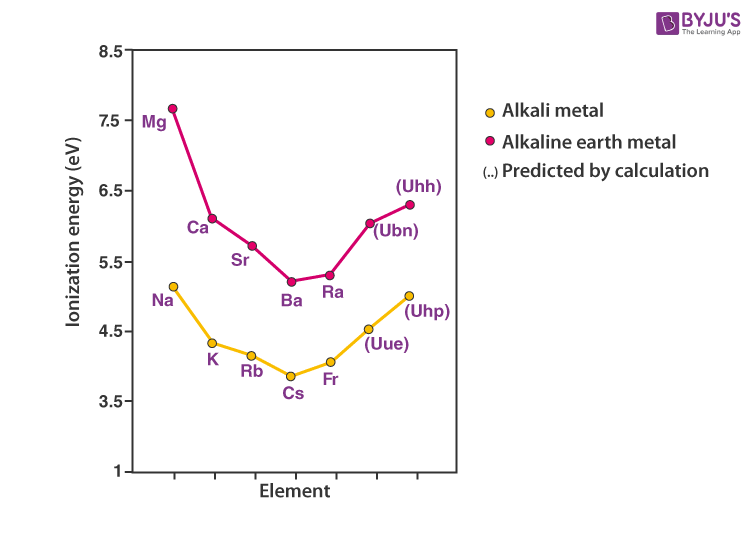
As you can see, the first ionisation energy decreases as you go down Group 1. This means it takes less energy to remove the outer electron from potassium than from sodium, and even less for caesium. This observation is fundamental to understanding the chemistry of the group.
Explaining the Trend: The "Why"
To explain this trend, we need to consider three factors that influence the attraction between the positive nucleus and the negative outer electron:
- Nuclear Charge: The number of protons in the nucleus.
- Atomic Radius: The distance of the outer electron from the nucleus.
- Electron Shielding: The repulsion from inner-shell electrons that "shields" the outer electron from the full pull of the nucleus.
The following video provides an excellent introduction to these factors and how they apply to the Group 1 trend.
Ionization Energy - Basic Introduction
This video from The Organic Chemistry Tutor explains the factors affecting ionisation energy and then applies them directly to the alkali metals.
First, watch the segment that explains the three key factors: the reasons. Next, watch the specific explanation for the trend down Group 1, using Lithium and Sodium as examples: lithium, sodium, and potassium. The Bohr model diagrams are particularly helpful for visualizing the concepts of distance and shielding.
As the video explains, as you go down Group 1:
- Nuclear Charge increases. (e.g., Li has 3 protons, Na has 11, K has 19). An increased nuclear charge should increase the attraction for the outer electron, making ionisation energy higher.
- Atomic Radius increases. Each element down the group has one more electron shell than the one above it. This pushes the outer electron further from the nucleus. Since electrostatic attraction decreases with distance, this effect decreases the ionisation energy.
- Electron Shielding increases. With more electron shells, there are more inner electrons to shield the outer electron from the nucleus's pull. This significantly reduces the effective nuclear charge felt by the valence electron, which decreases the ionisation energy.
The crucial point is that the combined effects of increasing atomic radius and increasing electron shielding outweigh the effect of the increasing nuclear charge. The outer electron is progressively further away and more effectively shielded, so it is held less tightly and becomes easier to remove.
For a comprehensive written explanation that ties all these points together, please read the following sections from Chemguide. This is the level of detail you should aim for in an exam answer.
This resource explains the factors influencing ionisation energy and then applies them to the trend down a group, using Group 1 as the main example.
First, read the section Factors affecting the size for a detailed breakdown of nuclear charge, distance, and shielding. Then, read the section Trends down a group. This part perfectly synthesizes the factors to explain why sodium's ionisation energy is lower than lithium's, which is the model explanation for the entire group.
Conclusion
Let's consolidate what we've learned.
- First Ionisation Energy is the energy required to remove one mole of electrons from one mole of gaseous atoms.
- The trend for Group 1 is that the first ionisation energy decreases as you descend the group.
- This decrease is explained by two main factors that outweigh the increase in nuclear charge:
- Increasing Atomic Radius: The outer electron is in a higher energy level, further from the nucleus, weakening its attraction.
- Increasing Electron Shielding: There are more inner electron shells, which shield the outer electron from the full attractive force of the positive nucleus.
This trend in ionisation energy has a direct and important consequence: it determines the chemical reactivity of the elements. In our next lesson, we will connect the decreasing ionisation energy to the increasing reactivity of the alkali metals as you go down the group.