Welcome back. The previous lesson used repeated reports to ask what someone experienced at sampled moments. This lesson asks a different question: does interfering with speech-related processing change what someone can do? An articulatory-suppression experiment can help answer that, provided its verbal interference is compared with a suitable nonverbal distraction. Allow about 35–40 minutes for the short video, two readings, and the worked interpretation.
What repeated speech is meant to disrupt
Suppose you briefly see a code, then have to retain it while doing something else. One possible strategy is to rehearse its digits silently. In a common working-memory model, that rehearsal helps maintain verbal information; it is distinct from the brief phonological store that holds sound-related information.
Watch Alan Baddeley’s explanation of the model and of a way to interfere with rehearsal.
alan baddeley: introduction of the phonological loop
In “alan baddeley: introduction of the phonological loop,” from gocognitive, Baddeley describes why repeated speech is useful as an experimental interference task.
Watch store and rehearsal for the model’s two components and the code example. Then skip ahead to repeated syllables, focusing on why saying an irrelevant sound makes silent rehearsal of visually presented words harder. The intervening discussion of word length is not needed for this lesson.
In articulatory suppression, a participant repeatedly says an irrelevant sound or word—such as “the”—while performing a primary task. The repeated utterance occupies speech-production processes that might otherwise be used to rehearse material silently. Researchers then look for a change in primary-task performance.
This is an interference method, not a microphone placed inside someone’s mind. Speech-related processing may support a task without taking the form of a clearly experienced inner voice. Conversely, disrupting rehearsal does not necessarily eliminate every kind of verbal thought or every sound-related representation.
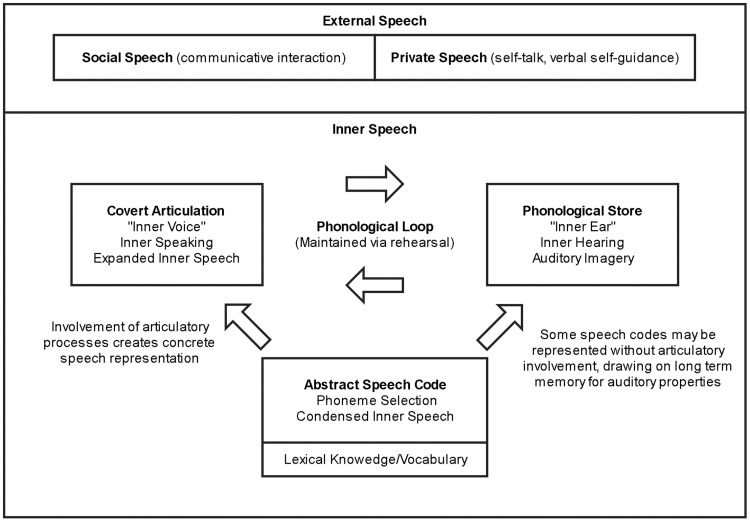
The conceptual diagram below helps keep those possibilities separate. It depicts covert articulation and a phonological store as related but distinguishable components; it does not depict a direct recording of experience.
Why a nonverbal distraction matters
Repeatedly saying “the” adds a second task. If performance worsens compared with doing the primary task alone, two explanations remain open: speech-related processing may have been disrupted, or any concurrent task might have made performance worse. A nonverbal distraction—often a repeated tapping task—helps separate these explanations.
Read how the comparison is motivated, then why choosing the control task requires care.
Inner Speech: Development, Cognitive Functions, Phenomenology, and Neurobiology
This review explains the basic logic of dual-task studies of inner speech. Read it for the reason a nonverbal condition belongs alongside articulatory suppression.
In “Dual-Task Methods,” read from the opening sentence, dual-task rationale, through the sentence about identifying effects specific to inner speech processes. Stop before the subsequent discussion of an additional random-number-generation control. Focus on what the nonverbal task rules out—and what it does not automatically rule out.
Variability and methodological choices in articulatory suppression tasks: a review
This methodological review adds an important qualification: having some control task is not enough if the two secondary tasks impose substantially different demands.
On p. 5, in Section 3, “The role of the articulatory suppression in the experimental design,” begin at the paragraph opening “Examining articles employing articulatory suppression.” Read the control comparison until the explanation that a mismatch in cognitive demands could account for the result. Stop before the paragraph beginning “In contrast to the previous case.” Attend especially to why a passive, no-distraction condition is insufficient on its own.
A useful design therefore has three conditions:
- No secondary task: a baseline for primary-task performance.
- Nonverbal dual task: for example, tapping at a specified pace while doing the primary task.
- Articulatory-suppression dual task: repeatedly saying an irrelevant word while doing the same primary task.
The crucial comparison is repeated speech versus nonverbal distraction, not just repeated speech versus silence. Ideally, the two secondary tasks take place for the same duration and are reasonably comparable in difficulty. Researchers also need to check that participants actually performed them as instructed.
“Nonverbal” does not mean “neutral.” Tapping can compete with attention, timing, or spatial processing; repeated speech can impose its own attentional and auditory demands. The control narrows the interpretation of a performance difference, but it does not make the two conditions identical in every respect.
Reading an experimental result
Consider an invented experiment in which participants briefly see digit sequences and then recall them in order. Each participant completes trials under all three conditions, with their order varied across participants. The table gives illustrative average recall accuracy, not findings from a published study.
| Condition during retention | Correctly recalled sequences |
|---|---|
| No secondary task | 85% |
| Nonverbal tapping | 78% |
| Repeatedly saying “the” | 59% |
Compared with the no-task baseline, tapping is associated with a 7-percentage-point drop. Repeated speech is associated with a 26-point drop. More importantly, accuracy under repeated speech is 19 points lower than under tapping.
If that difference were reliable and the secondary tasks were suitably matched, the pattern would support a task-dependent contribution of speech-related processing to retaining these digit sequences. The tapping condition shows that merely adding another task has some cost; it does not account for the entire additional cost observed during repeated speech.
Now consider what the table cannot tell us. It contains recall scores, not reports of experience. It does not show that participants heard digits in a vivid inner voice before suppression, that every participant used the same strategy, or that repeating “the” abolished all inner speech. Even an apparently selective effect might partly reflect imperfect matching of the two distractions. Those possibilities call for careful controls and, where the question concerns conscious experience, complementary reports—not for ignoring the performance difference.
The converse also matters. No extra impairment under suppression would not prove an absence of inner speech. Participants might use another strategy, the task might not benefit much from verbal processing, or the manipulation might not effectively disrupt the process of interest. An experiment tests the role of a process in its particular task and conditions.
Conclusion
Articulatory suppression uses repeated speech to interfere with processes that can support silent verbal rehearsal. A nonverbal dual-task condition is essential because it estimates the cost of doing two tasks at once. When repeated speech impairs performance more than a well-matched nonverbal distraction, the result supports a role for speech-related processing in that task—not a direct observation of anyone’s conscious inner voice.
The next lesson will examine the memory case more closely: how rehearsal may help keep a short list available, and what recall patterns can reveal about that contribution.