Hello. This module turns from what inner speech is and how it is studied to what speech-related thinking can do. The first case is short-term memory: keeping a few words available long enough to repeat them in order. You will use a word-recall example to see why silently rehearsing words can help, what the phonological-loop model proposes, and why a memory result does not tell us exactly what someone experienced in their mind.
Keeping a list available
Suppose seven words are presented one at a time, and you must repeat them in the same order a few seconds later. Recognizing the words is not enough; you have to keep their identities and positions available until recall. One possible strategy is to run through the list silently, starting over whenever there is time.
Psychologist Alan Baddeley describes a model of this strategy in a short interview. In the phonological-loop model, verbal information can be held briefly in a speech-based form, while a rehearsal process refreshes it. Listen for the distinction between holding a word and repeating it to keep it available.
alan baddeley: introduction of the phonological loop
Watch “alan baddeley: introduction of the phonological loop” from gocognitive. Baddeley introduces the model and then explains why the length of words matters in recall.
Watch the basic model for the brief store and internal repetition. Continue with word length, focusing on his prediction about what happens when each pass through a list takes longer.
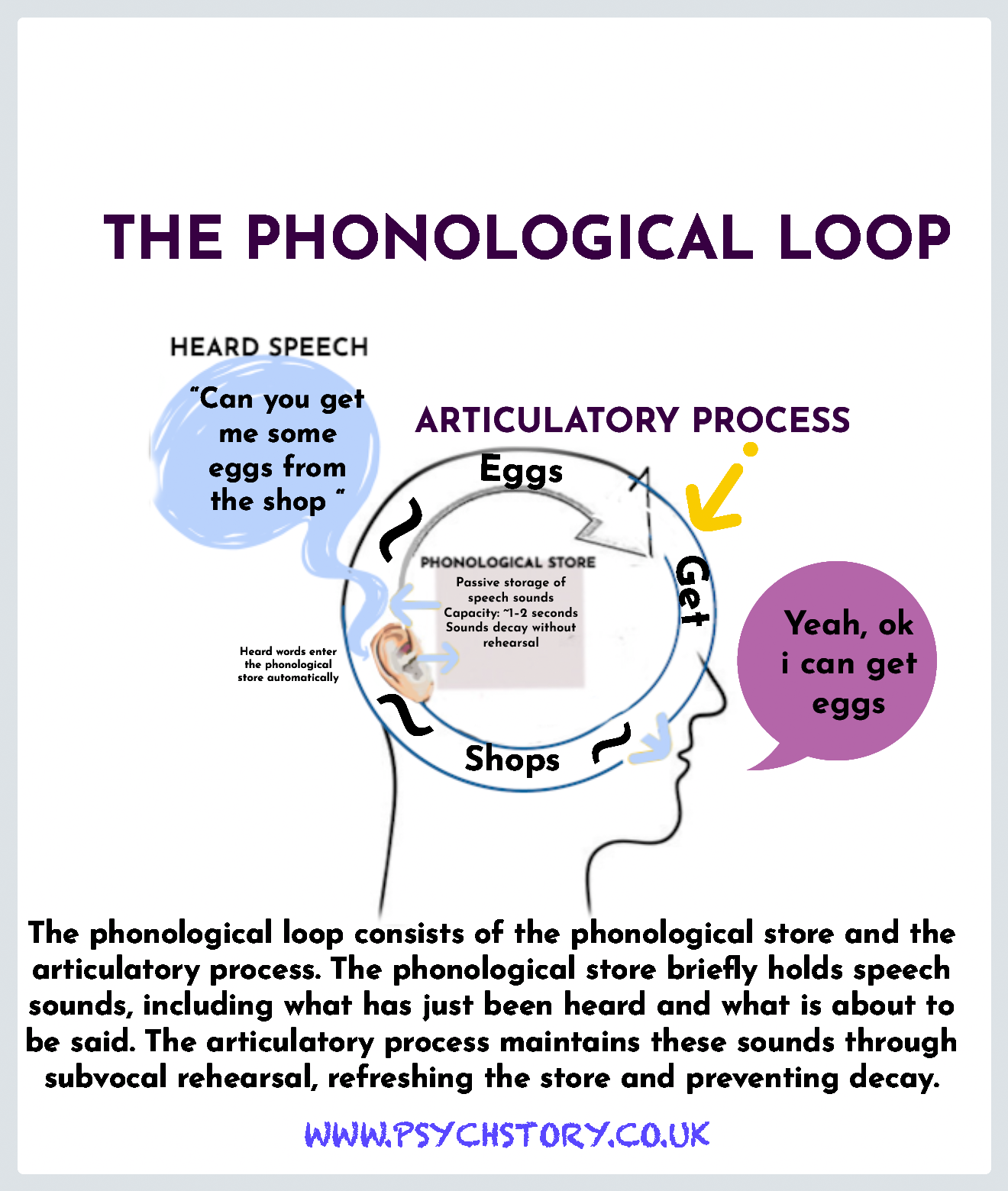
The model has two cooperating parts. The phonological store briefly holds a speech-based representation of the items. The articulatory rehearsal process refreshes that representation by repeating the items, usually without speaking aloud. Rehearsal need not mean hearing a clear, voice-like sound in your head; the model concerns speech-related processing, not a guarantee about how that processing feels.
The diagram makes the division of labour visible. Treat it as a sketch of a proposed memory system, not a literal map of where words travel inside the head.
What a word-recall comparison reveals
Read the “Working Memory” discussion in Chapter 4. Short-Term and Working Memory from Essentials of Cognitive Psychology. It gives two useful contrasts: lists whose words sound alike, and lists whose words take different amounts of time to say.
Chapter 4. Short-Term and Working Memory – ESSENTIALS OF COGNITIVE PSYCHOLOGY
Read the working-memory discussion in Essentials of Cognitive Psychology for the word-list evidence behind the phonological-loop model.
Under “WORKING MEMORY,” begin with the paragraph opening “According to Baddeley” and read through the sound comparison. Then read the paragraph beginning “How much information can the phonological loop hold?” through the tape analogy. Focus on why equally long lists need not be equally easy to recall.
The central comparison is between two lists of seven words each. One contains short words such as “lip,” “base,” and “rain”; the other contains longer words such as “carpenter,” “thermostat,” and “photograph.” If short-term recall depended only on the number of words, equal-sized lists would make similar demands. Yet people generally recall lists of short words better than lists of long words. This is the word-length effect.
Rehearsal offers an explanation. A pass through seven short words is relatively quick, so there may be time to repeat them before their temporary representations become difficult to retrieve. A pass through seven long words takes longer. By the time the later words have been rehearsed, earlier ones may be less available. The advantage of short words is therefore consistent with a system whose performance depends partly on rehearsal time, not just an item count.
The chapter’s “about two seconds” description is a useful approximation, not a rigid limit that applies to every person or list. Its tape analogy captures the prediction that more brief utterances than lengthy ones can be refreshed within a short interval. Unlike a tape, however, memory is affected by such things as how familiar the words are and how easily they can be distinguished.
The other comparison helps identify what kind of information is being maintained. Similar-sounding words, such as “leak,” “beak,” and “peek,” are easier to confuse during ordered recall than words that sound different. The phonological similarity effect fits the idea that sound-based representations play a part, including when the words were first seen in print. It is distinct from the word-length effect: one concerns confusability of sounds; the other concerns, in part, time spent rehearsing.
From a recall result to a claim about inner speech
The word lists support a specific, limited account: silent verbal rehearsal can help maintain words for short-term recall. They do not show that every remembered word was accompanied by a consciously heard inner voice.
That distinction matters for the broader question of how people think. Someone might deliberately repeat a list without experiencing it as an audible-sounding voice. Someone else might use the words’ meanings, a visual arrangement, or a combination of strategies. Good recall alone cannot identify their subjective experience. Conversely, difficulty with one word-list task would not establish that a person lacks inner speech in other situations.
One way to probe the rehearsal account is to occupy the speech-production process. Baddeley briefly describes what happens when participants repeatedly say an irrelevant sound while trying to remember visually presented words. This is articulatory suppression—a method encountered earlier in the course. Here, attend to the particular prediction it tests: if repeating words helps produce the short-word advantage, disrupting repetition should change that advantage.
alan baddeley: introduction of the phonological loop
Return to Baddeley’s gocognitive interview for his account of disrupting rehearsal. This segment connects the word-length result to an experimental manipulation.
Watch blocked rehearsal. Note his contrast between words shown visually and words heard aloud, rather than treating suppression as a test of all forms of remembering.
For visually presented lists, articulatory suppression can remove the usual advantage of short over long words. That pattern strengthens the case that rehearsal contributes to the advantage: when a speech-related process is occupied, word length no longer has the same effect in that condition. Heard words can still reach a speech-based store by a different route, so the results are not identical for spoken and printed lists.
Suppression does not erase memory, nor does it provide a direct observation of anyone’s inner experience. It interferes with a task-relevant process. The inference is that speech-related rehearsal helps with this form of recall, not that all short-term memory—or all silent thought—requires a conscious inner voice.
The takeaway for everyday remembering
Silently repeating a name just after an introduction or keeping a short verbal instruction in mind uses the same basic idea as the word-list example: rehearsal can refresh information you need soon. It is especially useful when the goal is to retain the words themselves, including their order, for a short interval. Other tasks may invite different strategies.
The key distinction is between a useful mechanism and a universal requirement. Word-length and sound-similarity effects help explain why a speech-based rehearsal mechanism is useful for short-term word recall. They do not imply that thinking always takes the form of words, or that everyone must experience rehearsal as a voice.
In the next lesson, the focus shifts from keeping words available to planning: whether speech-related thinking helps with particular planning tasks, without assuming that planning always depends on it.