Welcome to the first module, which asks what counts as inner speech before considering how often it occurs or what it does. Your starting assumption—that silent thinking always involves words—is understandable, but it combines two different questions: what a thought is about and how it is experienced. A thought about a conversation, for example, need not contain any mentally spoken words.
This lesson gives you a way to distinguish inner speech, imagined sounds, imagined sights, and thoughts experienced without words or images. The distinctions are useful precisely because real experiences can combine them or resist a clear label. Allow about 35–40 minutes, including the short readings and video.
Begin with the form of the experience
Suppose you are deciding whether to take an umbrella. The thought might occur as a silent phrase—“It might rain”—or as a picture of dark clouds. You might mentally hear a weather presenter saying those words. You might also simply grasp that rain is likely and an umbrella would be useful, without noticing a phrase or picture. These experiences have similar subject matter, but different forms.
A useful starting definition is that inner speech is the experience of language without audible speaking. Language matters here: a word, phrase, or utterance is present in experience. Sound is not required. Someone may experience themselves silently forming the words without hearing a distinct voice. Conversely, a vivid imagined voice can have sound-like qualities without feeling like something the person is actively saying.
Inner Speech: Development, Cognitive Functions, Phenomenology, and Neurobiology
Read this review’s opening definition, then its account of inner speaking, inner hearing, and thought without symbols. Together, these passages establish why “inner voice” is not a complete definition.
At the beginning of the article, read the opening definition. Later, find the discussion that starts “In contrast to questionnaires, which largely focus on trait-like qualities of inner speech.” Read the account of experience through its distinctions among inner speaking, inner hearing, and unsymbolized thinking. Focus on what a person reports experiencing, rather than on an assumed mechanism in the brain.
The review describes inner speaking as an experience of actively producing meaningful language without speaking aloud. Inner hearing instead feels more like receiving or hearing something internally. Both can involve words, but they differ in the apparent role of the experiencer: speaker or listener. That is a distinction in experience, not a claim that researchers can always separate the underlying processes.
It helps to keep three aspects apart:
| Aspect | What to notice |
|---|---|
| Content | Are particular words or linguistic structures present, or only an idea that could later be put into words? |
| Sensory quality | Is there an apparent sound, a visual appearance, neither, or both? |
| Activity | Does it feel as though you are forming an utterance, hearing one, or doing neither? |
These aspects do not supply a diagnostic checklist. They prevent one feature—especially the presence or absence of an audible-seeming voice—from standing in for the whole experience.
Imagining a sound is not necessarily speaking inwardly
Mentally replaying a doorbell is auditory imagery: a sound is represented despite no doorbell sounding. Mentally replaying a friend’s pronunciation of “umbrella” is auditory imagery of speech. It contains language, but it may feel like recalling a sound rather than producing an utterance. In contrast, silently telling yourself “Take the umbrella” may be experienced as active inner speaking even if it has little sound-like quality.
The boundary is not universally agreed upon. Some researchers treat inner speech as a kind of auditory imagery when it has a sound-like character. Others emphasize its links to forming language, which distinguish it from imagining a siren or replaying a recording. The disagreement is a reason to describe a particular experience carefully, not to force every instance into one exclusive box.
Inner Speech: Development, Cognitive Functions, Phenomenology, and Neurobiology
Return to the same review for its comparison of inner speech and auditory imagery. Read it as an argument for a useful distinction, rather than as proof that the boundary is settled.
In the later discussion of inner speaking and inner hearing, find the paragraph beginning “It has also been suggested that inner speech is a special case of a more general phenomenon of auditory imagery.” Read the comparison. Then locate the paragraph beginning “Instead, we advocate an alternative approach” and read the proposed model. Focus on the contrast between forming language and representing its sound, while noting that the authors allow overlap.
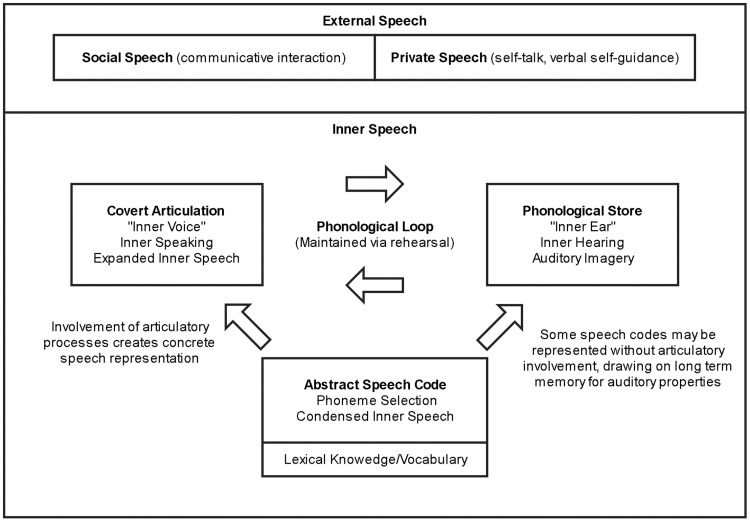
The following image depicts the review’s model, not a scan of what happens during every thought. It separates outward speech from several possible components of inner speech: a more abstract language representation, covert articulation, and a sound-related store. It also shows why an experience can draw on more than one component.
A related caution applies to visual imagery. Picturing dark clouds is visual imagery, not inner speech merely because you could describe the clouds in words. Seeing the written word “rain” in your mind is a more interesting case: the experience is visual in form but linguistic in content. You might also silently read that imagined word. In that event, visual imagery and inner speech could occur together.
The next clip broadens the point: inward language need not always resemble hearing an ordinary voice.
Meet the Neuroscientist Who Discovered That Some People Have No Inner Speech
Watch the segment on auditory imagery and inner speech in “Meet the Neuroscientist Who Discovered That Some People Have No Inner Speech,” from Giant’s Shoulder. It introduces a broader way of discussing internal linguistic activity.
Watch the distinction. Attend to why imagining a sound and using language inwardly need not be identical, and to the example of inward signing. The broader phrase “internal linguistic activity” is helpful when a voice-based description would exclude a possible form of language experience.
A thought may be explicit without words or images
The umbrella decision can also present itself as an already grasped relation: rain is likely; taking an umbrella makes sense. You can later explain that relation in a sentence. But the sentence used to report the thought does not establish that the sentence was present during it.
Researchers use unsymbolized thinking for a reported experience of a specific, present thought that does not seem to involve words, images, or other symbols. It is more precise than saying “nothing was in my mind.” The person reports a differentiated thought—one about something—while denying that it arrived in a worded or pictured form.
That description requires care. A fleeting hunch may not be a clearly differentiated thought. A person might overlook a faint word or image; equally, asking them to describe an experience may prompt words that were not there at the time. Researchers debate how confidently such reports establish a distinct kind of experience. For this lesson, the important point is narrower: the absence of a heard voice does not, by itself, establish wordless thought. The person might have soundless verbal thought, visualized words, an image with no words, or something harder to characterize.
An additional account of inner experience makes clear that these features can occur simultaneously.
Read this article’s compact account of inner speaking, inner seeing, and unsymbolized thinking. Its closing observation is especially important: the categories need not occupy separate moments.
Find the paragraph beginning “Heavey and Hurlburt (2008) have said that there are five frequent phenomena.” Read the full account. Notice how it distinguishes an explicit wordless thought from visual imagery, emotion, and attention to a sensation.
Emotion and sensory awareness belong in this picture without being substitutes for thought. Feeling anxious about rain is not itself inner speech. Noticing cold drops on your skin is perception, not an imagined rainy scene. Either could accompany a silent phrase, a mental image, or an explicit wordless thought.
Describing mixed and uncertain cases
Consider someone reporting, “I saw the route in my head and told myself to turn left.” The description supports visual imagery and inner speech together. There is no need to choose whichever seems more prominent. By contrast, “I pictured the route, then realized the left turn was shorter” establishes imagery, but leaves the form of the realization open. “Realized” names a change in understanding, not the words or images, if any, that accompanied it.
The same restraint helps with reports such as “I heard ‘turn left’ in my head.” The report identifies an internally experienced utterance, but does not yet settle whether it felt actively spoken, passively heard, vividly recalled, or some combination. “I just knew which way to go” is similarly incomplete evidence for unsymbolized thinking: it may describe a specific wordless experience, or it may be a quick summary made afterward.
A careful interpretation therefore has three possible outcomes:
- A supported distinction: “The person reports a pictured route, with no reported words.”
- A supported combination: “The person reports a pictured route while silently saying ‘left.’”
- An open case: “The person reports knowing the route, but has not described the form of that knowing.”
The open case is not a failure to classify. It preserves the difference between what someone experienced and what a brief description lets us infer. It also prepares you for a recurring issue in this course: asking someone how they generally think is different from finding out what, if anything, was present at a particular moment.
Takeaways
Inner speech involves language experienced without audible speaking; it need not sound like a voice. Auditory imagery represents sound, including sometimes the sound of speech. Visual imagery represents something seen inwardly, which can include written words. An explicit thought may also be reported without words or images. These are distinctions about forms of experience, not mutually exclusive kinds of people or thoughts. When a description does not specify the form, uncertainty is the accurate conclusion.
The next lesson examines varieties within inner speech, including fuller utterances, abbreviated verbal thought, and speech experienced as a monologue or dialogue.