Merhaba! Welcome to your fourth lesson.
In our last lesson, we learned how to form negative sentences (I don't scan...) and yes/no questions (Does the tool detect...?). This allows you to confirm or deny information. However, professional communication requires more than just yes or no answers. You need to ask for specific details.
Today, we will learn how to form WH-questions using words like what, why, how, and when. These are "information questions" that allow you to ask for details, such as the name of a server, the reason for an error, or the time of a meeting. This skill is fundamental for investigating security issues, understanding tasks, and participating in technical discussions.
1. From "Yes/No" to "Information" Questions
Last time, you learned to ask questions that can be answered with a simple "yes" or "no":
Do you use Tenable?(Tenable kullanıyor musun?) -> Yes, I do.Does the script work?(Script çalışıyor mu?) -> No, it doesn't.
WH-questions are different. They ask for information and cannot be answered with "yes" or "no". The name "WH-question" comes from the question words, most of which start with "wh-": what, when, where, why, who, which, and also how.
To get a clear overview of what these questions are and how they differ from yes/no questions, please watch the beginning of this video. The explanation is in Turkish, which will help you grasp the core concept.
WHAT, WHERE, WHEN, WHY, WHICH, WHOSE, WHO, HOW | WH QUESTIONS KONU ANLATIMI
This video from the 'sıfırdan ingilizce' channel introduces WH-questions and clearly distinguishes them from the yes/no questions we studied in the last lesson.
Please watch from the beginning until 02:48. Focus on understanding why these are called 'information questions' and the basic meaning of each question word (What, Where, When, Why, Who, How).
As the video explained, you use these words to ask for specific kinds of information:
- What? (Ne?) - Asks about things or actions.
- When? (Ne zaman?) - Asks about time.
- Where? (Nerede/Nereye?) - Asks about place.
- Why? (Neden/Niçin?) - Asks about a reason.
- Who? (Kim?) - Asks about a person.
- How? (Nasıl?) - Asks about the way something is done (manner/method).
2. The Structure of WH-Questions
The good news is that the structure for WH-questions is very similar to the yes/no questions you already know. You just add the WH-word at the beginning.
WH-word + do/does + Subject + Verb (base form)?
Let's see how this works:
-
Yes/No Question:
Do you run the scan? -
WH-Question:
**When** do you run the scan? -
Yes/No Question:
Does the analyst write a report? -
WH-Question:
**Why** does the analyst write a report?
Notice that the "golden rule" from our last lesson still applies: when you use do or does, the main verb is always in its base form (no -s).
To explore this structure with more examples, let's look at a helpful article.
Wh Soruları (Wh Questions) Kalıplar ve Örnekleri
This article from Konuşarak Öğren, titled 'Wh Soruları (Wh Questions) Kalıplar ve Örnekleri', clearly explains the sentence structure and provides many useful examples with Turkish translations.
Please read the introduction and the section 'Wh Soru Kalıpları ve Anlamları'. Pay close attention to the formula presented: WH-word + yardımcı fiil + özne + fiil. The examples with 'When do you go to school?' and 'Why did you go there?' are excellent illustrations.
Here are some examples directly related to your work in cybersecurity:
- What do you need? (Neye ihtiyacın var?)
- When do you patch the servers? (Sunucuları ne zaman güncellersin?)
- Why does the application crash? (Uygulama neden çöküyor?)
- How do you generate the report? (Raporu nasıl oluşturursun?)
3. A Closer Look at What, When, Why, and How
Let's dive a little deeper into the most common question words you'll use.
What? (Ne?)
Used to ask for information about something.
What is the vulnerability?(Zafiyet nedir?)What does this script do?(Bu script ne işe yarar?)
When? (Ne zaman?) vs. What time? (Saat kaçta?)
Both ask about time, but there's a small difference. When is for general time (day, month, morning), while What time asks for a specific clock time. The article from Konuşarak Öğren explains this well.
**When** is the meeting?->On Friday./In the afternoon.**What time** is the meeting?->At 3:00 PM.
Why? (Neden?)
Used to ask for a reason. The answer often starts with Because (Çünkü).
- A:
**Why** do you use Tenable.ad? - B:
**Because** it helps us find security gaps in Active Directory.
How? (Nasıl?)
Used to ask about a process or method. You can also combine How with other words.
**How** do you fix this vulnerability?(Bu zafiyeti nasıl düzeltirsin?)**How often** do you perform a scan?(Ne sıklıkla tarama yaparsın?)**How many** vulnerabilities did you find?(Kaç tane zafiyet buldun?)
This next video provides more examples for each question word with Turkish explanations.
What, Where, When, Why, How, Who, Kullanımı #4
This video from Özer Kiraz offers simple, clear examples for each WH-word. It's a great way to hear the words used in different sentences.
Please watch the following segments: 'What': 00:40 - 01:25 'When': 02:01 - 02:19 'Why': 03:05 - 03:24 'How': 03:24 - 04:16 Focus on how the meaning of 'how' changes when you add another word, like 'How tall' or 'How good'.
Test your understanding!
Choose the correct WH-word (What, When, Why, How) to complete each question.
- A: ______ do you update the firewall rules? B: We update them every month.
- A: ______ is the purpose of this scan? B: The purpose is to find critical vulnerabilities.
- A: ______ do you identify false positives? B: I check the service and version information.
- A: ______ does the system require a strong password? B: Because it contains sensitive data.
Show answer
- When (The answer "every month" is about time/frequency). How often would also be a correct and even better choice.
- What (The answer describes the purpose, which is a 'thing' or concept).
- How (The answer describes a method or process).
- Why (The answer starts with "Because," indicating a reason).
4. Practice: Asking Questions in Cybersecurity
Let's apply what you've learned to your professional field. Look at the image below. It lists common questions that a cybersecurity professional might ask.
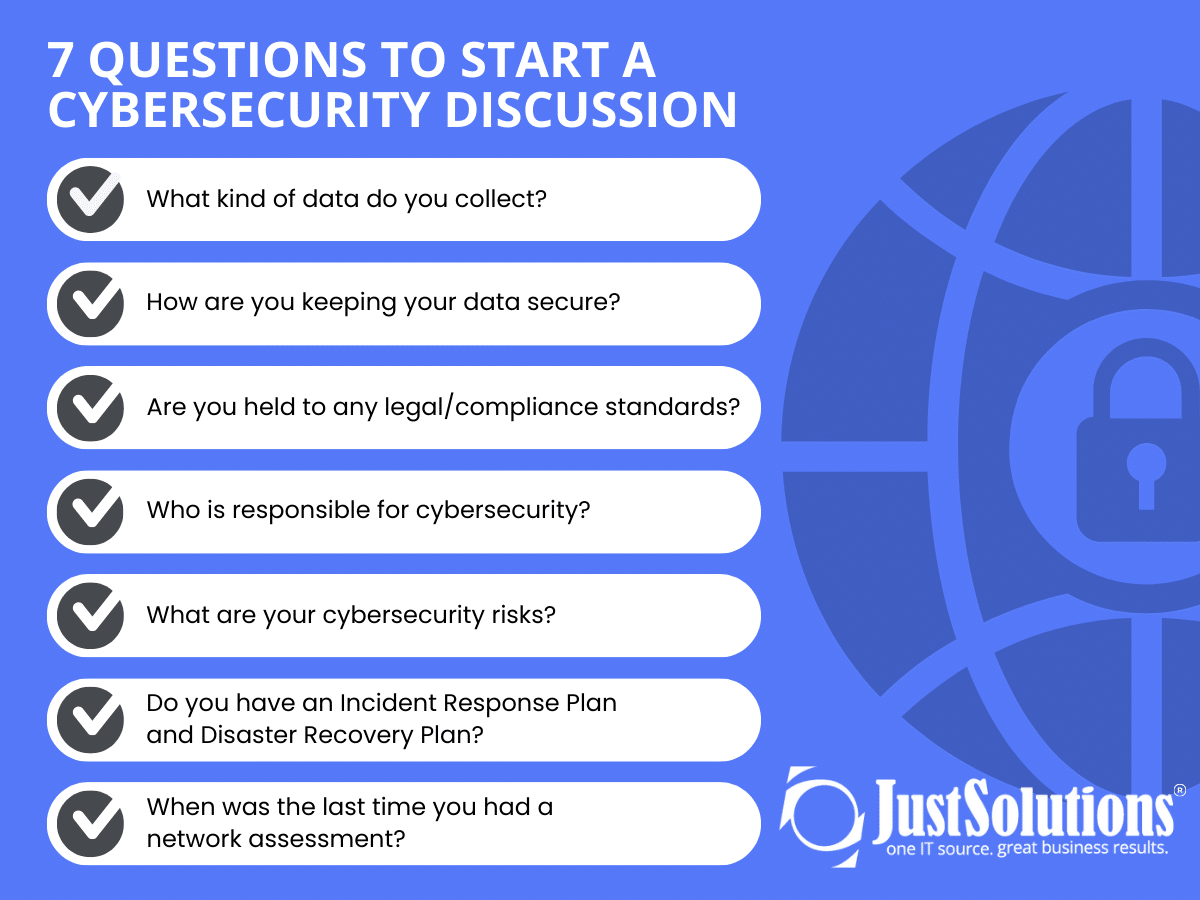
Now, let's practice forming questions like these. For each answer below, write the correct WH-question.
-
Question: _________________________________________________?
Answer: We collect user login data and file access logs. -
Question: _________________________________________________?
Answer: We perform network assessments once a month. -
Question: _________________________________________________?
Answer: The biggest risk is a phishing attack.
Show possible questions
-
Question: What data do you collect?
Answer: We collect user login data and file access logs. -
Question: How often do you perform network assessments?
Answer: We perform network assessments once a month. -
Question: What is the biggest risk?
Answer: The biggest risk is a phishing attack.
Conclusion
Excellent work! You can now ask for specific information, which is a crucial skill for any technical professional. You have moved beyond simple yes/no questions to having more detailed conversations.
Key Takeaways:
- WH-questions are used to ask for information about what, when, where, why, who, and how.
- The basic sentence structure is: WH-word +
do/does+ Subject + Verb? - This structure allows you to ask for details about tasks, tools, and security issues in your daily work.
Preview of the Next Lesson:
Now that you can form statements and questions, our next step is to make them more precise. In the next lesson, we will focus on using articles (a, an, the) and plural nouns. This will help you distinguish between talking about a general concept (e.g., "a vulnerability") and a specific one you are currently discussing (e.g., "the vulnerability on server X").