Merhaba! Welcome to your fifth lesson.
In our last lesson, we focused on asking for details using WH-questions like What, When, Why, and How. This was a big step in moving from simple yes/no answers to having more meaningful technical conversations.
Today, we'll build on that by learning how to use articles (a, an, the) and plural nouns correctly in professional contexts. This is a fundamental skill that adds precision to your language. It helps your colleagues understand if you are talking about a general issue ("we found a vulnerability") or a specific one that you have already discussed ("we need to patch the vulnerability").
1. Articles: Specifying Nouns
In English, articles are small words (a, an, the) that come before nouns. They signal whether you are referring to a general item or a specific one. This distinction is very important in technical communication. Since Turkish does not use articles in the same way, this concept can be tricky, but we'll break it down clearly.
Let's start with a video that explains the core difference in Turkish.
DERS: 11 - A, AN, THE - Konu Anlatımı
This video from Bahrom Hudayar's channel explains the difference between 'a/an' (general, belirsiz) and 'the' (specific, belirli). It uses clear examples to show how we introduce a new, general item with 'a' and then refer back to that specific item with 'the'.
Please watch these two short clips: From 02:23 to 03:53: This part explains the main concept using the example of buying a book. From 12:29 to 13:21: This part summarizes the idea using the example of watching a movie. Focus on understanding this key sequence: first mention uses 'a', and later mentions use 'the'.
The Rules for a, an, and the
As the video explained, the rules are based on whether the noun is general or specific.
a / an (Indefinite/Belirsiz Articles)
- Use
aoranwhen you are talking about a singular, countable noun for the first time, or in a general sense. It means "one of many" or "any one." ais used before a word that starts with a consonant sound.anis used before a word that starts with a vowel sound (a, e, i, o, u).
For a clear written summary of these rules, please refer to this document.
These course notes from Gaziosmanpaşa University provide a concise explanation of the rules for 'a' and 'an'.
Please find the section titled 'Belirsiz artikeller: a / an'. It is on page 1. Read the short explanation and the examples: 'a + sessiz bir ses' (a + a consonant sound) and 'an + sesli bir ses' (an + a vowel sound).
Here are some examples relevant to your work:
a server(bir sunucu)a report(bir rapor)an application(bir uygulama)an update(bir güncelleme)an administrator(bir yönetici)
the (Definite/Belirli Article)
- Use
thewhen you are talking about a specific noun that both you and the listener know. This could be because:- It was already mentioned: "I see a vulnerability. The vulnerability is critical."
- It is unique in the context: "Please check the firewall." (We know which firewall). "The CEO will join the call." (There's only one CEO).
- It is unique in the world: "the internet", "the sun".
Let's compare:
- "We need a patching tool." (Herhangi bir yama aracına ihtiyacımız var.)
- "We need the patching tool from Microsoft." (Microsoft'un o belirli yama aracına ihtiyacımız var.)
Test your understanding!
Fill in the blanks with a, an, or the.
- I need to write ___ report about the scan results.
- ___ report needs to be ready by Friday.
- We detected ___ unusual activity on the network.
- This is ___ urgent issue.
- What is ___ IP address of the server?
Show answer
- a (You are introducing the report for the first time).
- The (You are referring to the specific report mentioned in the previous sentence).
- an (You are introducing "unusual activity" for the first time. It starts with a vowel sound).
- an (The word 'urgent' starts with a vowel sound).
- the (A server usually has one specific IP address that you are asking for).
2. Plural Nouns: From One to Many
Now let's talk about making nouns plural (çoğul). In your work, you rarely find just one "vulnerability" or "server." You usually deal with many of them. Knowing how to form plurals is essential.
This image provides a quick visual summary of the main rules for forming plurals.
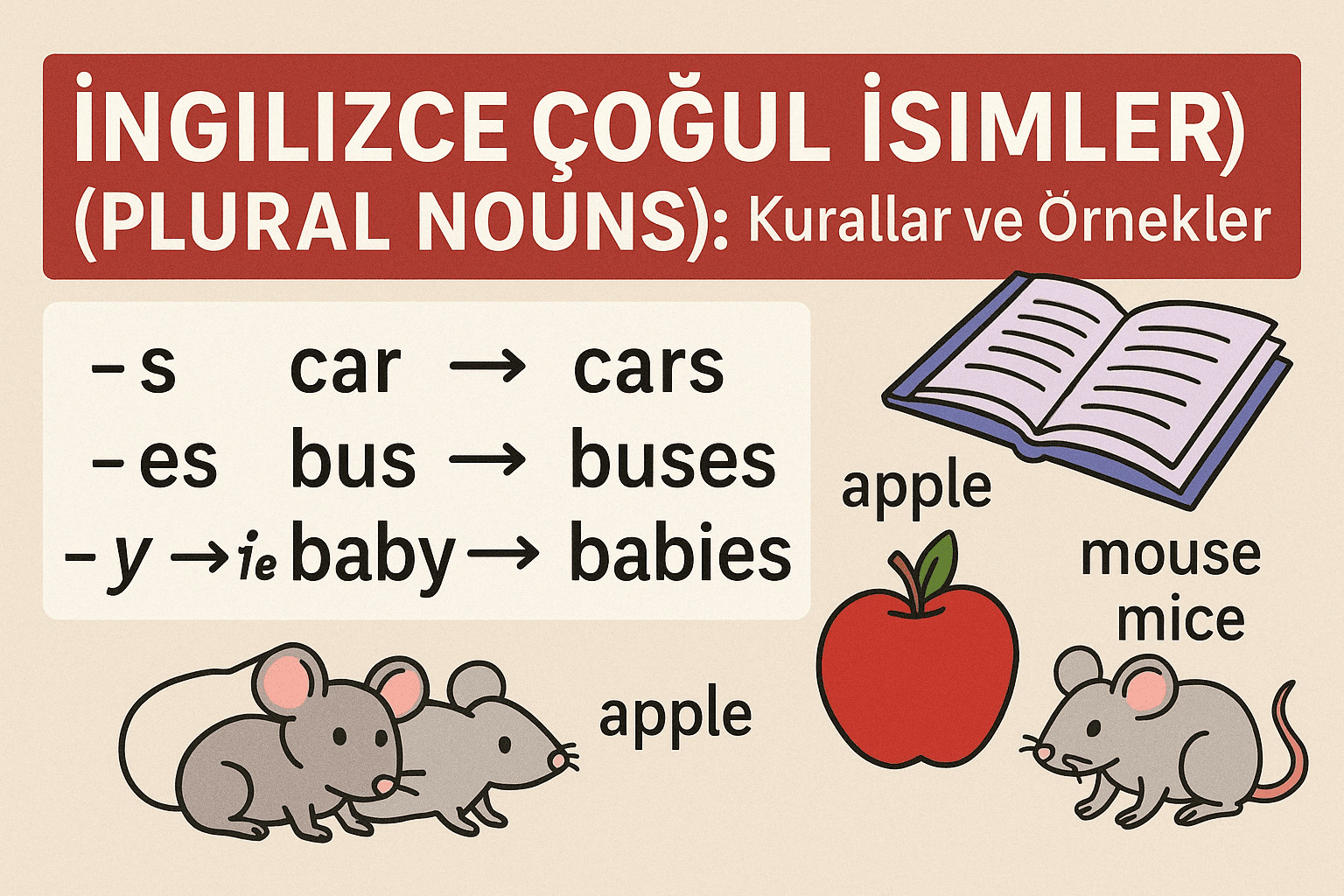
To learn these rules in more detail, let's watch a video that explains them step-by-step in Turkish.
İNGİLİZCE TEKİL - ÇOĞUL KONU ANLATIMI | SINGULAR AND PLURAL NOUNS | - s, es, and ies
This video from 'Ms. Jasmin ELT' clearly explains the rules for changing singular nouns to plural nouns.
Please watch the following sections: General Rule (-s): from 00:33 to 01:17. Rule for -ch, -sh, -x, -s (-es): from 01:17 to 02:15. Rule for -y (-ies): from 03:44 to 04:34. Irregular Plurals: from 04:34 to 05:57. Pay attention to the examples for each rule.
Here's a summary of the most important rules for your field:
| Rule | Example (Singular) | Example (Plural) |
|---|---|---|
| Add -s (most common) | server, report, ticket | servers, reports, tickets |
| Add -es (ends in -s, -sh, -ch, -x, -z) | patch, box, bus | patches, boxes, buses |
| Change -y to -ies (ends in consonant + y) | vulnerability, company | vulnerabilities, companies |
| Irregular (must be memorized) | man, person, child | men, people, children |
Now, let's practice what you've learned.
Let's return to the 'uzaktan - eğitim' PDF for a quick practice exercise.
Please go to page 16 and find the exercise table under the heading 'ALIŞTIRMALAR I)'. Complete the 'Çoğul' (Plural) column for 'Computer', 'Address', 'Book', and 'erasers' (make this one singular). You can ignore 'Man' and 'Child' as they are irregular and already filled in.
3. Application: Countable vs. Uncountable Nouns in Cybersecurity
Some nouns in English are countable (sayılabilir) and some are uncountable (sayılamayan).
- Countable nouns can be counted. They have a singular and a plural form. You can use
a/anwith the singular form.- one vulnerability, two vulnerabilities
- a server, many servers
- Uncountable nouns cannot be counted. They have only one form (no plural
s). You cannot usea/anwith them.- information (NOT
informations) - software (NOT
softwares) - advice (NOT
advices)
- information (NOT
This distinction is very important for technical terms. A textbook for ICT students has a perfect note on this.
This is a note from a textbook called 'ENGLISH FOR ICT STUDENTS'. It shows how some technical words can be both countable and uncountable depending on the context.
Please read the section titled 'NOTE' on page 50 (VI-50). It gives examples for 'TECHNOLOGY' and 'SECURITY'.
Let's analyze those examples, which are highly relevant to your work:
-
Security (Uncountable): Refers to the general concept of being secure.
- "Network security is very important." (Ağ güvenliği çok önemlidir.)
-
A security / securities (Countable): Refers to a specific financial document. This context is less common for you, but it shows the difference.
-
Technology (Uncountable): Refers to the general concept.
- "They invested in the latest technology." (En son teknolojiye yatırım yaptılar.)
-
A technology / technologies (Countable): Refers to a specific type or piece of technology.
- "Firewalls and scanners are important technologies for defense." (Güvenlik duvarları ve tarayıcılar, savunma için önemli teknolojilerdir.)
You will most often use data, information, and software as uncountable nouns.
- Correct: "We need more data."
- Incorrect: "We need more
datas."
Conclusion
Great job today! Mastering articles and plurals will make your professional English much more accurate and clear.
Key Takeaways:
- Use
a/anfor a general, singular noun being mentioned for the first time. - Use
thefor a specific noun that everyone in the conversation knows. - Most nouns become plural by adding
-sor-es. Pay special attention to words likevulnerability -> vulnerabilities. - Some important technical nouns like
informationandsoftwareare usually uncountable and do not have a plural form.
Preview of the Next Lesson:
Now that we have covered basic sentence structure, questions, and noun specifics, we are ready to expand our vocabulary. In the next lesson, we will focus on common workplace vocabulary, learning the English words for objects, actions, and scheduling. This will allow you to put all the grammar we've learned into practical use.