Hello! Welcome to the fifth and final lesson in our foundational module on neural communication.
In our last lesson, we distinguished between excitatory ("Go!") and inhibitory ("Stop!") signals at the synapse. We saw that a neurotransmitter's message is delivered when it binds to a postsynaptic receptor. But what happens after that? For the nervous system to process information quickly and accurately, the signal can't linger indefinitely. The synapse needs to be reset.
Today, we will investigate the crucial "clean-up" mechanisms that terminate synaptic signals. This lesson addresses the final learning outcome for this module: to explain the role of neurotransmitter reuptake and degradation in terminating synaptic signals.
Understanding how neurotransmitters are cleared from the synapse is fundamental. It's not just a housekeeping task; it's an active and precisely regulated process that ensures the fidelity of neural communication. These mechanisms are also the targets of many important drugs, including those used to treat Parkinson's disease, depression, and other neurological conditions.
Why Must the Signal End?
Imagine a conversation where no one ever stopped talking. New information would be impossible to convey, and the message would become a meaningless drone. The same principle applies at the synapse. If a neurotransmitter remained in the synaptic cleft, it would continuously stimulate the postsynaptic neuron, effectively jamming the communication channel.
To maintain precise, moment-to-moment control, the neurotransmitter's action must be brief and well-defined. This allows neurons to fire in specific patterns, encoding the complex information that underlies every thought, sensation, and movement.
Terminating Neurotransmitter Action
To begin, let's read a short introduction from the online textbook Introduction to Neuroscience that explains why terminating the signal is so critical.
Please read the first two paragraphs under the heading 'Terminating Neurotransmitter Action'. Focus on the main reason why neurotransmitter action must be stopped.
The "Clean-Up" Crew: An Overview of Mechanisms
As you just read, neurons have evolved sophisticated strategies to clear neurotransmitters from the synaptic cleft. There are three main ways this is accomplished:
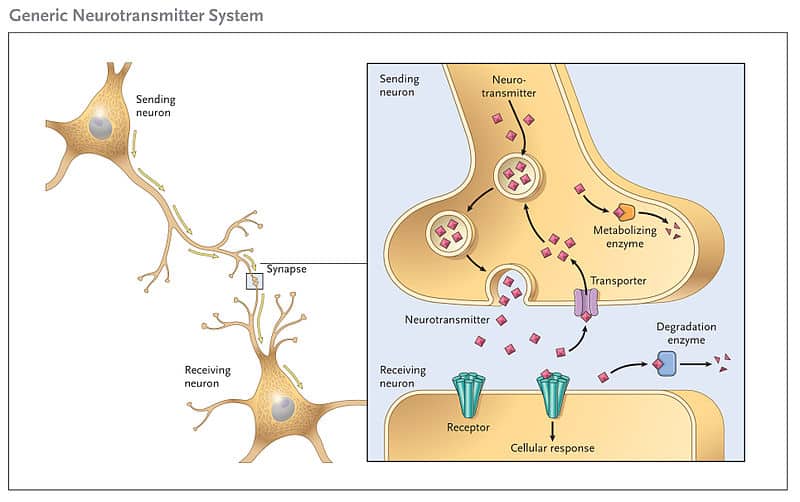
- Reuptake: Specialized transporter proteins, acting like tiny vacuum cleaners, are located on the membrane of the presynaptic neuron (or sometimes on neighboring glial cells). They actively pump the neurotransmitter molecules out of the synaptic cleft and back into the cell that released them. This is a highly efficient recycling system.
- Enzymatic Degradation: Enzymes located in the synaptic cleft grab the neurotransmitter molecules and break them down into inactive substances.
- Diffusion: Some neurotransmitter molecules simply drift away from the synapse. This is generally a slower and less significant factor compared to reuptake and degradation.
Let's watch a quick video that introduces these three processes.
The following video from the 'Neuroscientifically Challenged' channel provides an excellent, concise overview of these three key mechanisms.
Please watch from 02:04 to 02:55. Pay attention to the definitions of diffusion, enzymatic degradation, and reuptake.
The diagram below provides a visual summary of the two primary mechanisms, reuptake and degradation, which will be the focus of our lesson.
Mechanism 1: Enzymatic Degradation
Enzymatic degradation is a fast and effective way to switch off a synaptic signal. The most classic example of this process involves the neurotransmitter acetylcholine (ACh), which plays a critical role in muscle control and memory.
In cholinergic synapses, the enzyme acetylcholinesterase (AChE) resides in the synaptic cleft. It rapidly breaks down acetylcholine into two inactive components: acetate and choline. The choline is then taken back up by the presynaptic neuron to be recycled for the synthesis of new acetylcholine.
Let's watch a short clip that illustrates the enzymatic degradation of acetylcholine.
Watch the segment from 04:11 to 04:40. Note the names of the enzyme (acetylcholinesterase) and the breakdown products (acetate and choline).
This mechanism is incredibly fast, allowing for the precise timing needed for functions like muscle contraction.
Mechanism 2: Reuptake
Reuptake is the most common strategy used to clear neurotransmitters, especially for the amino acids (glutamate, GABA) and monoamines (dopamine, serotonin, norepinephrine). Each of these neurotransmitters has its own specific transporter protein designed to recognize and recycle it.
Reuptake of Glutamate and GABA
In our last lesson, we discussed the brain's main excitatory and inhibitory neurotransmitters, glutamate and GABA. Both are primarily cleared from the synapse via reuptake. For glutamate, this process involves a fascinating partnership with neighboring support cells called astrocytes, which help recycle it in what's known as the glutamate-glutamine cycle.
Let's see how reuptake works for the neurotransmitters we discussed in our last lesson. This clip shows the process for both glutamate and GABA.
Watch the segments on glutamate (11:39 - 12:22) and GABA (13:41 - 14:03). For glutamate, notice the role of glial cells in the 'glutamate-glutamine cycle'.
Reuptake of Serotonin and Norepinephrine
Reuptake transporters are important targets for many medications. For example, a major class of antidepressants, the Selective Serotonin Reuptake Inhibitors (SSRIs), work by blocking the Serotonin Transporter (SERT). This leaves more serotonin in the synaptic cleft, enhancing its effects.
Test your understanding!
A certain drug is described as a Norepinephrine Reuptake Inhibitor (NRI). Based on what you've learned, how does this drug work at the synapse, and what is its effect on norepinephrine levels?
Show answer
A Norepinephrine Reuptake Inhibitor (NRI) works by blocking the norepinephrine transporter (NET). By inhibiting this reuptake pump, the drug prevents norepinephrine from being efficiently removed from the synaptic cleft. This leads to an increased concentration of norepinephrine in the synapse, allowing it to act on postsynaptic receptors for a longer time and exert a stronger or more prolonged effect.
Dopamine: A Special Case for Parkinson's Disease
Now, let's focus on dopamine, the neurotransmitter at the heart of our course on Parkinson's disease. The termination of dopamine's signal is a critical process, and understanding it is key to understanding both the disease and its treatments.
Dopamine clearance involves a two-step process:
- Reuptake (the primary step): Dopamine is rapidly removed from the synaptic cleft by a specific transporter called the Dopamine Transporter (DAT). This is the main "off switch" for the dopamine signal.
- Enzymatic Degradation (the secondary step): Once dopamine is taken back inside the presynaptic neuron, it can either be repackaged into vesicles for re-release or be broken down by enzymes. The two main enzymes responsible for degrading dopamine are:
- Monoamine Oxidase (MAO)
- Catechol-O-Methyltransferase (COMT)
This two-step regulation is crucial for maintaining the right balance of dopamine in the brain.
Dopamine | Dopaminergic pathways in brain | Dopamine deficiency | Parkinson's disease
The following video from 'Animated biology With arpan' focuses specifically on dopamine and clearly explains this two-step process of reuptake and degradation.
Please watch from 01:24 to 02:29. Pay close attention to the key players: the Dopamine Transporter (DAT), Monoamine Oxidase (MAO), and Catechol-O-methyltransferase (COMT).
As we will explore in great detail in later modules, the loss of dopamine-producing neurons is the central pathology of Parkinson's disease. Many treatments for the disease are designed to boost the function of the remaining dopamine. They do this by either providing more dopamine precursor (L-DOPA) or by blocking the enzymes MAO and COMT, thereby preventing the breakdown of the little dopamine that is still available.
Conclusion
This lesson concludes our foundational module on neural communication. We have journeyed from the structure of a single neuron to the complex orchestration of signals at the synapse.
Key takeaways from this lesson:
- Synaptic signals must be terminated to ensure precise and rapid neural communication.
- The two main mechanisms for signal termination are enzymatic degradation and reuptake.
- Acetylcholine is a classic example of a neurotransmitter cleared by the enzyme acetylcholinesterase (AChE).
- Reuptake is the most common mechanism, used by neurotransmitters like glutamate, GABA, serotonin, and dopamine, each via its specific transporter protein.
- Dopamine termination is a two-step process: reuptake by the Dopamine Transporter (DAT), followed by degradation by the enzymes MAO and COMT. This process is a major target for Parkinson's disease therapies.
With this foundation, we are now ready to move from the single synapse to the larger brain circuits involved in movement. In our next module, "The Basal Ganglia: The Brain's Motor Control Center," we will begin to assemble these building blocks to understand how the brain orchestrates voluntary movement, and we will identify the specific brain structures that are most affected in Parkinson's disease.