Hello! Welcome back to your training on the core skills of a legal assistant.
In our last two lessons, we built a solid foundation for legal research. You first learned where to find legal information, including key Moroccan resources, and then you mastered how to construct precise search queries using Boolean operators and connectors.
Today, we're putting those skills to work on one of the most common and critical tasks you'll perform: locating the specific laws that govern a legal issue. By the end of this lesson, you will be able to locate relevant statutes and codes applicable to a given legal issue. This means that when a supervising attorney asks, "What does the law say about X?", you'll know exactly how to find the answer in the official legal codes. Given your interest in reading law codes, this lesson will help you navigate them with professional efficiency.
Why Start with Statutes?
When faced with a legal question, it can be tempting to jump straight into searching for court cases. However, the most effective research process almost always begins with statutes. Statutes (and the codes they are organized into) are the laws passed by legislative bodies. Case law, which we will cover next, often exists to interpret these statutes. Therefore, understanding the statute first provides the essential context for understanding the cases.
Let's watch a very short clip that explains this hierarchy.
This clip from the 'Legal Research Strategy' video by the Harvard Law School Library explains why you should look for statutes before diving into case law.
Watch from 01:59 to 02:20. Notice the key reason given: cases are often interpreting the statute, so finding the statute first can lead you directly to the most relevant cases.
The Strategic Approach to Finding Statutes
Simply running a keyword search in a massive legal code is rarely the best approach. You might get thousands of irrelevant results or miss the one crucial section you need. A strategic researcher uses a variety of tools to zero in on the correct law.
Let's outline a professional workflow for finding statutes, which often starts by leveraging the work others have already done.
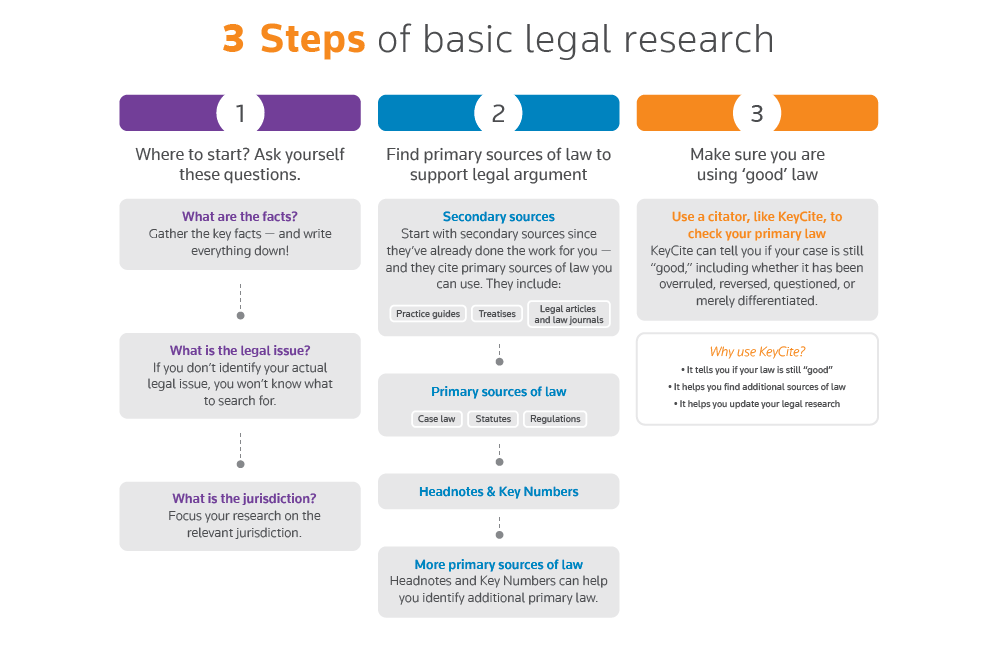
This chart shows a standard three-step legal research process. Today, we are focused on the second step: "Find Primary Sources," specifically how to locate statutes and codes.
Step 1: Start with Secondary Sources
As we've touched on before, the single most effective way to begin research in an unfamiliar area is to consult a secondary source. These are materials that explain the law, such as:
- Legal encyclopedias
- Treatises (in-depth books on a specific legal topic)
- Law review articles
- Practice guides and manuals
- Even well-regarded legal blogs or government agency websites
The key value of a secondary source is that it will not only provide a summary of the legal rules but will also provide citations to the primary law—the specific statutes you are looking for. This is the fastest way to get pointed in the right direction.
Step 2: Use a Variety of Finding Aids
Once a secondary source has given you a starting point, or if you need to search directly in the codes, you have several methods at your disposal.
To learn about these different techniques, please read the following guide from the UCLA School of Law Library.
Legal Research: An Overview: Searching in the Codes
This guide, 'Searching in the Codes,' provides an excellent overview of the different methods you can use to find a specific statute within a legal code.
Please read the entire text on this page, starting from 'Special Challenges Of Online Code Searching' and continuing through 'Code Chapter / Table of Contents Browse'. Focus on understanding the five main finding methods presented: Secondary Source Citations, Popular Name Table, Code Index, Keyword Searching, and browsing the Table of Contents.
Let's summarize the key methods you just read about:
- Using a Known Citation: This is the most direct method. If a secondary source, a colleague, or a court case gives you a citation (e.g., "Article 39 of the Moroccan Labor Code"), you can go directly to that law. On most legal databases like Westlaw or Lexis, you can simply type the citation into the main search bar.

*This image shows an example of entering a statute's citation directly into the search bar of a legal database (Westlaw) to pull up the specific law.*
2. Using a Popular Name Table: Sometimes a law is known by its name, like the "Sarbanes-Oxley Act" in the U.S. Legal codes have "Popular Name Tables" that act as a cross-reference, linking the common name to its official citation in the code.
-
Using the Subject Index: Every published code, whether in print or online, has a detailed subject index. This is like the index at the back of a book. It's organized alphabetically by topic and can be more reliable than a keyword search because it uses the official terminology and structure of the code. For example, you could look up "Licenciement" (Termination) in the index of the Moroccan Labor Code to find all related articles.
-
Keyword Searching: This is where you apply the skills from our last lesson. You can run a "Terms and Connectors" search directly within a specific code or across all statutes. This is powerful but requires care. As the reading noted, you must account for different terminology (e.g.,
(enfant OR mineur)) and be aware that your search may include annotations, not just the law's text. -
Browsing the Table of Contents: Once you find one relevant statute, don't stop there. The surrounding sections often contain important definitions, exceptions, or procedures. Always look at the Table of Contents for the chapter or title to understand the full context.
Test your understanding!
A senior partner mentions a law she vaguely remembers as the "Family Code" (Code de la Famille) in Morocco and asks you to find the articles related to child custody. What would be the two most efficient starting methods to choose from the list above?
Show answer
The two most efficient methods would be:
- Using a Popular Name Table: Since the partner gave you the common name of the law ("Code de la Famille"), this is a perfect use case for a popular name table to find where it is officially codified.
- Using the Subject Index: Once you have located the Family Code, you could use its subject index to look up terms like "garde d'enfants" (child custody) to quickly find the specific articles governing that topic. This is more precise than a broad keyword search.
A Practical Walkthrough
Theory is useful, but seeing the process in action is what makes it stick. Let's watch an extended example of a researcher tackling a real-world problem. The scenario involves a partner asking about the legality of shipping wine across state lines in the U.S.
Pay close attention to how the researcher moves from a broad question to a specific, actionable answer by following the exact steps we've discussed.
Class 1 - Beginning Legal Research
In this section of 'Beginning Legal Research', instructor Loreen Peritz demonstrates the entire research process, from receiving a vague question to finding a specific state statute and interpreting it.
Please watch from 17:06 to 26:54. Observe how she: Starts with a general Google search to find a secondary source (a specialized website). Uses that secondary source to understand the issue and, crucially, to get a citation to the primary law (the state statute). Takes that citation to an authoritative database (Westlaw) to pull up the actual text of the statute. Reads the statute to provide a specific answer to the partner's question.
This demonstration perfectly illustrates the workflow of a legal professional. Notice how she didn't just guess keywords and search in a large database. She used a secondary source to narrow her focus, find the exact citation, and then confidently retrieve the primary law. This process is efficient, reliable, and a core competency for any legal assistant.
The "Finding Statutes Chart" from Lewis & Clark Law School's guide provides an excellent summary of which path to take.
Lesson Three- Finding Statutes - Legal Research Certification ...
This chart summarizes the strategies for finding a statute based on what information you have at the start.
Review the 'Finding Statutes Chart'. You don't need to read the rest of the page. This chart is a great mental model to use when you start a research task.
Conclusion
Great job today. You have now learned the strategies for locating the foundational source of law: statutes and codes. This moves you from simply knowing how to use a search bar to thinking like a legal researcher—choosing the right tool for the job to find the law efficiently and accurately.
Key Takeaways:
- Always start your research with statutes when possible, as they are the primary rules that cases interpret.
- The most effective path often begins with a secondary source to gain context and find direct citations.
- Master a variety of finding aids: direct citation lookup, popular name tables, subject indexes, and strategic keyword searching.
- Once you find a relevant statute, always browse the table of contents to understand its full context and not miss related definitions or exceptions.
Preview of the Next Lesson:
With the skill of locating statutes now in your toolkit, you're ready for the next layer of research. A statute provides the rule, but how have the courts applied that rule in real-world disputes? In our next lesson, we will focus on how to find and retrieve case law using citation indexes and keyword searches.