Introduction
In our last lesson, we witnessed the revolutionary discovery of the atomic nucleus. Rutherford's gold foil experiment shattered the "plum pudding" model and gave us a new picture: a tiny, dense, positively charged nucleus surrounded by orbiting electrons. This "planetary" model was a triumph of experimental science, as it perfectly explained the alpha particle scattering data.
However, as is often the case in science, solving one puzzle revealed an even deeper one. The very success of Rutherford's model created an immediate and profound crisis when viewed through the lens of 19th-century classical physics. Today, we will explore this crisis. Our goal is to articulate precisely why a classical nuclear atom is inherently unstable. This isn't about finding a flaw in Rutherford's experiment; it's about uncovering a fundamental contradiction between the new model of the atom and the well-established laws of classical electromagnetism—a clash of titans that forced physics into a new and strange territory.
The Inescapable Logic of Classical Electromagnetism
The argument for the instability of the classical atom is a chain of three logical steps. If we accept the premises of classical physics, the conclusion is inescapable.
Premise 1: An Orbiting Electron is an Accelerating Electron
In physics, acceleration is defined as any change in velocity. Velocity is a vector, possessing both magnitude (speed) and direction. An electron in a circular orbit, even if moving at a constant speed, is continuously changing its direction. This constant change in direction means it is constantly accelerating. This is the same principle that describes the centripetal acceleration needed to keep a planet in orbit around the sun.
To build your intuition on this first key point, let's turn to a clear explanation.
Why atoms are unstable in classical physics
The article 'Why atoms are unstable in classical physics' begins by establishing this crucial first premise. It uses a simple diagram to illustrate why circular motion is, by definition, a state of constant acceleration.
Please read the section titled 'An electron accelerates when it is orbiting'. Focus on the definition of acceleration and how it applies to an object moving in a circle.
Premise 2: Accelerating Charges Radiate Energy
This is one of the most fundamental predictions of James Clerk Maxwell's theory of electromagnetism, a theory that had, by the early 20th century, achieved spectacular success in explaining light, radio waves, and all electric and magnetic phenomena. The theory states that while a stationary charge creates an electric field and a charge moving at a constant velocity creates both electric and magnetic fields, an accelerating charge produces a disturbance in the electromagnetic field that propagates outwards as an electromagnetic wave (i.e., light). This wave carries energy away from the charge.
Essentially, for a charge to change its state of motion (to accelerate), the field around it must reconfigure itself. This reconfiguration doesn't happen instantaneously; it ripples outwards, carrying energy with it.
The following resources delve into this principle.
[PDF] But, how can the atom be so stable, Dr. Maxwell? - arXiv
For a deeper, first-principles explanation of why accelerated charges must radiate, let's consult the paper 'But, how can the atom be so stable, Dr. Maxwell?'. It uses a helpful analogy to build intuition.
Please read section 1, 'Electromagnetic radiation: a triumph of classical Physics'. Pay special attention to the analogy of the 'ice cream' and the 'swarm of bees'. This will help you form a mental model of energy being detached from the charge upon acceleration.
The Conclusion: The "Death Spiral"
If we combine these two premises, the conclusion is fatal for the classical atom:
- The electron in Rutherford's model is orbiting, so it is accelerating.
- Because it is an accelerating charge, it must continuously radiate energy in the form of light.
By the law of conservation of energy, this radiated energy must come from the electron's own mechanical energy (its kinetic and potential energy). As the electron loses energy, it can no longer maintain its orbit against the electrostatic pull of the positive nucleus. Its speed decreases, and it spirals inward, getting closer and closer to the nucleus. This process would not be slow; the spiral would be catastrophically fast, ending with the electron crashing into the nucleus.
Let's watch a short video that summarizes this entire catastrophic process.
Flaws in Rutherford's Model of the Atom
The video 'Flaws in Rutherford's Model of the Atom' provides a concise visual and verbal explanation of this 'death spiral'.
Watch the segment from 02:31 to 04:56. This clip directly links the electron's acceleration to the radiation of energy and the resulting spiral into the nucleus, clearly stating why this implies atoms should be unstable.
The stark reality is that, according to the robust and trusted laws of classical physics, an atom should collapse in a tiny fraction of a second. The very existence of stable matter—the desk you're sitting at, the air you're breathing, you yourself—is a direct refutation of this classical prediction.
Guided Discovery: Quantifying the Catastrophe
To truly appreciate the scale of this problem, we need to move from the qualitative argument to a quantitative one. How long would it actually take for the classical atom to collapse?
Let's use our physics and mathematics toolkit to explore this. The power (energy per second) radiated by an accelerating point charge is given by the Larmor formula:
Where:
- is the charge of the particle (for an electron, this is ).
- is its acceleration.
- is the permittivity of free space.
- is the speed of light.
For our purposes, we can write this using the electrostatic constant to make it look more familiar: .
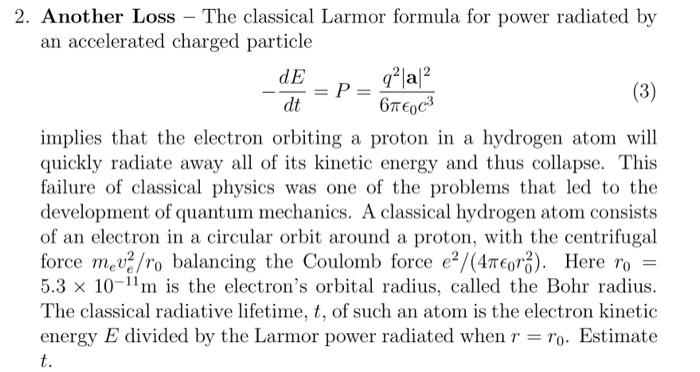
Problem:
Consider a classical hydrogen atom: an electron of mass and charge in a circular orbit of radius around a stationary proton of charge .
-
Find the Acceleration: The electron is held in orbit by the Coulomb force. By equating the Coulomb force to the centripetal force (), derive an expression for the electron's acceleration, , in terms of , and .
-
Find the Radiated Power: Substitute your expression for acceleration from part 1 into the Larmor formula to find the power radiated by the electron as a function of its orbital radius .
-
Analyze the Energy Loss: The total energy of the electron in a circular orbit is given by . The radiated power is the rate at which the atom loses energy, so .
- (a) Based on your result from part 2, does the electron radiate energy faster or slower as it gets closer to the nucleus (i.e., as decreases)?
- (b) What does this imply about the final moments of the atom's collapse? Is it a gentle settling or a rapid plunge?
-
The Second Flaw (Conceptual Question): As the electron spirals inward, its orbital radius and its orbital frequency continuously decrease. What would the spectrum of the emitted light look like? How does this compare to the experimental observation of discrete, sharp spectral lines that we will discuss in the next module?
Insights from the Collapse
Solving the full differential equation from the problem above shows that a classical hydrogen atom starting at a typical atomic radius would collapse in about seconds. This is not a subtle discrepancy; it is a prediction that is wrong by many orders of magnitude. The universe has existed for billions of years, not picoseconds.
This "classical catastrophe" is one of the most important failures in the history of physics. It demonstrates, in the starkest terms possible, that the laws of Newton and Maxwell, which work so perfectly on the macroscopic scale of planets and electrical generators, simply do not apply without modification to the microscopic scale of the atom.
Furthermore, your answer to question 4 reveals a second, equally devastating flaw. A spiraling electron would radiate light at a continuously changing frequency, producing a continuous spectrum—a "rainbow" of light. This directly contradicts the experimental fact that atoms emit and absorb light only at very specific, discrete frequencies (line spectra), a unique fingerprint for each element. Rutherford's model, in its classical form, could explain neither the stability of atoms nor their characteristic light spectra.
Physics had hit a wall. The beautiful, experimentally-grounded nuclear model was correct in its architecture, yet it was impossible under the known laws of physics. It was clear that a radical new idea was needed to explain how an electron could exist in an atom without radiating its energy away.
Conclusion
In this lesson, we have laid bare the profound crisis that faced physics in the early 20th century. Rutherford gave us the correct layout of the atom, but classical mechanics and electromagnetism predicted its immediate demise.
Key Takeaways:
- A Chain of Failure: An orbiting electron is accelerating, an accelerating charge radiates energy, and energy radiation leads to orbital decay and atomic collapse.
- A Quantitative Catastrophe: The predicted lifetime of a classical atom is infinitesimally short (), in complete contradiction to the observed stability of matter.
- The Spectroscopic Failure: The classical model predicts a continuous emission spectrum, whereas experiments show discrete line spectra.
- The Need for a New Physics: The failure was not in Rutherford's model of atomic structure, but in the classical laws used to describe its dynamics. This crisis was the essential catalyst for the development of quantum mechanics.
We are now poised at a turning point. In our next module, we will examine the first bold step into the quantum world. We will meet Niels Bohr, who, in a move of "desperate genius," proposed a set of revolutionary postulates that saved the atom by simply declaring that certain classical rules no longer applied. His model, while ultimately incomplete, was the crucial bridge from classical failure to quantum reality.