Introduction
In our last lesson, we confronted the "classical catastrophe." We established that Rutherford's nuclear atom, while structurally correct, was doomed to instantaneous collapse according to the laws of classical electromagnetism. We saw two profound failures: the atom should be unstable, and as it collapses, it should emit a continuous rainbow of light. The very fact that you and the world around you are stable and not glowing continuously is proof that classical physics has reached its limit.
Today, we will dissect the second failure—the problem of light. The light emitted by atoms is not the continuous smear predicted by classical theory. Instead, it is a coded message, a series of sharp, distinct lines of colour that act as a unique fingerprint for each element. Our learning goal is to interpret these atomic emission spectra as the crucial empirical clues that demanded a non-classical explanation. We will move from being theoreticians pointing out a paradox to being experimentalists looking at the hard data that nature provided. This data, more than any theoretical argument, forced a revolution in physics.
The Message in the Light: Atomic Spectra
When a pure element, in its gaseous form, is energized—by heating it or passing an electric current through it—it emits light. If you pass this light through a prism, you do not see a continuous spectrum like a rainbow. Instead, you see a set of discrete, bright lines against a dark background. This is called an emission spectrum.
Conversely, if you shine a continuous spectrum of white light through a cool gas of the same element, you see a rainbow with specific dark lines missing. These dark lines are at the exact same wavelengths as the bright lines in the emission spectrum. This is an absorption spectrum.
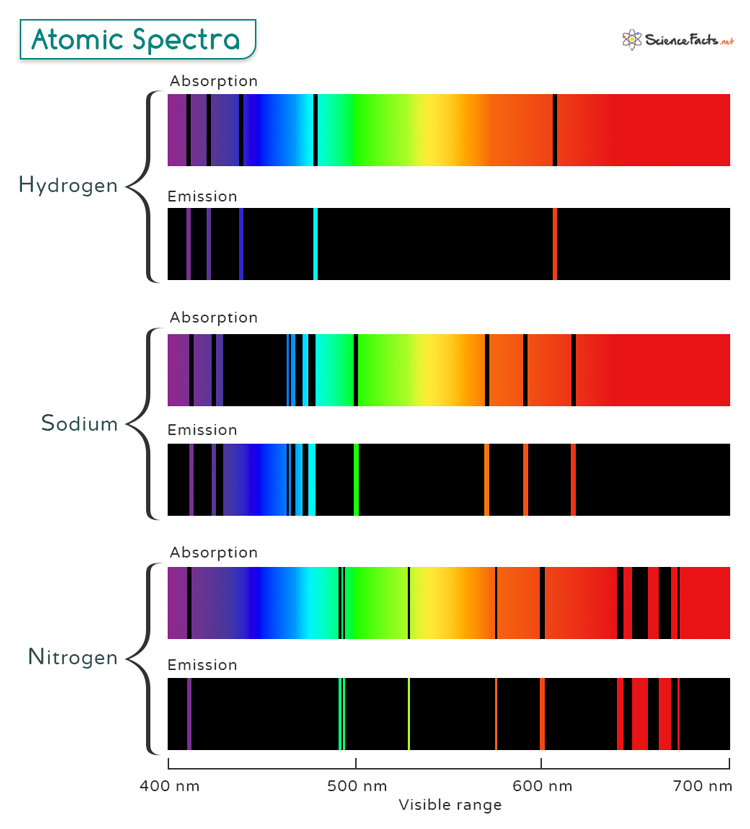
This experimental reality presents a deep mystery. Why do atoms only emit and absorb light at these specific, "allowed" wavelengths? A classical electron spiraling into the nucleus would change its orbital frequency continuously, emitting light of all wavelengths and creating a continuous spectrum. The existence of these sharp lines is a direct contradiction of the classical model. It's as if the atom has a set of internal rules that only permit it to interact with light of very particular energies.
Finding the Pattern: The Rydberg Formula
For a time, these spectral lines were a chaotic collection of data. However, scientists began to search for mathematical patterns, much like Kepler found patterns in Tycho Brahe's planetary data. In 1885, a Swiss schoolteacher named Johann Balmer found a simple empirical formula that predicted the exact wavelengths of the four visible lines of the hydrogen spectrum.
This was soon generalized by Johannes Rydberg into a comprehensive formula that described all known spectral lines of hydrogen, including those in the ultraviolet (Lyman series) and infrared (Paschen series).
To understand this crucial empirical step, let's watch a video that details these discoveries and the resulting formula.
Quantum Chemistry 1.3 - Rydberg Formula
The video 'Quantum Chemistry 1.3 - Rydberg Formula' from the channel TMP Chem explains how the seemingly random spectral lines of hydrogen were organized into a single, elegant, and predictive mathematical formula. Pay close attention to the structure of the final formula.
Please watch the video from the beginning to 06:26. Focus on: The experimental setup for observing spectra. The individual discoveries of Balmer, Lyman, and Paschen for different regions of the spectrum. The final, generalized Rydberg formula and the crucial, non-classical appearance of integers in it.
The Rydberg formula is:
where is the Rydberg constant, and and are integers ().
This formula was a monumental achievement, but it's essential to understand its status: it was purely empirical. It perfectly described what was happening but offered no explanation for why. Why this specific mathematical form? And most provocatively, why integers? Nature, at its most fundamental level, appeared to be counting. Classical physics, built on continuous functions and variables, had no place for such discrete integer steps.
Guided Discovery: Decoding the Rydberg Formula
Let's now step into the shoes of a physicist at the turn of the 20th century. You have the failed classical model on one hand and the successful but mysterious Rydberg formula on the other. Let's see if we can deduce the structure of the atom from the code hidden in this formula.
Problem:
-
The Core Contradiction: In your own words, explain the fundamental conflict between the prediction of a classical spiraling electron (as discussed in our last lesson) and the experimental evidence presented by atomic line spectra. Why can't the classical model produce sharp lines?
-
The Strangest Feature: Look at the Rydberg formula. From the perspective of classical physics, what is the most unusual and non-intuitive feature of this equation? Explain why this feature suggests that the processes inside the atom are governed by rules different from the ones that govern planets or billiard balls.
-
From Wavelength to Energy: The energy of a photon is given by Planck's relation, , and we know that for light, .
(a) Combine these to express the photon's energy in terms of its wavelength .
(b) Now, use your result from (a) and the Rydberg formula to write an equation for the energy of the photon emitted by a hydrogen atom. Your equation should be in terms of and . -
The Conceptual Leap: Your equation from 3(b) has the form . The law of conservation of energy dictates that the energy of the emitted photon must equal the energy lost by the atom.
(a) If we write this as , what does this imply about the possible energy values () that an electron can have inside a hydrogen atom?
(b) What mathematical form must these allowed energy "levels" take? (Hint: Compare the structure of your equation to the structure of the equation in 4(a)).
Insight: The Spectrum as an Architectural Blueprint
Your work on the guided discovery problem reveals the profound insight hidden within the spectral data. The Rydberg formula is more than just a pattern; it is a blueprint for the atom's energy architecture.
The fact that the emitted photon's energy is a difference between two terms, each depending on an integer squared, strongly implies that the electron inside the atom cannot have just any energy. It must exist in one of a set of discrete, "stationary" energy states, or levels. The energy of these levels is quantized, described by , where is an integer.
A spectral line is the result of an electron "jumping" from a higher energy level () to a lower one (), releasing the energy difference as a single photon of a specific wavelength. The atom doesn't radiate continuously because the electron doesn't spiral; it transitions instantaneously between these allowed states.
Niels Bohr himself, in his 1922 Nobel Lecture, eloquently contrasted the stability of atoms with the instability of classical systems:
[PDF] Niels Bohr - Nobel Lecture
In his Nobel Lecture, Bohr explains why the definite and unchangeable properties seen in spectra are impossible to understand with classical mechanics, where outcomes depend on history (like the formation of the solar system).
Please read the section titled 'Atomic stability and electrodynamic theory'. Focus on Bohr's argument that the unchangeable nature of spectral lines, independent of an atom's history, demands a non-classical stability that is impossible in systems like planetary orbits.
The discrete spectrum, therefore, is not a minor anomaly; it is the definitive experimental verdict that the internal dynamics of the atom are quantized. The failure of classical physics wasn't just a theoretical prediction; it was a daily reality in every spectroscopy lab.
Conclusion
Today, we have seen how the puzzle of atomic structure was guided by direct experimental evidence. The crisis of the classical atom wasn't just a thought experiment; it was a stark contradiction with observed reality.
Key Takeaways:
- Spectra are Discrete: Atoms emit and absorb light only at specific, characteristic wavelengths, creating line spectra that act as elemental "fingerprints."
- The Rydberg Formula: This empirical formula masterfully described the mathematical pattern of hydrogen's spectrum, revealing an underlying structure based on integers.
- The Empirical Demand for Quanta: The discrete nature of spectra and the integer dependence of the Rydberg formula are incompatible with the continuous nature of classical physics. They serve as direct experimental proof that energy within an atom is quantized.
- Energy Levels: The structure of the Rydberg formula implies that electrons exist in discrete energy levels, and spectral lines are produced by electrons transitioning between these levels.
We have now established the empirical foundation. We know that the atom's energy is quantized because the light it emits is quantized. The next logical question is how. How can we build a model of an atom that has these properties? In our next lesson, we will examine Niels Bohr's brilliant and audacious model, which was the first serious attempt to build a theoretical structure upon this empirical foundation.