Introduction
In our last lesson, we established the "architectural rules" for building atoms: the Aufbau principle, the Pauli exclusion principle, and Hund's rule. By applying them, we can now determine the ground-state electron configuration for any element, essentially creating a blueprint of its electronic structure.
Today, we transition from the blueprint to the building itself. We will explore how this underlying electron architecture gives rise to one of the most fundamental, tangible properties of an atom: its size. Our learning outcome is to predict and justify the periodic trend in atomic radius using the concepts of effective nuclear charge and the principal quantum number.
This is a crucial step in our journey. It connects the abstract quantum world of orbitals and electron configurations to the measurable, physical properties that drive chemical behavior. The "size" of an atom, as we will see, is a direct consequence of the constant tug-of-war between the nucleus and its electrons.
The Problem of "Size" and the Forces at Play
Before we can discuss trends, we must confront a philosophical point: what does the "size" of an atom even mean? An electron's wave function extends, in principle, to infinity. Atoms are not hard spheres with definite edges, but fuzzy clouds of probability.
Operationally, chemists define atomic radius in various ways, often by measuring the distance between the nuclei of two bonded atoms and dividing by two. For our purposes, think of the atomic radius as the typical extent of the outermost, or valence, electron cloud.
The size of this cloud is determined by a dynamic equilibrium between two opposing forces, both rooted in Coulomb's Law ():
- Attraction: The electrostatic pull between the positively charged nucleus ( protons) and the negatively charged valence electrons. This force pulls the electron cloud inward, seeking to minimize the atom's size.
- Repulsion & Shielding: The repulsion between electrons. Critically, the inner-shell (core) electrons act as a "shield," partially canceling out the full nuclear charge. The valence electrons, therefore, do not feel the pull of all protons.
This leads us to a central concept: the Effective Nuclear Charge (). This is the net positive charge experienced by a valence electron. We can approximate it with a simple formula:
Where is the actual nuclear charge (the atomic number) and is the shielding constant, which we can approximate as the number of core electrons.
To build a deeper physical intuition for these competing factors, let's watch a short video that frames the discussion in terms of fundamental physics.
Ionization Energy, Electron Affinity, Atomic Radius, Ionic Radii, Electronegativity, Metal Character
This video from The Organic Chemistry Tutor grounds the discussion of atomic radius in the first principles of electrostatic forces. It will help us connect the abstract trends to the underlying physics of attraction and distance.
Please watch the segment from 00:58 to 03:21. Focus on the two key factors identified: the magnitude of the charges (more protons mean more attraction) and the distance between them. How does this relate to the concepts of nuclear attraction and shielding?
Now, with this framework of attraction () and distance (determined by the principal quantum number, ), we are ready to analyze the structure of the periodic table.
Trend 1: Across a Period (Left to Right)
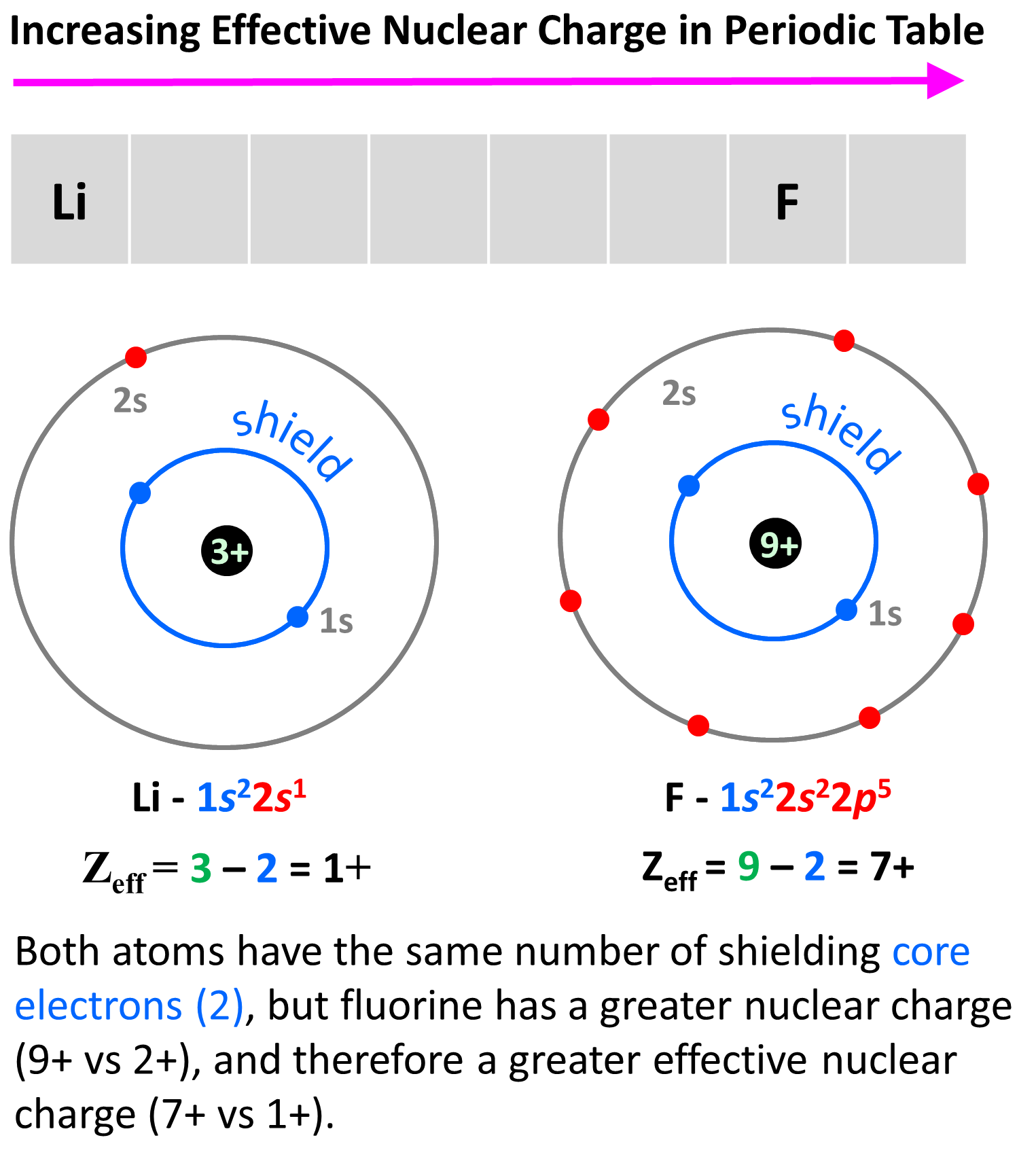
Let's examine the trend as we move from left to right across a period, for example, from Lithium (Li) to Fluorine (F).
The empirical observation is that atomic radius decreases across a period.
Why? Let's analyze our two key variables:
- Principal Quantum Number (): For every element in Period 2 (Li, Be, B, C, N, O, F), the valence electrons are being added to the same shell (). The "house" isn't getting a new floor; we are just adding more occupants to the current top floor.
- Effective Nuclear Charge ():
- Lithium (Li): Z=3, Core electrons=2 (in 1s). So, .
- Fluorine (F): Z=9, Core electrons=2 (in 1s). So, .
As we move across the period, the nuclear charge increases, but the number of shielding core electrons remains constant. The result is a steady and significant increase in the effective nuclear charge (). The valence electrons are pulled progressively closer to the nucleus, causing the entire valence shell to contract.
The following image provides a clear visual summary of this effect.
Now, let's watch a video that animates this process and walks through the calculation of .
Effective Nuclear Charge, Shielding effect, & Periodic Properties Tutorial; Crash Chemistry Academy
This clip from Crash Chemistry Academy provides an excellent visualization of why the radius shrinks across a period. Pay close attention to how it represents the constant shielding versus the increasing nuclear pull.
Please watch the segment from 06:37 to 09:09. Observe how the model for Beryllium and Fluorine demonstrates the increase in Zeff and the corresponding decrease in atomic size.
Trend 2: Down a Group
Now, let's consider moving down a group, for example, the alkali metals: Lithium (Li), Sodium (Na), Potassium (K).
The empirical observation is that atomic radius increases down a group.
This might seem straightforward, but the reasoning holds a subtle trap that we must carefully navigate. Let's analyze our factors:
- Principal Quantum Number (): This is the dominant factor here. As we move from Li () to Na () to K (), we are adding a completely new, higher-energy electron shell. The valence electron is, by definition, in an orbital that is much further from the nucleus.
- Effective Nuclear Charge (): Using our simple approximation:
- Li (Z=3, S=2) →
- Na (Z=11, S=10) →
- K (Z=19, S=18) →
In this simple model, appears to be constant for a group. The increase in size is therefore explained entirely by the addition of new shells ().
Effective Nuclear Charge, Shielding effect, & Periodic Properties Tutorial; Crash Chemistry Academy
Let's watch the next segment from the same video, which explains this trend down a group.
Watch from 09:09 to 13:38. Focus on how the addition of a new principal energy level is presented as the primary reason for the size increase, while Zeff is treated as roughly constant.
A Deeper Look: Is Really Constant?
Your intuition for first principles might be questioning the simplicity of this model. You might ask: "Is the shielding from 10 core electrons in Sodium truly 10 times as effective as the shielding from 2 core electrons in Lithium?"
The answer is no. As orbitals become larger and more diffuse for higher , the core electrons become less efficient at shielding the nucleus. A more rigorous calculation shows that actually increases slightly as you go down a group.
This presents a paradox: if the net pull () gets stronger, why does the atom get bigger? This is a point of frequent confusion, and it is worth clarifying.
The following discussion from Chemistry Stack Exchange directly tackles this advanced point. It's a perfect example of refining a simple model to arrive at a deeper truth.
Read the accepted answer by Szgoger and the second answer by Withnail. Pay special attention to Szgoger's comment explaining the resolution and Withnail's distinction between Zeff (an apparent charge) and the actual force governed by Coulomb's Law.
The resolution is a matter of hierarchy of effects. The increase in radius due to adding a new, much larger shell (increasing ) is a massive effect. The slight increase in provides a slightly stronger pull, but it is nowhere near enough to counteract the huge increase in distance. Remember Coulomb's law: force diminishes with the square of the distance. The jump from to is the dominant factor, and the atom gets bigger despite the slightly stronger effective nuclear pull.
Guided Discovery Problem
Let's synthesize these ideas to predict and explain the relative sizes of different atoms.
Problem:
(a) Across a Period:
Consider the elements Magnesium (Mg, Z=12) and Sulfur (S, Z=16).
i. Write their shorthand electron configurations.
ii. Identify the principal quantum number () for their valence electrons.
iii. Estimate their effective nuclear charge ().
iv. Based on your analysis, predict which atom is smaller and provide a concise justification.
(b) Down a Group:
Consider the elements Oxygen (O, Z=8) and Selenium (Se, Z=34).
i. Identify their group and the principal quantum numbers for their respective valence shells.
ii. Explain why Selenium is significantly larger than Oxygen, making sure to correctly describe the roles of both and .
(c) A Mixed Challenge:
Rank the following four elements from smallest to largest atomic radius: Nitrogen (N), Silicon (Si), Fluorine (F), Phosphorus (P).
Justify your ranking with a clear, step-by-step argument. (Hint: First, locate them on a periodic table. Use the trends to make pairwise comparisons before assembling the final order.)
(d) Thinking Ahead: The Size of Ions
i. Consider a Sodium atom (Na) and a Sodium ion (Na⁺). Which is larger? Why? What fundamental change in the atom's structure occurred?
ii. Now consider a Chlorine atom (Cl) and a Chloride ion (Cl⁻). Which is larger? Why? Here, the nuclear charge has not changed. What has?
- Insight from the Problem: This problem forces you to treat the two trends not as separate rules to be memorized, but as outcomes of the same underlying principles. The key to the mixed challenge (c) is to realize that the effect of changing the principal shell () is much more dramatic than moving across a period. The ion questions (d) push the concepts of nuclear pull and electron-electron repulsion further, demonstrating that they are versatile tools for explaining not just neutral atoms, but charged species as well. This directly sets the stage for understanding why it takes energy to create these ions in the first place.
Conclusion
Today, you have bridged the gap between electron configuration and physical reality. By analyzing the balance of competing forces, you can now predict and, more importantly, justify the periodic trends in atomic size.
Key Takeaways:
- Atomic radius is a dynamic equilibrium between the inward pull of the effective nuclear charge () and the spatial extent of the valence shell, defined by the principal quantum number ().
- Across a period, is constant while increases, causing the atomic radius to decrease.
- Down a group, the addition of a new electron shell (increasing ) is the dominant effect, causing the atomic radius to increase, even though also increases slightly.
- The "rules" for periodic trends are not arbitrary; they are the logical consequences of Coulomb's Law applied to the quantum mechanical structure of the atom.
In our next lesson, we will explore a direct consequence of these ideas: ionization energy. The energy required to remove an electron is intimately tied to how strongly it is held by the nucleus. Having mastered the concepts of atomic radius and effective nuclear charge, you are now perfectly prepared to understand why some elements give up their electrons easily while others hold on to them tenaciously.