Introduction
In our recent lessons, we have assembled the complete conceptual toolkit for understanding the electronic structure of atoms. We began with the Pauli Exclusion Principle, the fundamental quantum rule that forbids electrons from sharing a quantum state, thus giving matter its structure. We then explored how shielding and penetration cause orbitals within a shell to have different energies, leading to the general filling order described by the Aufbau principle. Finally, we unpacked Hund's rule, revealing that the drive for maximum spin multiplicity is a subtle quantum effect—exchange energy—that minimizes electron-electron repulsion.
Today, our objective is to synthesize these three pillars—Pauli's Principle, the Aufbau Principle, and Hund's Rule—into a single, coherent procedure. Your learning outcome is to apply these principles to write the ground-state electron configuration for any given element. This isn't just a mechanical exercise; it is about learning to predict the most stable arrangement of electrons by consistently applying the principle of energy minimization.
The Three Rules of Atomic Architecture
Let's begin with a concise review of the three rules that govern how electrons build up an atom. Think of them as a hierarchy of constraints.
- The Aufbau Principle (The Energy Rule): Electrons occupy the lowest energy orbitals available first. This principle dictates the sequence of filling.
- The Pauli Exclusion Principle (The Occupancy Rule): No two electrons in an atom can have the same set of four quantum numbers (). This means any single orbital can hold a maximum of two electrons, and if it does, their spins must be opposite (paired, ↑↓).
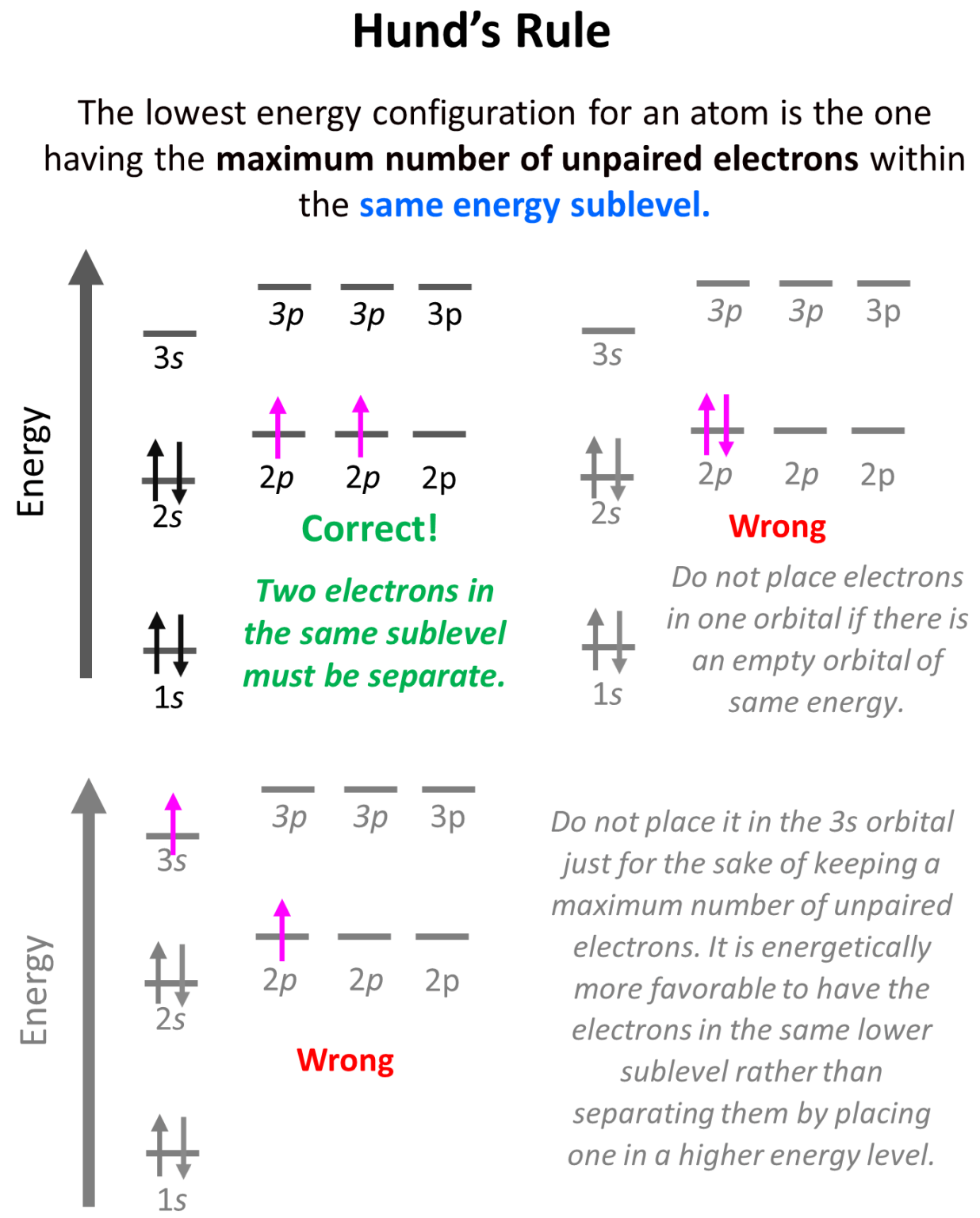
- Hund's Rule (The Degeneracy Rule): When filling a set of degenerate orbitals (like the three p-orbitals), electrons will first occupy each orbital singly with parallel spins (↑) before any orbital is doubly occupied.
Here are two quick visual reminders for the Pauli Exclusion Principle and Hund's Rule.

The combination of these rules gives us a systematic "building-up" process, or Aufbau in German.
Atomic Structure: The Building-Up Principle
To formalize this process, please read the following text. It introduces the Aufbau principle and connects it to the other two rules, providing the standard order of orbital occupation.
Please read the sections titled 'The building-up principle' and 'Hund's rule'. Focus on the logic of feeding electrons into the established orbital energy order while respecting the constraints imposed by the Pauli principle and Hund's rule.
The "Why" of the Filling Order
The filling order provided in the text (1s, 2s, 2p, 3s, 3p, 4s, 3d, ...) is the direct result of the energy landscape created by shielding and penetration, which we've discussed before. The apparent oddity of filling the 4s orbital before the 3d is one of the most important consequences of this.
To reinforce your intuition for why this order arises, let's watch a video that connects the abstract orbital shapes to their resulting energies.
I learnt chemistry using physics! (It blew my mind)
This video provides an excellent physical justification for the orbital energy ordering, especially the 4s vs. 3d case. It frames the topic as a process of discovery, which aligns with our approach.
Please watch the segment from 15:24 to 23:45. Pay close attention to the argument about orbital penetration. How does the ability of the 4s orbital to 'penetrate' the inner electron shield make it lower in energy than the 3d orbital, despite being in a higher principal shell?
The key insight is that orbital energies are not fixed; they are a consequence of the interplay between nuclear attraction and electron-electron repulsion. The 4s orbital, despite its larger average radius, has a small but significant probability of being found very close to the nucleus, "penetrating" the shield of core electrons. This taste of the full nuclear charge stabilizes it, dipping its energy just below the 3d orbitals for elements like Potassium and Calcium.
This entire process of electrons "stacking" into progressively higher energy levels is fundamentally mandated by the Pauli Exclusion Principle. Without it, all electrons would collapse into the 1s orbital.
Why can't you walk through walls? The Pauli Exclusion Principle Explained
To connect this back to first principles, let's briefly watch a clip that illustrates this 'stacking' effect as a direct consequence of the Pauli principle.
Watch the segment from 32:34 to 35:38. This explains how the Pauli Exclusion Principle forces electrons into higher energy states once lower ones are filled, which is the very essence of the Aufbau principle.
Guided Discovery Problem
Now, let's apply this integrated understanding. The Aufbau principle is a powerful guideline, but the ultimate rule is always energy minimization. The following problem explores a region of the periodic table where this distinction becomes critical.
Problem:
We will derive the electron configurations for elements in the first transition series (Scandium to Zinc), paying special attention to anomalies that reveal deeper principles.
(a) The Baseline:
Write the full and shorthand (noble gas) electron configurations for Potassium (K, Z=19) and Calcium (Ca, Z=20). Draw the orbital diagram for the valence electrons. Briefly explain why the 4s orbital is filled before the 3d orbitals.
(b) The Beginning of the d-block:
Write the shorthand electron configurations and valence orbital diagrams for Scandium (Sc, Z=21), Titanium (Ti, Z=22), and Vanadium (V, Z=23). Confirm that you are applying both Hund's rule and the Aufbau principle correctly.
(c) The First Anomaly: Chromium (Cr, Z=24)
i. First, predict the electron configuration for Chromium by strictly following the standard Aufbau filling order.
ii. The experimentally determined ground-state configuration is actually [Ar] 4s¹3d⁵. Draw the orbital diagrams for both your predicted configuration and the actual one.
iii. Propose a reason for this deviation. Consider the concept of exchange energy. How many pairs of parallel-spin electrons exist in the 3d subshell in the actual configuration versus your predicted one? How does the special symmetry of a half-filled d subshell contribute to its stability?
(d) The Second Anomaly: Copper (Cu, Z=29)
i. Predict the electron configuration for Copper by strictly following the standard Aufbau filling order.
ii. The experimentally determined ground-state configuration is [Ar] 4s¹3d¹⁰. Draw the orbital diagrams for both configurations.
iii. Explain this anomaly. What is special about a fully-filled d subshell? (Think about symmetry and shielding).
- Insight from the Problem: This exercise demonstrates that the "rules" are robust guidelines, but the underlying principle is always the pursuit of the lowest possible energy state. The anomalies for Chromium and Copper are not exceptions to be memorized; they are profound examples of the system optimizing itself. The enhanced stability of half-filled and fully-filled subshells is a real, measurable effect arising from the quantum mechanical benefits of exchange energy and charge distribution symmetry. You are balancing the small energy cost of promoting an electron from 4s to 3d against the larger energy payoff from achieving a more stable
dsubshell configuration.
Conclusion
You are now equipped to determine the ground-state electron configuration of any element. More importantly, you understand the physical reasoning behind the procedure.
Key Takeaways:
- Writing electron configurations is a systematic process governed by three principles: Aufbau (energy order), Pauli (occupancy limit), and Hund (degeneracy filling).
- The orbital filling order (1s, 2s, 2p, 3s, 3p, 4s, 3d...) is a direct consequence of the energy landscape created by nuclear charge, shielding, and orbital penetration.
- Anomalies like those for Chromium (Cr) and Copper (Cu) are not "exceptions" but rather powerful illustrations of the ultimate principle: energy minimization. The extra stability afforded by half-filled (
d⁵) and fully-filled (d¹⁰) subshells, due to maximized exchange energy and spherical symmetry, can outweigh the standard Aufbau filling order.
In our next lesson, we will see how these electron configurations are the direct cause of the periodic table's structure. The repeating patterns of valence electron configurations explain the periodic trends in atomic radius, ionization energy, and electron affinity, finally connecting the quantum world of orbitals to the macroscopic world of chemical properties.