Welcome to the first lesson of our second module, where we pivot from the broad religious and social reform movements of the 19th century to the specific political ideologies that shaped the destiny of the subcontinent's Muslims. In our previous lesson, we concluded our study of the Muslim renaissance by examining the ideological contributions of the Ulema, noting that their work created a deep, theological foundation for a separate Muslim identity. We contrasted this with the modernist, rationalist stream of thought championed by Sir Syed Ahmad Khan.
Today, we will delve into that modernist stream, focusing squarely on Sir Syed as a political thinker. This lesson directly addresses a recurring and high-yield topic in the CSS examinations: Sir Syed's political ideology, his evolving relationship with the Indian National Congress, and the strategic measures he devised to safeguard Muslim interests against the perceived threat of Hindu majority rule. By the end of this lesson, you will be able to construct a nuanced, evidence-based argument analyzing how he laid the political groundwork for Muslim separatism.
From Unity to Skepticism: The Making of a Political Thinker
To understand Sir Syed's later political doctrine, it is essential to first appreciate his initial stance. In the years following the 1857 War of Independence, Sir Syed was a fervent advocate for Hindu-Muslim unity and a shared Indian identity under the British Crown. His famous metaphor of Hindus and Muslims being the "two eyes of a beautiful bride" (India) captured this spirit of cooperation. He believed the path to progress lay in collective action and mutual trust.
[PDF] Sayyid Ahmad Khan and Hindu-Muslim Question in India
This research paper provides a detailed account of Sir Syed's early political thought. It will help you establish a baseline from which to measure his subsequent ideological shift.
Read the initial part of the paper, which details his early views on unity. Pay attention to his argument that "Hindu and Muslim are merely religious terms" and that all inhabitants of India constituted one nation. Also, note his famous bride analogy and his efforts to establish cross-community institutions like the British Indian Association.
This initial phase of his public life demonstrates that his later political separatism was not a preconceived notion but a conclusion he reached after a series of specific historical developments.
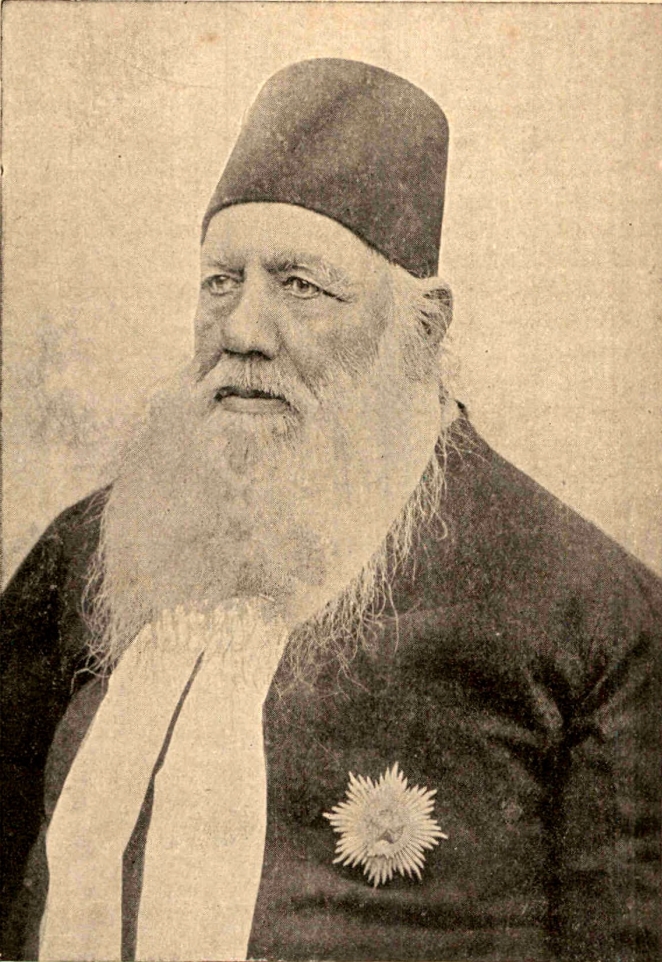
The Turning Point: The Urdu-Hindi Controversy of 1867
The first major fissure in Sir Syed’s vision of a united political future appeared over a cultural, not a political, issue. The demand by some prominent Hindus in Banaras to replace Urdu (in Persian script) with Hindi (in Devanagari script) as the official court language in the North-Western Provinces struck Sir Syed as a profound betrayal.
For him, Urdu was a shared heritage, a symbol of centuries of cultural synthesis. The campaign against it was, in his eyes, an attempt to erase the Muslim contribution to Indian civilization. This event was the catalyst for his political transformation.
[PDF] Sayyid Ahmad Khan and Hindu-Muslim Question in India
Continue with the same paper to understand the impact of the Urdu-Hindi controversy. This section is crucial as it marks the precise moment of his ideological pivot.
Read the section describing the controversy. Focus on the Hindu counter-proposal for a separate Hindi university and the demand to replace Urdu entirely. Most importantly, internalize his reaction. In a conversation with a British official, he expressed his conviction that this was the beginning of a rift that would lead to "total separation." He confided that he could now "clearly read the writing on the wall."
Pakistan Affairs Topic-5 : Ideology of Pakistan & Reformers | Sir Syed Ahmed khan | CSS | PMS
This video segment offers a concise summary of this pivotal transition, framed for a CSS exam perspective.
Watch the brief explanation starting from the discussion on how the Urdu-Hindi controversy caused him to switch from being a promoter of Hindu-Muslim unity to focusing solely on the Muslim community.
The Urdu-Hindi controversy convinced Sir Syed that the cultural and political interests of Hindus and Muslims were not just different, but potentially irreconcilable. If they could not agree on a shared language, how could they build a shared nation?
A New Political Ideology: The Peril of Majority Rule
Following the 1867 controversy, Sir Syed began to systematically analyze the political future of India. He studied the British political system and concluded that the democratic principle of "one person, one vote" would be disastrous for Muslims in the unique context of India.
His central argument was that representative democracy works only in culturally homogeneous societies. In a heterogeneous society like India, defined by deep religious divisions, a system of "election, pure and simple" would not lead to representation but to the tyranny of the majority. The numerically superior Hindu community, he argued, would "totally over-ride the interests of the smaller community."
This realization formed the core of his new political ideology and would guide all his subsequent actions. It was not an opposition to democracy in principle, but a pragmatic assessment of its application in a divided society.
Sir Syed Ahmed Khan & The Freedom Struggle
To gain a more critical and advanced understanding of Sir Syed's political views, it is essential to explore his social conservatism, which deeply informed his politics. This video by Dr. Ishtiaq Ahmed provides a scholarly critique that goes beyond the standard narrative.
Watch these two crucial segments: First, watch the part detailing his deeply conservative views on education, particularly his opposition to modern education for women and for Muslims from lower social strata. This reveals the elitist nature of his vision. Next, focus on his direct opposition to representative government and universal suffrage. His argument that men of "low caste," even with M.A. or B.A. degrees, should not be in positions of authority over high-born individuals is a stark illustration of his anti-democratic and hierarchical worldview. Understanding this elitism is key to a sophisticated CSS answer, as it shows his fear of majority rule was intertwined with a fear of losing the traditional social hierarchy.
Strategic Counter-Measures
Guided by this new ideology, Sir Syed formulated a two-pronged strategy to protect Muslim interests. This strategy was both passive (what Muslims should not do) and active (what they should do).
1. Political Aloofness: Opposition to the Indian National Congress
When the Indian National Congress (INC) was formed in 1885, Sir Syed saw it as the political embodiment of his fears. He viewed it not as a "national" body, but as a Hindu-dominated organization whose demands for competitive exams and elected councils would cement Hindu hegemony.
Consequently, his first strategic directive was clear: Muslims must remain aloof from the Congress. Joining it, he warned, would be politically suicidal. He famously argued that in a joint parliament, Muslims would be a "permanent minority," their voice consistently outvoted, much like the Irish members in the British Parliament.
[PDF] Sayyid Ahmad Khan and Hindu-Muslim Question in India
This is the most critical section for your exam preparation on this topic. It details Sir Syed's direct confrontation with the INC and lays out his political arguments.
Please read the entire section detailing his anti-Congress discourse. Focus on the following key points: His refusal to join the Congress and his reasoning that Muslims would be a permanent minority. His famous Lucknow speech of 1887, where he methodically broke down the four possible electoral scenarios, concluding that in every case, Muslims would lose out. Pay close attention to his analysis of how even with reserved seats, the power imbalance would remain, as the Hindu would have four dice to the Muslim's one. His Meerut speech of 1888, where he bluntly asked, if the British were to leave, "who will then rule India?" His answer—that one nation would inevitably overpower the other—is a direct precursor to the Two-Nation Theory.
2. Political Consolidation: Education and Alliances
Sir Syed's strategy was not merely negative. He knew that boycotting the INC was not enough; Muslims needed to build their own strength. This led to the active part of his strategy:
-
Educational Empowerment: He established the Muhammadan Educational Conference in 1886. While ostensibly an educational body, it was a political tool. It served as a parallel, all-India platform for Muslims to meet, discuss their collective problems, and develop a unified political consciousness, separate from the INC. His emphasis on modern education through the Aligarh Movement was designed to create an elite class of Muslims who could effectively negotiate with the British and lead the community.
-
Strategic Alliances: To counter the INC's influence, he formed the United Indian Patriotic Association in 1888. Crucially, this was not an exclusively Muslim organization. He invited anti-Congress elements from both communities, including influential Hindu rajas. This demonstrates that his opposition was targeted specifically at the INC's brand of majoritarian politics, not at Hindus in general.
[PDF] Sayyid Ahmad Khan and Hindu-Muslim Question in India
Finally, read this short concluding section which describes his active political counter-measure.
Focus on the formation of the United Indian Patriotic Association and note its inclusive, anti-Congress nature. This is a key piece of evidence for analyzing the nuances of his strategy.
Conclusion
Sir Syed Ahmad Khan's political ideology represents a foundational moment in the history of Muslim nationalism in South Asia. His journey from an advocate of Hindu-Muslim unity to the primary architect of Muslim political separatism was a direct response to specific historical events, most notably the Urdu-Hindi controversy. His core ideology was animated by a deep-seated and pragmatically argued fear that Western-style democracy in a culturally heterogeneous India would lead to the permanent political subjugation of the Muslim minority.
To counter this threat, he devised a sophisticated two-part strategy: first, a policy of political aloofness, advising Muslims to boycott the Indian National Congress, which he viewed as a vehicle for Hindu majoritarianism. Second, a proactive policy of consolidation, using the Muhammadan Educational Conference to foster a separate political consciousness and the United Indian Patriotic Association to build a cross-communal front against the INC. While his social views were profoundly conservative and elitist, his political diagnosis and strategic responses effectively laid the intellectual and political groundwork for the Two-Nation Theory and, ultimately, the creation of Pakistan.
Key Takeaways:
- Ideological Pivot: Sir Syed transitioned from a proponent of Hindu-Muslim unity to a political separatist, a shift catalyzed by the 1867 Urdu-Hindi controversy.
- Core Ideology: His political thought was centered on the belief that simple majority rule was unsuitable for India's religiously divided society and would lead to Hindu dominance.
- Critique of Democracy: His opposition to universal suffrage was rooted in both a pragmatic fear of majority rule and a deeply conservative, elitist social outlook that valued traditional hierarchy over individual rights.
- Strategy 1 (Passive): He formulated a policy of political aloofness from the Indian National Congress, which he identified as the primary threat to Muslim political interests.
- Strategy 2 (Active): He created parallel institutions like the Muhammadan Educational Conference and the United Indian Patriotic Association to consolidate Muslim strength and build anti-Congress alliances.
- Legacy: He is considered the first major political thinker to articulate the idea of Muslims as a separate political nation in the modern sense, providing the intellectual framework for the future Pakistan Movement.
In our next lesson, we will build directly on Sir Syed's contribution by critically analyzing the Two-Nation Theory itself—its historical and intellectual foundations, its articulation by later leaders, and its role as the central ideological pillar of the demand for Pakistan.