Welcome back. In our last lesson, we examined Sir Syed Ahmad Khan's political thought, concluding that he was the first to diagnose the core political problem facing Muslims in a post-British India: how to avoid subjugation by a permanent, and culturally distinct, Hindu majority. He identified the problem and proposed a strategy of political aloofness and educational uplift.
Today, we build directly on that foundation to explore the solution that emerged from his diagnosis: the Two-Nation Theory. This lesson will critically analyze the historical and intellectual foundations of this powerful ideology, which served as the ultimate justification for the creation of Pakistan. We will move beyond a simple definition to dissect its origins, key architects, and enduring legacy. This topic is central to many CSS exam questions, often requiring a nuanced understanding of its evolution and its role in the partition of India.
The Two-Nation "Reality" vs. The Two-Nation "Theory"
A sophisticated analysis, suitable for the CSS exam, begins by distinguishing between the reality of Muslim separateness and the theory that gave it political form. The idea that Muslims and Hindus constituted distinct societies was not an invention of 20th-century politicians. It was a lived reality observed for centuries.
The Two-Nation Reality versus Theory - Pakistan - DAWN.COM
This excellent article from Dawn introduces a crucial distinction that will elevate your analysis. It argues that a "reality" of separate identities existed long before the political "theory" was articulated.
First, read the section Rejection of state. Note the author's core argument: the "reality" of being distinct nations existed before the theory was formulated to explain it, much like gravity existed before Newton's theory. Then, read the section on Historic origins, paying attention to the mention of Al-Biruni's 11th-century observations on the profound differences between Hindu and Muslim societies. This provides the deep historical context for the theory.
This long-standing sense of cultural and religious distinctiveness eventually took on a clear geographical and demographic shape. By the early 20th century, it was possible to map the concentration of the subcontinent's Muslim population.
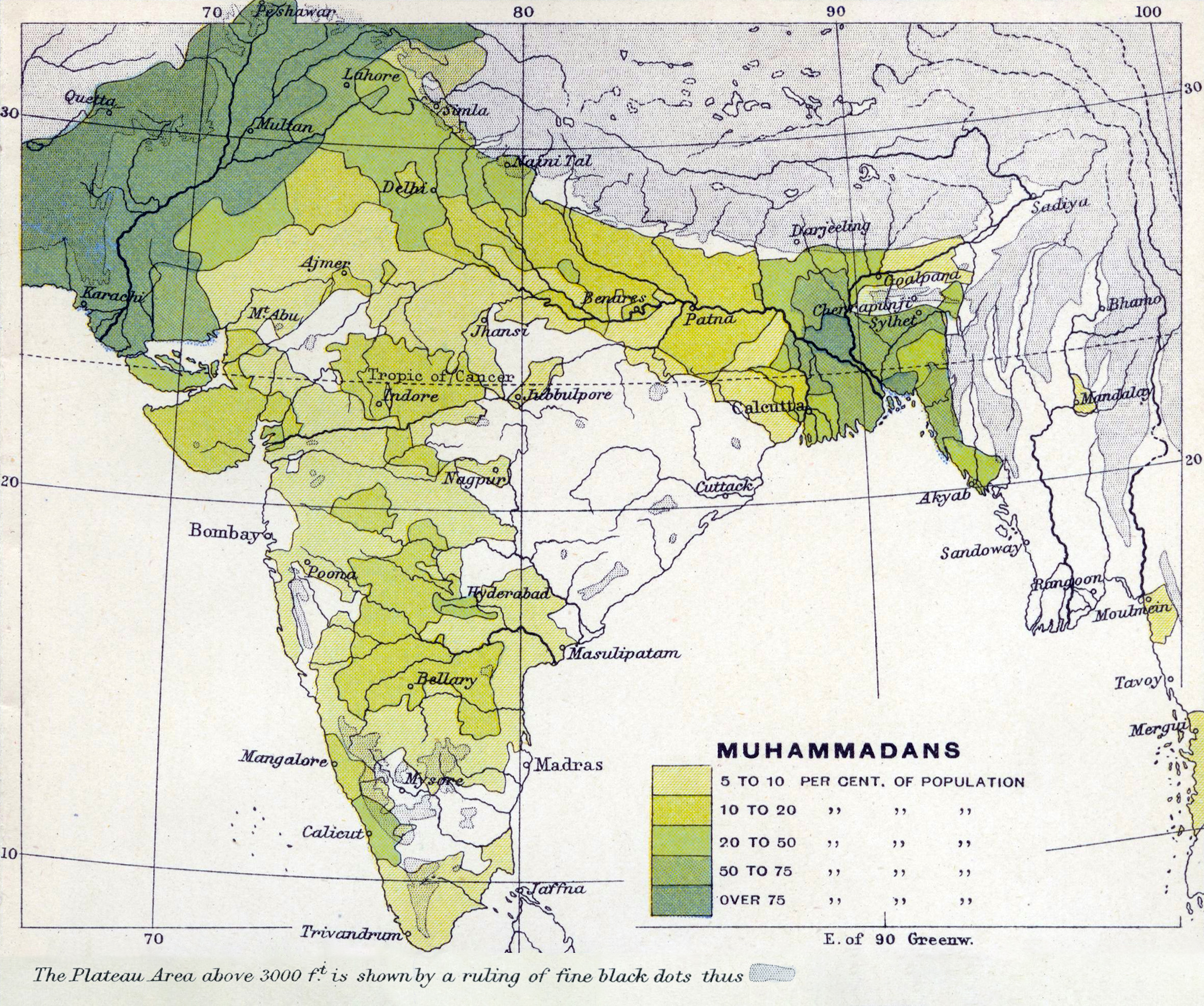
This map is not just a demographic chart; it is a visual representation of the "Two-Nation Reality" on the ground, decades before the Lahore Resolution. It shows that the idea of a separate political future for Muslims was rooted in a tangible demographic presence in specific, contiguous regions.
The Intellectual Architects: Formalizing the Theory
While the "reality" was old, the "theory" was new. It was the intellectual effort to translate the socio-religious differences into a modern political ideology. Building on Sir Syed's work, several key figures became the architects of this theory.
-
Allama Iqbal: The Visionary (1930)
In our last module, we explored various reform movements. Now we see how a philosopher and poet, Allama Iqbal, provided the first clear political vision. In his presidential address to the All-India Muslim League session in Allahabad in 1930, he synthesized the desire for religious preservation with the demand for political sovereignty. -
Chaudhri Rehmat Ali: The Namer (1933)
If Iqbal gave the vision, Chaudhri Rehmat Ali gave it a name and an uncompromising political goal. A student at Cambridge, he published a pamphlet titled "Now or Never; Are We to Live or Perish for Ever?". It was here that he coined the name "Pakistan" (from Punjab, Afghania [NWFP], Kashmir, Sindh, and Baluchistan).
The Two-Nation Reality versus Theory - Pakistan - DAWN.COM
Let's return to the Dawn article to trace the contributions of these key intellectual architects.
Read the sections Iqbal, Rehmat Ali, Jinnah and The name and the rationale. For Iqbal, focus on his 1930 Allahabad proposal for a consolidated North-West Indian Muslim state. Critically, note the author's point about Iqbal's subsequent clarification, which shows the idea was still evolving. For Rehmat Ali, pay close attention to the powerful excerpt from his Now or Never pamphlet, where he lists the fundamental differences—religion, culture, history, laws, customs—that make Muslims a distinct nation. This is a primary source articulation of the theory.
Iqbal provided the philosophical dream, and Rehmat Ali provided the concrete, powerfully named political objective. It fell to a third figure to transform this ideology into a nation-state.
The Political Articulation: Jinnah and the Failure of Federalism
It is a common oversimplification to assume the Two-Nation Theory was always a demand for a separate state. Its political articulation, particularly under Quaid-e-Azam Muhammad Ali Jinnah, was more nuanced and evolved in response to the political positions of the Indian National Congress.
The core of the political conflict was not just about religion, but about the future constitutional structure of India. Would it be a centralized, unitary state where the majority community's culture and politics would dominate? Or would it be a decentralized federation that gave meaningful autonomy to its diverse religious, cultural, and linguistic units?
Asialink Insights | One nation or two: The roots of India-Pakistan conflict | Asialink
This article from Asialink offers a crucial counter-narrative. It argues that Partition was not caused simply by the Two-Nation Theory, but by the Congress's failure to address the "federal question."
First, read the section defining the one-nation and two-nation theories. Next, read the section that introduces the underlying contest about the constitutional structure. Finally, and most importantly, read the section tracing the Muslim League's initial position. Note how it started by seeking safeguards within a united India (Fourteen Points), and how the Congress's shift towards a centralized system in the Nehru Report pushed the League towards separatism.
This perspective is vital for a strong CSS answer. It shows that the demand for Pakistan was not the starting point, but rather the conclusion reached after attempts at a federal, united India were rebuffed. The insistence on a highly centralized "one-nation" model by the Congress leadership made the "two-nation" solution seem like the only viable path to protect Muslim political, economic, and cultural interests.
Jinnah's pragmatism is further evident in his willingness to consider alternatives even late in the process.
The Two-Nation Reality versus Theory - Pakistan - DAWN.COM
This final reading from the Dawn article highlights the flexibility of the theory under Jinnah's leadership.
Read the section titled The Quaid's openmindedness. Focus on two key examples of Jinnah's flexibility: the Muslim League's acceptance of the 1946 Cabinet Mission Plan (which proposed a three-tiered confederation) and his endorsement of the proposal for a sovereign, united Bengal. These examples demonstrate that the goal was securing Muslim interests, and a separate state was the means, not an end in itself from the very beginning.
Critical Analysis: Answering the Key Objections
A critical analysis requires engaging with the main challenges to the theory.
1. Was it based on hatred?
The theory's proponents consistently argued it was based on difference, not animosity. The core argument was a political one: in a democratic system based on simple majority rule, a permanent minority with a distinct identity could not safeguard its future. It was a demand for political rights, not an expression of xenophobia.
2. Was it negated by the creation of Bangladesh in 1971?
This is the most frequent and powerful critique leveled against the Two-Nation Theory. The argument goes: if religion was the basis of nationhood, why did Muslim East Pakistan break away from Muslim West Pakistan?
The answer is complex and has two key dimensions:
- The "Two-Nation, Three-State" Reality: The first argument, presented in the Dawn article, is that 1971 did not negate the theory but modified it. East Pakistan chose to become Bangladesh; it did not choose to merge with Hindu-majority West Bengal or India. It re-asserted a distinct Muslim identity, albeit one with a stronger ethno-linguistic character. This created a "Two-Nation, Three-State" reality in the subcontinent.
- The Irony of Centralization: The second argument, presented powerfully in the Asialink article, is that Pakistan's own leadership failed to heed the lessons of its creation. After winning independence on a platform of federalism and minority rights, the Pakistani state ironically adopted the same centralizing, assimilationist policies it had accused the Congress of. The imposition of a single national language (Urdu) and a highly centralized state structure denied East Pakistan the cultural and political autonomy it expected, ultimately leading to secession.
Asialink Insights | One nation or two: The roots of India-Pakistan conflict | Asialink
To fully grasp this critical point, read the section from the Asialink article that discusses this irony.
Read the section starting with "Ironically...". It explains how Pakistan's post-colonial leadership used "Islam and Urdu as instruments of national identity" in the same way the Congress had used a secular "one-nation" identity, leading to the same result: the alienation of a major population group.
Conclusion
The Two-Nation Theory was not a monolithic or static idea. It was a dynamic ideology that evolved from a centuries-old "reality" of cultural difference into a formal political "theory" designed to solve the problem of Muslim minority status in a modern democratic state.
Key Takeaways for your CSS Exam:
- Reality vs. Theory: The reality of Hindu-Muslim distinctiveness predates the political theory by centuries. The theory was an attempt to explain and politicize that reality.
- Intellectual Evolution: The theory was shaped sequentially by Sir Syed (identifying the problem), Iqbal (providing the vision), Rehmat Ali (giving it a name), and Jinnah (transforming it into a state).
- The Federal Question: The demand for Pakistan was the culmination of a failed negotiation over federalism. The Congress's insistence on a centralized, unitary state was a significant contributing factor to the partition.
- Not Based on Hatred: The theory's primary justification was political and cultural preservation against the perceived threat of demographic and political domination, not religious hatred.
- The 1971 Debate: The separation of Bangladesh does not necessarily negate the theory but certainly complicates it. It can be interpreted as a shift to a "Two-Nation, Three-State" reality, and it stands as a stark warning about the dangers of centralized power and the failure to accommodate ethnic and linguistic diversity within a national framework.
In our next lesson, we will perform a deep dive into the intellectual cornerstone of this theory: Allama Iqbal's 1930 Allahabad Address. We will analyze his specific arguments for Muslim nationalism and explore how his poetic and philosophical vision provided the intellectual soul of the Pakistan Movement.