In our previous lesson, we explored Allama Iqbal’s sophisticated vision of an Islamic state as a dynamic, ethical polity grounded in social democracy. Iqbal provided the philosophical soul for a separate Muslim homeland, but it required a political architect of immense skill and determination to translate that vision into a geopolitical reality. That architect was Quaid-e-Azam Muhammad Ali Jinnah.
This lesson will trace Jinnah's remarkable political evolution, a journey that is central to understanding the genesis of Pakistan and is a recurring theme in CSS examinations. We will analyze his transformation through distinct phases, moving from his early role as the "ambassador of Hindu-Muslim unity" to his ultimate position as the primary proponent of a separate Muslim state. Our objective is to understand not just what happened, but why this shift occurred, examining the key events and motivations that shaped his path.
Phase 1: The Ambassador of Hindu-Muslim Unity (c. 1906–1920)
Muhammad Ali Jinnah entered politics not as a Muslim leader, but as an Indian nationalist. Steeped in the tradition of 19th-century British liberalism during his legal education in London, he was a firm believer in constitutionalism, the rule of law, and a united, self-governing India.
His initial political home was the Indian National Congress, which he joined in 1906. He saw it as the primary vehicle for achieving Indian self-rule through ordered, evolutionary progress. The following video provides an excellent overview of this initial phase, highlighting his commitment to a united Indian identity.
JINNAH AS AN INDIAN NATIONALIST (1906 - 1920)
This video from Dr. Ishtiaq Ahmed's series on the freedom struggle focuses specifically on Jinnah's early career as a nationalist.
Watch the opening segments to understand Jinnah's political beginnings. Note his joining of the Congress in 1906 and his initial opposition to the formation of the Muslim League, which he viewed as a move that would divide Indians. Then, watch the section covering his pivotal role in orchestrating the Lucknow Pact of 1916. Pay close attention to the concessions made by both the Congress and the Muslim League, especially the Congress's acceptance of separate electorates for Muslims.
The Lucknow Pact of 1916 stands as the pinnacle of this phase. Orchestrated by Jinnah, it was a landmark agreement between the Congress and the All-India Muslim League to present a common set of constitutional demands to the British. In this pact, the Congress formally accepted the principle of separate electorates for Muslims, a demand Jinnah had initially opposed but later accepted as necessary for securing Muslim trust. This achievement earned him the title "ambassador of Hindu-Muslim unity" from Sarojini Naidu, a leading Congress figure. His strategy was clear: to build a united front between the two major communities to press for self-government.
Phase 2: Disillusionment and Divergence (1920–1937)
The spirit of Lucknow was short-lived. The 1920s witnessed a fundamental shift in Indian politics that began to alienate Jinnah from the Congress. The primary catalyst was the rise of Mohandas Karamchand Gandhi and his introduction of mass civil disobedience and religious symbolism into the political arena, most notably through the Khilafat Movement.
Jinnah, the constitutionalist, was deeply uncomfortable with this populist, extra-constitutional approach. He believed it would stir religious passions and lead to mob rule, undermining the orderly path to freedom he cherished. In 1920, he famously walked out of the Congress session in Nagpur, refusing to endorse Gandhi's program.
The following reading explains the formative influences on Jinnah's liberal politics and how his priorities began to shift during this second phase.
Jinnah's Vision of Pakistan | Transnational Institute
This article by Sharif al Mujahid clearly outlines the phases of Jinnah's political career. It details his early liberal convictions and the beginnings of his shift.
Read the section titled "Jinnah as Liberal". Focus on Jinnah's constitutionalist approach and his reasons for leaving both the Congress and the Home Rule League when they adopted Gandhi's methods. Note the author's argument that while the strands of Indian nationhood and Hindu-Muslim unity continued, his efforts for Muslim unity became "increasingly pronounced."
The final blow to Jinnah's hopes for a united front came with the Nehru Report of 1928. This constitutional proposal, drafted by a committee led by Motilal Nehru, rejected the principle of separate electorates that had been agreed upon in the Lucknow Pact. Jinnah proposed a set of amendments to secure minimal Muslim rights, including one-third representation in the central legislature. When these were summarily rejected, he famously lamented it as the "parting of the ways."
His response was the Fourteen Points (1929), a comprehensive formula for safeguarding Muslim political rights within a federal Indian structure. This can be seen as his last major attempt to find a solution within a united India. Deeply disillusioned, Jinnah spent the early 1930s in a self-imposed exile in London.
Phase 3: The Paradigmatic Shift to a Separate State (1937–1947)
The event that triggered Jinnah's final and most decisive transformation was the aftermath of the 1937 provincial elections. The Muslim League performed poorly, while the Congress swept to power in a majority of provinces. Confident in its strength, the Congress refused to form coalition governments with the League, demanding instead that League members dissolve their party identity and join the Congress.
For Jinnah, this was irrefutable proof that in a united, democratic India, the Congress would use its brute majority to impose a Hindu-dominated rule, leaving Muslims with no real share in power. This experience convinced him that parliamentary democracy of the Westminster type was unsuitable for India. The two years of Congress rule (1937-39) were, in his view, marked by policies that threatened Muslim culture and identity, galvanizing Muslim opinion behind the League.
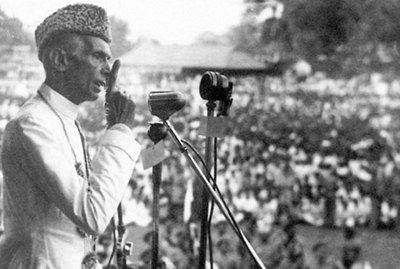
This period marked what the historian Sharif al Mujahid calls a "paradigmatic shift." Jinnah underwent a profound transformation:
- From Elite to Mass Leader: He began to reorganize the Muslim League from an elite club into a powerful mass movement.
- Adoption of Islamic Discourse: He shed his exclusively Western attire for the sherwani and karakuli cap in public, and began to frame his political arguments in Islamic terms, arguing that Muslims were a distinct "nation," not a minority.
- From Unity to Separation: The goal was no longer to find a place for Muslims within India, but to carve out a separate state where they could develop according to their own genius.
The following reading details this dramatic change in his political posture and rhetoric.
Jinnah's Vision of Pakistan | Transnational Institute
We return to the same article to analyze Jinnah's final transformation.
Read the sections from "Jinnah’s Transformation" to the end of the Id message quote. Pay close attention to how Jinnah began defining Muslims as a separate nation with a distinct civilization and culture. Note the explicit quotes where he links the Muslim League with Islam and presents the Quran as a complete code of life, a rhetorical strategy aimed at mobilizing the Muslim masses.
This evolution culminated in the Lahore Resolution of March 1940, where the Muslim League formally demanded the creation of independent Muslim states. From this point on, Jinnah became the unequivocal leader of the Pakistan movement, navigating the complex end-game of British rule with a single-minded focus on achieving a separate homeland for the Muslims of India.
Critical Analysis: The Driving Forces of Transformation
For your CSS exam, a simple chronological account is insufficient. You must critically analyze the forces behind Jinnah's evolution. Was he driven by ideology, political pragmatism, or personal ambition? Scholars debate this intensely.
The following video discussion presents multiple academic perspectives on this question.
JINNAH: HIS SUCCESSES, FAILURES AND ROLE IN HISTORY PANEL DISCUSSION
This panel discussion features prominent historians like Dr. Ishtiaq Ahmed and Dr. Pervez Hoodbhoy analyzing Jinnah's historical role and motivations. It offers the kind of critical depth needed for an advanced answer.
First, listen to Professor Misra's breakdown of Jinnah's political career into four distinct phases. This provides a clear analytical framework. Next, focus on the discussion between Dr. Hoodbhoy and Dr. Ahmed about the reasons for Jinnah's shift. Note the emphasis on the 1937 election defeat as the turning point where Jinnah realized the "religion card" was essential for political mobilization. Finally, listen to Dr. Ahmed's argument that Jinnah was determined to have India partitioned and used every argument, including creating fear of Hindu domination, to achieve his goal. This presents a strong counter-argument to the idea that Pakistan was merely a bargaining chip.
Two main interpretations emerge from scholarly analysis:
-
The Pragmatic Negotiator (Ayesha Jalal's Thesis): Prominent historian Ayesha Jalal argues that Jinnah's demand for "Pakistan" was initially a bargaining strategy. His goal was to secure iron-clad constitutional guarantees for Muslims and maximum provincial autonomy within a loose Indian federation or confederation. He used the threat of partition to raise the stakes, but was checkmated at the end by Congress's insistence on a strong, centralized state and Britain's haste to withdraw. In this view, the "moth-eaten" Pakistan he received was a compromise he was forced to accept.
-
The Determined Separatist (Ishtiaq Ahmed's Thesis): Other historians, like Ishtiaq Ahmed, argue that after 1937, Jinnah became genuinely convinced of the need for partition and pursued it with unwavering determination. He saw the Congress as an implacably Hindu body and believed that any form of united India would lead to the political and cultural subjugation of Muslims. In this view, his use of religious rhetoric and the Two-Nation Theory was not just a tactic, but a reflection of his conviction and a necessary tool to mobilize a scattered Muslim populace into a cohesive national force.
A strong CSS answer would acknowledge both perspectives, demonstrating an understanding of the historical complexity. It would conclude that Jinnah's evolution was likely driven by a combination of factors: his principled disillusionment with Congress's majoritarianism, his pragmatic realization that a new political strategy was needed after 1937, and his supreme confidence in his own ability to champion the Muslim cause.
Conclusion
Quaid-e-Azam Muhammad Ali Jinnah's political journey is a compelling narrative of ideological evolution shaped by political circumstances.
Key Takeaways:
- Phase 1 (Unity): Jinnah began as a liberal constitutionalist and Indian nationalist, whose crowning achievement was the 1916 Lucknow Pact, earning him the title "ambassador of Hindu-Muslim unity."
- Phase 2 (Disillusionment): The shift in Congress politics under Gandhi and the rejection of Muslim safeguards in the Nehru Report led to his deep disillusionment and the "parting of the ways."
- Phase 3 (Separation): The 1937 elections and the subsequent Congress ministries were the final catalyst, convincing Jinnah that Muslims needed a separate state to protect their political, economic, and cultural interests. He then transformed the Muslim League into a mass movement and successfully championed the cause for Pakistan.
- Analytical Debate: The motivations for his shift are debated, with some seeing it as a bargaining strategy for rights within a united India, and others as a determined pursuit of partition born from conviction.
In the next lesson, we will build upon this understanding by evaluating the specific leadership strategies Quaid-e-Azam employed to reorganize the Muslim League and articulate the demand for Pakistan, turning it from a resolution on paper into the world's largest Muslim state.