Greetings. In our last session, we delved into Pakistan's public health crisis, identifying it as a failure of governance where policy missteps in areas like sanitation and primary care have created profound human security challenges. Today, we transition from this discussion of human security to an examination of state security, focusing on Pakistan's cornerstone counter-terrorism strategy.
This lesson will evaluate the National Action Plan (NAP), including its objectives, implementation record, and impact on the security landscape. Born from a moment of national tragedy, the NAP represents the most comprehensive attempt to unify Pakistan's response to terrorism and extremism. We will dissect its origins, analyze its 20-point framework, and then conduct a critical, evidence-based assessment of its performance over the past decade. This will equip you with a nuanced understanding necessary for a high-level analysis in your CSS/PMS examinations.
The Genesis and Objectives of the National Action Plan
To evaluate the National Action Plan, we must first understand the context of its creation. The catalyst was the horrific attack on the Army Public School (APS) in Peshawar on December 16, 2014. This event created an unprecedented wave of public grief and anger, galvanizing a national consensus that the state's fragmented approach to terrorism was no longer tenable.
National Action Plan at 10: assessing Pakistan’s post-APS response - Newspaper - DAWN.COM
This retrospective article from Dawn captures the political atmosphere following the APS attack and the intent behind the NAP's creation.
Please read the introductory paragraphs, up to the end of the third paragraph. Focus on how the attack forced a political convergence and shaped the NAP's aim to be a "comprehensive strategy."
In response to this national demand for action, Pakistan's political and military leadership formulated a 20-point plan. This plan was ambitious in scope, aiming to tackle the menace of terrorism through both "kinetic" (military/force-based) and "non-kinetic" (ideological, legal, social) measures.
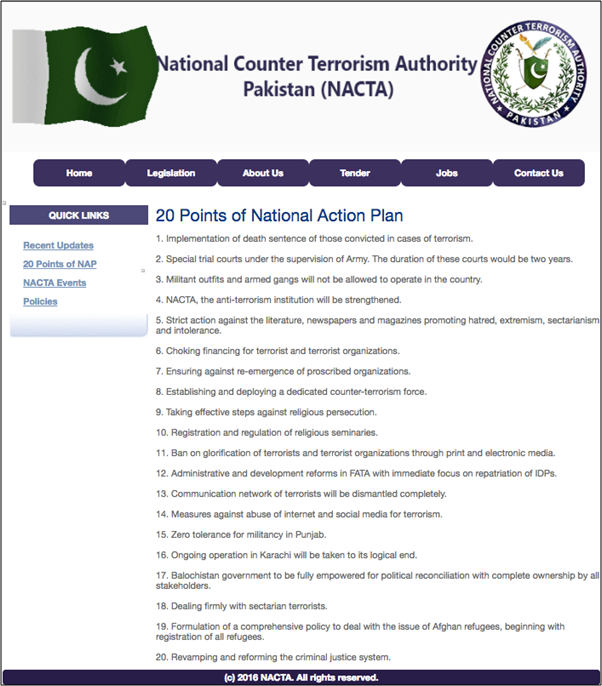
The security landscape, however, is not static. Following the withdrawal of US-led forces from Afghanistan and the Taliban's return to power in 2021, Pakistan faced a new wave of security challenges. This prompted a revision of the NAP into a more focused 14-point framework, which we will use as the basis for our evaluation.
A Quantified Evaluation of NAP's Implementation
A decade after its inception, the NAP has a mixed record. To move beyond generalities and provide a quantified analysis suitable for an exam answer, we will rely on a detailed 2025 report from the Institute for Strategic Studies, Research & Analysis (ISSRA).
This academic insight provides a point-by-point breakdown of the revised 14-point NAP, using data up to late 2024 and early 2025 to assess progress in each domain. It is an invaluable resource for building an evidence-based argument.
Read through the analysis from the Abstract to the end of the analysis (pages 19-26). As you read, categorize each of the 14 points based on the progress report: "good," "satisfactory," or "unsatisfactory." Pay close attention to the specific data points, tables, and figures used to justify each assessment. We will synthesize this information thematically.
Based on this detailed report, we can group the NAP's performance into several key areas.
1. Kinetic Operations and Intelligence Gathering
This domain covers the direct fight against militant groups.
- Successes: Point #7, concerning the strengthening of Counterterrorism Departments (CTDs), is rated as "good progress." Provincial police budgets, under which CTDs operate, have seen significant increases between 2021 and 2025, enhancing their operational capacity.
- Challenges: Point #1, "intolerance for militancy," is rated as "unsatisfactory." Despite the launch of Operation Azm-e-Istehkam in June 2024, which initially led to a sharp drop in attacks, the subsequent resurgence shows that the security situation remains volatile.

2. Countering the Ecosystem of Extremism
This involves tackling the financial, media, and ideological support systems for terrorism.
- Successes:
- Point #4, choking terror financing, is considered "good progress." Largely driven by pressure from the Financial Action Task Force (FATF), Pakistan established robust mechanisms that led to its removal from the FATF grey list in 2022. The number of proscribed persons has tripled, and millions of rupees in accounts have been frozen.
- Point #9, the regulation and registration of madaris, also shows "good progress." By 2023, approximately 30,000 madaris had been registered, bringing them into a formal documentation process.
- Challenges:
- Point #2, action against terrorism in media and cyberspace, shows mixed results. While the PTA has blocked over a million URLs, the Dawn article highlights a critical weakness: extremist content has migrated to less-regulated, encrypted platforms like Telegram, making it harder to track.
- Point #3, countering religious/sectarian terrorism, remains "unsatisfactory." The ISSRA report notes a rise in sectarian violence incidents and a slow pace of proscribing violent sectarian groups.
3. Legal and Judicial Reforms
This is arguably the weakest area of NAP's implementation.
- Failures:
- Point #6, ensuring the conclusion of counterterrorism cases, is rated "unsatisfactory." The report highlights a stark reality: while hundreds were sentenced to death between 2019 and 2022, no executions took place. As of late 2024, over 2,200 anti-terrorism cases remain pending.
- Point #12, Criminal Justice System (CJS) reforms, is similarly "unsatisfactory." The broader issues of an overburdened judiciary and overcrowded prisons persist, indicating a lack of meaningful systemic reform.
4. Socio-Political Integration and Regional Management
This area addresses the root causes of conflict and regional spillover.
- Mixed Record:
- Point #14, the repatriation of Afghan refugees, is deemed "satisfactory," with Pakistan initiating a large-scale program in collaboration with the UNHCR.
- Point #11, reforms in the merged areas of KP, is also "satisfactory," with significant investments in law enforcement and resource allocation efforts underway.
- However, Point #10, the reconciliation process in Balochistan, is rated "unsatisfactory." Despite development packages and the surrender of thousands of militants, deep-seated political and economic grievances continue to fuel instability.
Critical Analysis: An Implementation Deficit
The quantified data reveals a clear pattern: the National Action Plan has succeeded where there was a convergence of state capacity and strong external or internal pressure (e.g., terror financing under FATF scrutiny, kinetic operations). It has failed where implementation required navigating deep-seated structural problems in the judiciary and political system.
The Dawn article provides crucial insights into why this has happened, framing the NAP's story as one of an "implementation deficit."
National Action Plan at 10: assessing Pakistan’s post-APS response - Newspaper - DAWN.COM
This analysis by security experts and former officials explains the institutional hurdles that have plagued the NAP since its inception.
Please read the following sections for a critical perspective: Institutional Failure: Read the section "Reviewing Nacta" (Reviewing Nacta). Note the conclusion that NACTA, the body meant to lead the effort, has been hamstrung by a lack of funds, staff, and institutional power. Uneven Progress: Read the sections "NAP report card" and "Sectarianism and terrorists’ outreach" (NAP report card and Sectarianism). This part reinforces the mixed scorecard, crediting FATF for progress on terror financing but highlighting the persistent challenge of sectarianism. The Digital Frontier: Conclude with the paragraphs on the new digital challenges (digital realm challenges), which explain how militants have adapted their communication strategies, creating new blind spots for law enforcement.
The core arguments from analysts are clear:
- The plan was conceptually sound but poorly executed. As former NACTA coordinator Tariq Parvez states, the initial reduction in terrorism until 2018 was credited more to military operations than to the holistic implementation of NAP.
- The lead institution was never empowered. NACTA has remained a weak coordinating body, lacking the authority and resources to compel federal and provincial agencies to work in concert.
- Political will is inconsistent. The initial unity after the APS attack waned over time, and deep-rooted issues like judicial reform and tackling all forms of extremism without prejudice proved politically difficult.
- Militants are adaptive. As traditional media and funding channels were squeezed, extremist groups successfully pivoted to encrypted digital platforms, creating a new and complex challenge for the state.
Conclusion
The National Action Plan was born out of a national imperative to confront terrorism decisively. A decade on, its legacy is one of partial success and significant unfulfilled promise. A thorough evaluation reveals a clear distinction between intent and outcome.
- Key Takeaways:
- The NAP is a comprehensive framework that correctly identifies both kinetic and non-kinetic pillars for a successful counter-terrorism strategy.
- Implementation has been highly uneven. There have been measurable successes in areas like countering terror financing (largely due to FATF pressure) and strengthening CTD capacity.
- Major failures persist in crucial domains requiring deep structural change, most notably judicial and criminal justice reform, where a massive backlog of cases undermines the entire effort.
- The core problem is not the plan itself, but an implementation deficit rooted in institutional weakness (especially NACTA), inconsistent political will, and the adaptive nature of militant groups.
For your exam preparations, the most effective argument is that while the NAP provided a necessary strategic roadmap, its ultimate impact has been constrained by the very governance and institutional challenges it was meant to overcome.
In our next lesson, we will begin our exploration of Pakistan's foreign policy. We will start by analyzing the core determinants of Pakistan's foreign policy, examining how internal factors, including the security landscape shaped by initiatives like the NAP, influence its engagement with the wider world.