In our previous lesson, we examined how the Muslim press, through both impassioned agitation and strategic articulation, successfully mobilized popular support for the idea of Pakistan, making partition an unavoidable outcome by 1947. Today, we move from the political campaign to its devastating human consequences. Our focus is on the partition of Punjab, an event frequently tested in CSS examinations.
This lesson will analyze the profound impact of the 1947 division of Punjab on communal relations and the resulting mass displacement. We will explore why a region with a long history of syncretic culture descended into one of the most brutal episodes of sectarian violence in the 20th century. We will deconstruct the political decisions, the administrative collapse, and the anatomy of the violence itself to understand not just what happened, but why it happened with such ferocity.
The Unraveling of a Syncretic Society
Before 1947, and particularly in its urban centers like Lahore, Punjab was a testament to a deeply interwoven Indo-Islamic civilization. For centuries, Hindus, Muslims, and Sikhs had largely coexisted, creating a vibrant, hybrid culture. This was not a utopian society devoid of tension, but it was one where identities were fluid and shared traditions often outweighed religious divisions.
To understand the world that was lost, let's begin with a portrait of Lahore before the partition. In the following video, the historian Dr. Ishtiaq Ahmed, a Lahori himself, describes the city's cosmopolitan and progressive character.
The Battle for Lahore During the 1947 Partition
This clip from a lecture by Dr. Ishtiaq Ahmed, a leading scholar on the Punjab partition, paints a vivid picture of the pre-1947 social and political fabric of Lahore and Punjab.
Watch the opening segment from character of Lahore, where Dr. Ahmed describes it as a modern, forward-looking, and cosmopolitan city. Then, continue from Punjab's politics, paying close attention to his explanation of the Unionist Party's model of communal harmony under leaders like Sir Fazle Hussain and Sir Sikandar Hayat Khan, which maintained stability in the province until the 1940s.
As Dr. Ahmed explains, the Unionist Party, a cross-communal alliance of Muslim, Hindu, and Sikh landlords, successfully governed Punjab for decades by prioritizing regional interests over religious identity. However, this delicate balance began to crumble in the 1940s under the growing pressure of national-level, identity-based politics.
The erosion of this shared culture was a gradual process, accelerated by British colonial policies. To understand this long-term context, the following reading from The New Yorker is highly insightful.
The Bloody Legacy of Indian Partition
This article by historian William Dalrymple provides a scholarly overview of the partition. This section explains the deep roots of India's syncretic culture and how it began to polarize under British rule.
Please read the section beginning "The question of how". Focus on how it describes the emergence of a hybrid Indo-Islamic civilization over centuries and how the British policy of defining political communities based on religious identity began to undermine these shared traditions.
The article argues that by institutionalizing religious identity as the basis for political representation, the British inadvertently created the very divisions they later struggled to manage. This "ruptured community evolution" and set the stage for the political polarization that would consume Punjab.
The Politics of Partition and the Failure of Governance
The descent into chaos was not inevitable; it was precipitated by a series of political miscalculations and a catastrophic failure of governance.
-
Conflicting Political Demands: As Dr. Ishtiaq Ahmed details in his research, the political stage was set for conflict. The Muslim League, after its success in the 1945-46 elections, demanded the entirety of Punjab for Pakistan. In reaction, Sikh leaders, fearing domination in a Muslim-majority state, became the first to formally demand the partition of Punjab. The Indian National Congress, initially committed to a united India, eventually supported the province's partition as a way to secure a strong central government and prevent the entire, resource-rich province from going to Pakistan. The eminent historian Dr. Ayesha Jalal notes that Jinnah's focus on an all-India settlement left him unable to counter the provincial dynamics that led to Congress's success in partitioning Punjab and Bengal, ultimately undermining his vision.
-
The British Haste: Lord Mountbatten, the last Viceroy, made the fateful decision in June 1947 to bring forward the date of independence from June 1948 to August 15, 1947. This left a mere 72 days to divide a subcontinent and its assets. A British judge, Cyril Radcliffe, who had never been to India before, was given just 40 days to draw the borders, including the contentious line through the heart of Punjab.
-
Collapse of Administration: The provincial administration, once the bedrock of British control, disintegrated. The police force, which was about 73% Muslim as Dr. Ahmed notes in his lecture, became factionalized. British officials, aware of their imminent departure, were demoralized and largely powerless. The Punjab governor, Sir Evan Jenkins, repeatedly sent desperate reports to New Delhi warning of an impending civil war, but his warnings went unheeded. The specially created 50,000-man Punjab Boundary Force was deployed too late and was completely overwhelmed by the scale of the violence.

The Anatomy of Violence and 'Ethnic Cleansing'
The political breakdown created a vacuum that was filled by extreme violence. Beginning with riots in Rawalpindi in March 1947, which targeted Sikh and Hindu populations, the violence quickly spiraled. The resignation of the Unionist government and the imposition of Governor's Rule signaled the collapse of civil order.
Dr. Ishtiaq Ahmed's term for what happened in Punjab is "ethnic cleansing," where organized militias from all three communities—Muslim, Sikh, and Hindu—sought to eliminate the 'other' from their perceived territory to create homogenous populations.
The Battle for Lahore During the 1947 Partition
In this powerful segment, Dr. Ahmed provides a detailed, street-level account of how the violence erupted in Lahore in March 1947, transforming the city from a site of protest to a battlefield.
Watch the segment from Lahore's violence. Notice how a political event—Master Tara Singh's speech outside the Punjab Assembly—immediately triggered targeted violence, the involvement of student groups, and the start of a "ding dong battle" that culminated in organized arson and the exodus of Hindus and Sikhs.
The violence that engulfed Punjab was uniquely horrific in its nature and scale.
The Bloody Legacy of Indian Partition
These sections from William Dalrymple's article provide a stark, unfiltered account of the violence and the political climate that enabled it.
First, read the opening paragraphs, from the beginning of the article, to grasp the sheer scale of the death and destruction. Pay attention to the comparison with Nazi death camps. Next, read the section that begins "Hindus and Muslims had begun". This part is crucial for understanding the escalation of violence from 1946 onwards, the role of political leaders in fanning the flames, and the catastrophic haste of the final partition plan.
As the readings and video illustrate, the violence was characterized by:
- Organized Militias: Groups like the Muslim League National Guard and armed Sikh jathas were at the forefront of the massacres.
- Extreme Brutality: The violence went beyond killing and included mass rape, abduction, forced conversions, and mutilation, used as tools of terror to force populations to flee.
- Targeted Destruction: In Lahore, property owned by Hindus and Sikhs was systematically looted and burned. In East Punjab, Muslims faced a similar fate.
The Great Migration: A River of Grief
The immediate consequence of this "mutual genocide" was one of the greatest and most traumatic migrations in human history. In the space of a few months, an estimated 15 million people were uprooted. Muslims fled east to west, while Hindus and Sikhs fled west to east. Between one and two million people died in the process.
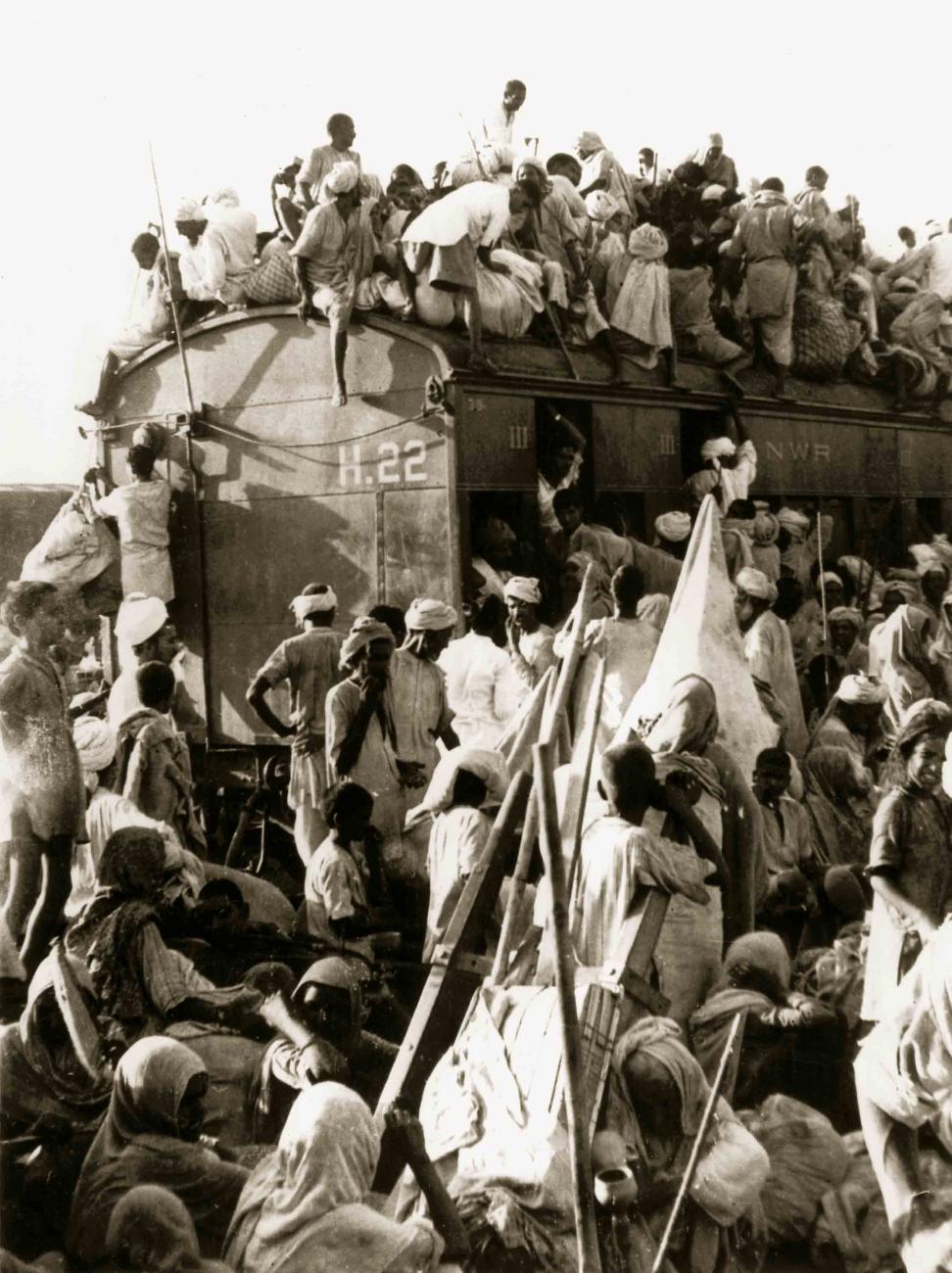
The journey to the new homelands was fraught with peril. Convoys of refugees stretching for miles were ambushed. Trains were stopped and their passengers massacred. The result was a near-total demographic exchange. West Punjab (in Pakistan) was "cleansed" of its Hindu and Sikh population, while East Punjab (in India) was "cleansed" of its Muslims.
This had a profound and lasting impact. Cities changed their character overnight. Lahore, once a multicultural hub, became an almost exclusively Muslim city. Amritsar, similarly, lost its significant Muslim population. The writer Saadat Hasan Manto, who was forced to migrate from Bombay to Lahore, captured the psychological trauma and madness of this period in his short stories, most famously in "Toba Tek Singh," where an inmate in a lunatic asylum finds himself stranded on a piece of land that belongs to neither India nor Pakistan—a powerful metaphor for the millions who lost their homes and sense of belonging.
Conclusion
The partition of Punjab in 1947 was a tragedy of immense proportions that shattered a complex society. Its analysis reveals several key takeaways for your CSS examinations:
- A Failure of Politics: The violence was not a spontaneous outburst of ancient hatreds but a direct result of the failure of political leadership—at the national and provincial levels—to find a power-sharing arrangement. The absolutist demands of the Muslim League, Congress, and Sikh leadership left no room for compromise.
- The Collapse of the State: The British administration's hasty withdrawal and the disintegration of its institutions, particularly law enforcement, created a power vacuum that was exploited by violent non-state actors.
- The Nature of the Violence: The violence was not random but organized and strategic, amounting to ethnic cleansing. It was used as a deliberate tool to create religiously homogenous territories.
- Enduring Legacy: The partition resulted in one of history's largest mass displacements, fundamentally and irrevocably altering the demographic, cultural, and psychological landscape of the region. The memory of this violence continues to shape relations between India and Pakistan to this day.
In our next lesson, we will examine how the fledgling state of Pakistan grappled with the immediate aftermath of this catastrophe. We will analyze the "existential challenges" it faced between 1947 and 1949, including managing the refugee crisis, establishing a new administration from scratch, and beginning the contentious debate over its identity and constitution with the Objectives Resolution.