Welcome to the first lesson of our new module on Regional Cooperation Frameworks. In our last session, we concluded our study of national security by evaluating Pakistan's overarching strategic position in a complex regional environment. A key pillar of that strategy, as we discussed, is leveraging regional organizations to advance both economic and security interests.
Today, we will begin our deep dive into these frameworks by addressing the learning outcome: Analyze the institutional structure, achievements, and failures of SAARC in promoting regional connectivity. The South Asian Association for Regional Cooperation (SAARC) represents the most ambitious attempt at building a comprehensive regional architecture in South Asia. For the CSS exam, a nuanced understanding of SAARC is essential. Questions frequently ask you to compare it with other organizations, critique its performance, and suggest reforms. This lesson will provide the analytical foundation for all those tasks by examining what SAARC is, what it has accomplished on paper, and why it has ultimately failed to live up to its potential.
The Vision and Structure of SAARC
The idea of South Asian regional cooperation emerged in the late 1970s and early 1980s, culminating in the formal establishment of SAARC in Dhaka on December 8, 1985. The context was complex. As you'll see in the video below, both India and Pakistan harbored initial reservations. India feared that its smaller neighbors might use the platform to "gang up" against it, while Pakistan was concerned that the organization would become a vehicle for institutionalizing Indian hegemony in the region.
Current Affairs SAARC Part 1 BY SIR ALI NAQVI
This segment from a lecture by Sir Ali Naqvi provides excellent insight into the initial political dynamics and apprehensions surrounding SAARC's formation.
Please watch the section covering the initial reluctance of India and Pakistan to join the organization. This historical context is crucial for understanding the deep-rooted mistrust that has plagued SAARC ever since.
Despite these apprehensions, the seven founding members (Afghanistan joined in 2007) adopted the SAARC Charter, which outlines a broad and ambitious vision.
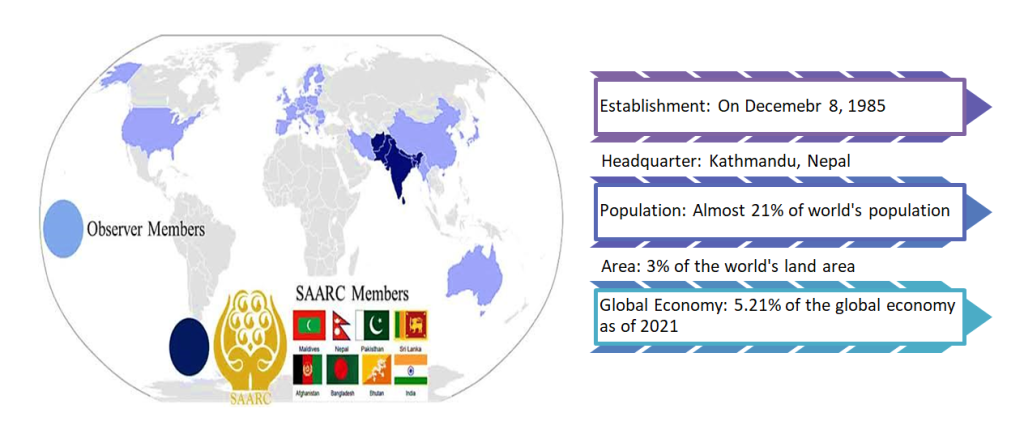
The core objectives of SAARC, as laid out in its Charter, are comprehensive. They are not limited to just one sector but span a wide array of goals aimed at collective progress.
[PDF] The Challenges of SAARC as a Regional Organization - ijrti
This academic paper, "The Challenges of SAARC as a Regional Organization," provides a detailed look at the organization's founding principles.
Please read the section titled "Establishment of SAARC." Focus on the list of objectives. Note their breadth, covering everything from economic growth and social progress to cultural development and collective self-reliance. Also, pay attention to the crucial principle embedded in the Charter: the deliberate exclusion of bilateral issues.
To achieve these objectives, SAARC developed a formal institutional structure. A short video from Drishti IAS provides a clear and concise overview of this framework.
Important Institutions - South Asian Association for Regional Cooperation (SAARC)
This video, "Important Institutions - South Asian Association for Regional Cooperation (SAARC)," breaks down the organization's key components.
Please watch the segment on principal organs and specialized bodies. This will familiarize you with the key institutional layers: The annual Summit of heads of state. The Standing Committee of foreign secretaries. The Secretariat based in Kathmandu. Specialized bodies like the SAARC Development Fund (SDF), South Asian University (SAU), and the SAARC Arbitration Council.
This structure provides, at least in theory, a complete framework for regional governance and cooperation.
Achievements: A Record of Intent over Impact
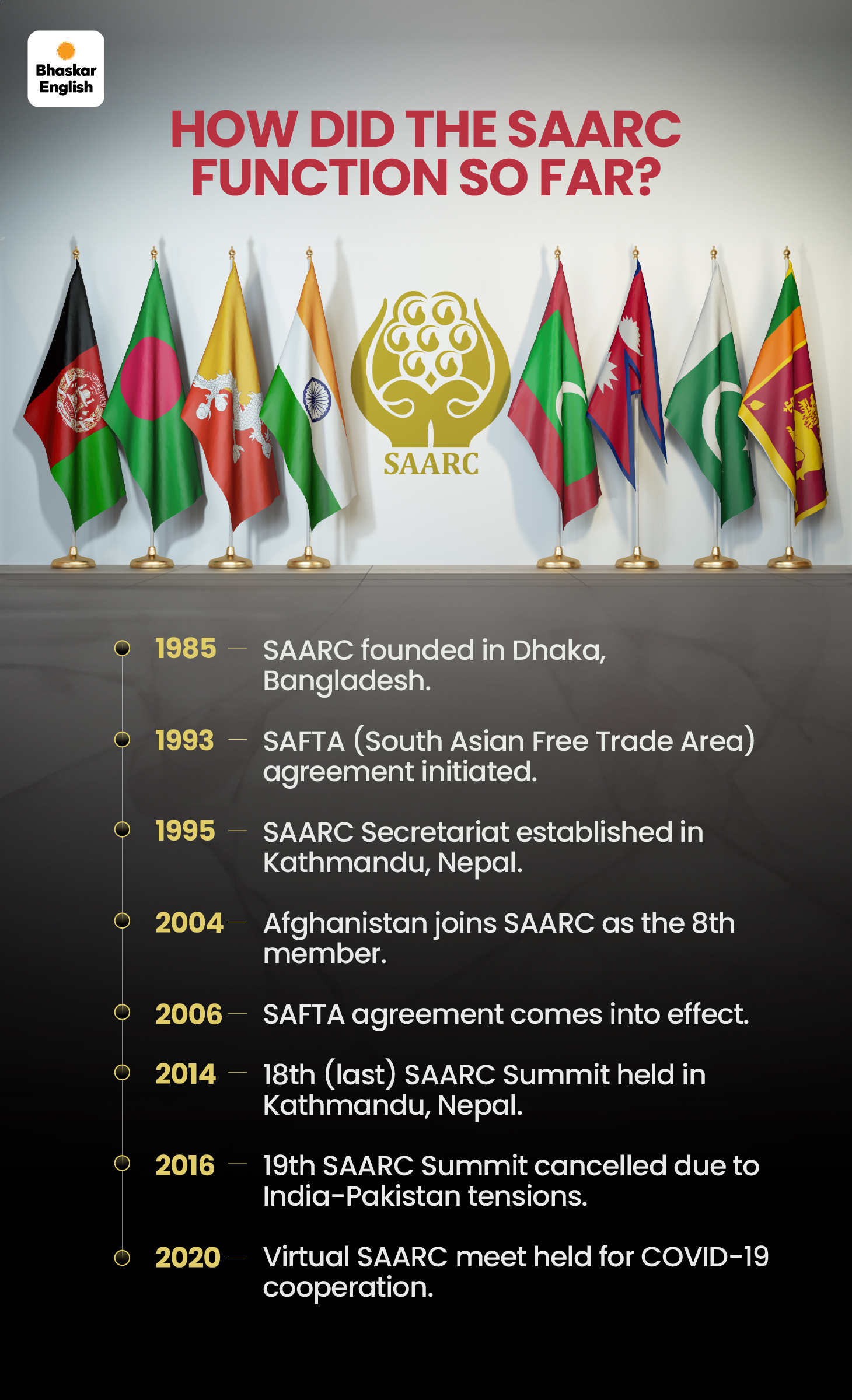
While SAARC is often dismissed as a failure, it is important to acknowledge its achievements, even if they are largely confined to agreements and institutional setups rather than tangible outcomes. These represent the "intent" of the organization and are important to mention in any balanced CSS answer.
The most significant area of achievement has been in the realm of trade liberalization.
- SAARC Preferential Trading Arrangement (SAPTA): Signed in 1993, this was the first step towards lowering tariffs among member states.
- South Asian Free Trade Area (SAFTA): This more ambitious agreement came into force in 2006, aiming to create a free trade zone by reducing customs duties to zero.
Beyond trade, other notable achievements include:
- The South Asian University (SAU): An international university in New Delhi, which stands as one of the few tangible, functioning successes of SAARC.
- SAARC Development Fund (SDF): Established to finance social and infrastructure projects across the region.
- Specialized Conventions: SAARC has facilitated conventions on critical issues like Combating Trafficking, Mutual Legal Assistance in Criminal Matters, and Countering Terrorism.
- SAARC Food Bank: Created to act as a regional reserve for food emergencies.
These initiatives demonstrate that on paper, SAARC has built a comprehensive architecture for cooperation. The critical question, however, is why this architecture has failed to produce meaningful regional integration and connectivity.
The Failures: A Story of Paralysis and Mistrust
The gap between SAARC's potential and its performance is vast. Its failures are not merely technical but are rooted in deep-seated political and structural problems. For your CSS analysis, understanding these failures is paramount.
1. The Overriding Obstacle: The India-Pakistan Conflict
There is a near-unanimous consensus among scholars and diplomats that the intractable hostility between India and Pakistan is the single greatest cause of SAARC's paralysis. The principle of making decisions by unanimity, combined with the charter's exclusion of bilateral disputes, has created a permanent deadlock. Instead of isolating regional cooperation from bilateral tensions, it has made the entire organization hostage to them.
[PDF] The Challenges of SAARC as a Regional Organization - ijrti
This section of the paper "The Challenges of SAARC" provides a detailed account of how the India-Pakistan rivalry has systematically undermined the organization.
Please read the entire section titled "Major Challenges: SAARC and the Indo-Pak conflict." As you read, focus on how this conflict has manifested: Historical Apprehensions: Note the initial fears from both sides—India's concern about being "ganged up" on and Pakistan's fear of Indian hegemony. Summit Cancellations: The most visible sign of failure is the frequent postponement of summits. Pay close attention to the 2016 Islamabad summit, which India boycotted after the Uri attack, leading to the current state of limbo. Stalling of Initiatives: Pakistan's reluctance stalled the SAARC Motor Vehicles Agreement (MVA), a key connectivity project. Likewise, Pakistan's objections led to the SAARC satellite project being pursued by India on a bilateral basis. This is a prime example of a lack of regional connectivity failure.
The commentary by Sir Ali Naqvi reinforces this point, explaining that with the two largest members in perpetual conflict, the organization is effectively bipolar and divided, preventing any meaningful collaboration.
Current Affairs SAARC Part 1 BY SIR ALI NAQVI
In this continuation of the lecture, the speaker breaks down SAARC's failures across different domains.
Watch the following segments to understand the practical consequences of political deadlock: Security Failure: This part explains why, despite signing a convention, SAARC has no collective counter-terrorism mechanism, no joint exercises, and no common definition of terrorism. Political Failure: Note the absence of political coordination, with no summit since 2014 and no common positions on global issues. Economic Failure: The SAFTA agreement, while an achievement on paper, is a practical failure. It was never fully ratified or implemented, and bilateral trade, especially between India and Pakistan, remains hostage to political tensions. The Core Reason: The speaker concludes by identifying the India-Pakistan conflict as the fundamental cause of this comprehensive failure.
2. Structural Imbalance and India's Dominance
Beyond the Indo-Pak rivalry, the sheer asymmetry of power within SAARC creates a climate of mistrust. India's size—geographically, economically, and militarily—dwarfs all other members combined.
This has two effects:
- Apprehension from Smaller States: Smaller nations fear that SAARC could be used by India to assert its hegemony. This fear, often termed the "Big Brother" syndrome, makes them reluctant to cede sovereignty or open their markets fully.
- India's Frustration: India, in turn, has harbored a "lingering suspicion" that its smaller neighbors might use the forum to align against it.
Reviving Saarc? - Newspaper - DAWN.COM
This 2025 opinion piece from Dawn offers a sharp analysis of the mindset and political dynamics that have crippled SAARC.
Read the first few paragraphs, focusing on how India's perspective and actions have shaped the organization's trajectory. Note the argument that India's suspicion has been a major impediment. The article also highlights how India's boycott of the 2016 summit and its subsequent focus on alternative groupings like BIMSTEC demonstrate a shift away from SAARC.
3. A Preference for Bilateralism and Sub-Regionalism
Given SAARC's dysfunction, member states, particularly India, have increasingly bypassed it in favor of bilateral agreements or smaller, more agile sub-regional groupings like BIMSTEC (Bay of Bengal Initiative for Multi-Sectoral Technical and Economic Cooperation). This creates a vicious cycle: as countries divert their political capital to other forums, SAARC becomes even more irrelevant. This trend underscores a critical concept for your analysis: South Asia is a "region without regionalism." It has a formal institutional structure, but the actual practice of cooperation happens elsewhere.
Conclusion
Our analysis today reveals SAARC as an organization rich in institutional design but impoverished in political will. We have examined its formal structure, its on-paper achievements in trade and institution-building, and the profound failures that have left it inert. The evidence overwhelmingly points to a set of interconnected problems that have stifled its potential to foster regional connectivity.
Key Takeaways:
- Comprehensive Structure: SAARC possesses a well-defined institutional framework with a broad mandate to promote cooperation across economic, social, and cultural domains.
- Achievements of Intent: The signing of SAFTA and the establishment of institutions like the South Asian University are notable achievements, but they lack widespread practical impact.
- Paralysis by Conflict: The primary cause of SAARC's failure is the persistent hostility between India and Pakistan, which has paralyzed its decision-making process and derailed key connectivity projects.
- Structural Mistrust: The asymmetrical power balance, with India's dominance, fosters apprehension among smaller states and hinders the development of genuine regional trust.
- Erosion of Relevance: The turn towards bilateralism and alternative forums like BIMSTEC has further marginalized SAARC, leaving it as an organization in a state of extended hibernation.
Having diagnosed the problems that plague SAARC, we are now positioned to consider solutions. In our next lesson, we will tackle the forward-looking aspect often required in CSS questions: Proposing recommendations to enhance SAARC's effectiveness, where we will draw comparative lessons from successful regional blocs like the European Union.