Welcome to the final lesson of our module on Pakistan's national security. In our previous lesson, we examined Pakistan's policy positions on the specific global issues of Palestine and the 'War on Terror'. These cases illustrated the complex balancing act between principle and pragmatism that defines Pakistan's foreign policy.
Today, we will broaden our perspective to fulfill the final learning outcome of this module: Evaluate Pakistan's strategic positioning within the changing regional security scenario and its policy responses to emerging challenges. This is a capstone lesson that synthesizes many of the themes we have discussed, integrating security, diplomatic, and economic dimensions into a holistic analysis. Understanding this bigger picture is essential for crafting the kind of comprehensive, high-level argument required in the CSS examination. We will explore the turbulent global order, identify Pakistan's core strategic challenges, and evaluate the key policy pillars it is constructing in response.
The New Global Context: A "Disordered World"
To understand Pakistan's strategic choices, we must first grasp the shifting landscape in which it operates. The post-Cold War era of a unipolar or even a clearly bipolar world is over. We are now in a more fragmented, unpredictable, and competitive international environment.
Dr. Maleeha Lodhi describes this new reality as a "disordered world" where rules are giving way to raw power.
In this article from the CSS Platform Nexus, Dr. Lodhi paints a stark picture of the collapsing international order.
Please read the article in its entirety. As you read, focus on these key characteristics of the current global environment: The unilateralism of great powers, particularly the US, and their disregard for international law and sovereignty. The paralysis of international institutions like the UN, leading to an "age of impunity" where conflicts rage without consequence. The eruption of a new resource struggle, especially over rare earth minerals, which connects geopolitics directly to geo-economics.
This global instability is compounded by its complexity. Former Foreign Secretary Inam-ul-Haque extends this analysis by introducing the concept of a "Polycene" world, where multiple, overlapping crises create a state of constant turbulence.
This article provides a theoretical framework for understanding the multifaceted nature of today's global challenges.
Please read the summary and the section that introduces the Polycene world. Pay attention to how different domains now intersect: Technology: The rise of AI and its impact on warfare and economics. Climate: The "polycrisis" of floods, droughts, and migration, which acts as a major destabilizer. Geopolitics: The shift to "polyamorous" multi-alignment, where states avoid rigid blocs. Warfare: The expansion of conflict into hybrid domains like cyber, information, and the economy. For Pakistan, this disordered and complex world means that the margin for error has shrunk. As a state positioned at the crossroads of major powers and regional conflicts, it stands directly in the path of these global fault lines. Pakistan's Strategic Compass for 2026: The Core Challenges In this volatile environment, Pakistan's foreign policy and security establishment has had to identify and prioritize a specific set of challenges. Aizaz Ahmad Chaudhry, a former Foreign Secretary, outlines seven key questions that define Pakistan's strategic agenda for the near future.
For Pakistan, this disordered and complex world means that the margin for error has shrunk. As a state positioned at the crossroads of major powers and regional conflicts, it stands directly in the path of these global fault lines.
Pakistan's Strategic Compass for 2026: The Core Challenges
In this volatile environment, Pakistan's foreign policy and security establishment has had to identify and prioritize a specific set of challenges. Aizaz Ahmad Chaudhry, a former Foreign Secretary, outlines seven key questions that define Pakistan's strategic agenda for the near future.
This article by Khurram Abbas clearly articulates the logic behind Pakistan's push for a multipolar regional structure.
Read the full article, focusing on the core strategic objective. Understand that Islamabad's vision is not to replace Indian hegemony with another, but rather to build alternative pillars of influence. Note the two main components of this strategy: Deepening Chinese Engagement: Encouraging China's economic and security footprint in the region. Strengthening Other Regional Players: Supporting the military and political capacity of countries like Bangladesh to create a more balanced power dynamic.
These seven points form the core of Pakistan's contemporary strategic calculus. The policy responses to these challenges are built on three interconnected pillars: a deliberate pivot to geo-economics, skillful navigation of a multipolar region, and the leveraging of regional organizations.
Pillar 1: The Pivot to Geo-Economics
The most significant shift in Pakistan's strategic thinking is the move to prioritize economic security as a central element of national security. This "geo-economics" vision seeks to transform Pakistan from a "security state" into a dynamic trading hub.

This image symbolizes Pakistan's ambition to integrate into the global digital economy, a key component of its geo-economic strategy, focusing on technological growth, cybersecurity, and trade.
This isn't just a theoretical concept; it is being actively implemented through a coordinated national effort.
[PDF] YEAR BOOK 2024-25 | Ministry of Commerce
This official publication provides concrete evidence of Pakistan's geo-economic policies in action.
Please review the following sections to see how the strategic vision translates into policy: First, read the Message from the Secretary Commerce to understand the overarching vision for integrating Pakistan into global markets. Next, review the trade performance data for FY 2024-25. Note the focus on diversifying exports beyond textiles into areas like pharmaceuticals and engineering. Then, look at the discussion on the global context. This highlights how Pakistan is aligning its policies with trends like green trade, digital transformation, and shifting supply chains. Finally, read about the new trade policy framework, which serves as the primary blueprint for achieving these geo-economic goals.
The success of this pivot is considered the "litmus test" for Pakistan's future. As analyst Adnan Rehmat argues, the goal for 2026 is to convert the military and diplomatic credibility regained in 2025 into tangible economic power and lasting influence.
Pillar 2: Navigating a Multipolar Region
Pakistan's geo-economic ambitions are intertwined with its diplomatic strategy of fostering a multipolar Asia. This approach seeks to move beyond the historic India-Pakistan binary and create a more balanced regional order where India's dominance is diluted by the presence of other influential actors.
This article by Fahd Humayun effectively synthesizes the precarious nature of regional stability and the logic behind Pakistan's strategic posture.
Please read the article in its entirety. It warns that despite an illusion of calm after the crises of 2025, the ground remains fragile. Focus on the core message: that Pakistan must reduce its vulnerability on multiple fronts through a combination of crisis management, external mediation, and credible deterrence. The author concludes that survival in this environment depends on "diplomacy backed by clarity and caution."
This strategy requires a "multi-vector" foreign policy, where Pakistan avoids rigid alliances and maintains functional relationships with all major powers.
Pakistan's Role In Changing Regional Apparatus |ft: Syed Yasir Shah & Osama Rizvi| Ep: 61 |WTI Talks
This discussion from WTI Talks explores the practicalities of Pakistan adopting a "multi-vector" foreign policy in the current regional climate.
Please watch the following segments: Multi-vector Foreign Policy: This section explains why Pakistan cannot afford to take sides and must maintain good relations with all key partners, including the US (for IMF support and as an export market) and China. De-risking and Mini-lateralism: Here, the concept of "de-risking" (managing relationships to prevent negative spillover) is introduced as a more practical alternative to "decoupling." The idea of "mini-lateralism" (cooperating with different groups of countries on specific issues) is also explained as a key tool. Prospects for Regional Integration: This concluding part emphasizes economic integration as the primary path forward, highlighting the untapped trade potential with Central Asian Republics (CARs) and other regional blocs.
Pillar 3: Leveraging Regional Organizations (SCO Case Study)
To pursue this multi-vector policy and promote regional integration, Pakistan actively participates in various multilateral forums. While we will discuss SAARC and ECO in a later module, the Shanghai Cooperation Organisation (SCO) serves as an excellent case study of Pakistan's contemporary strategic positioning.
CSS 2024:Shanghai Cooperation Org(SCO): Importance,Expansion and PAKISTAN I Ahmed Ali Naqvi I Ep.104
This video by Ahmed Ali Naqvi provides a concise analysis of the SCO's structure and its significance for Pakistan.
Watch these segments to understand why the SCO is a vital platform for Pakistan: Introduction to SCO: This gives a brief history of the organization and Pakistan's formal entry in 2017. SCO's Evolving Mandate: Note how the SCO has expanded from a narrow counter-terrorism focus to a broader platform for political, socio-economic, and military collaboration. Countering Western Influence: This section explains the perception of the SCO as a regional bloc formed to provide "regional solutions to regional problems," independent of Western, particularly US, influence. Importance for Pakistan: This is the most crucial part. The speaker outlines why SCO membership is so important: it offers a mechanism for counter-terrorism cooperation with regional powers, fosters economic collaboration, provides access to powerful allies like China and Russia, and ensures Pakistan's political relevance in the region, especially as US interest wanes.
Synthesis: A Strategy of Restraint with Readiness
Pakistan's strategic position in 2026 is one of calculated navigation through a fragile and contested region. The country faces persistent threats but is also creating new opportunities through a pragmatic and forward-looking strategy.
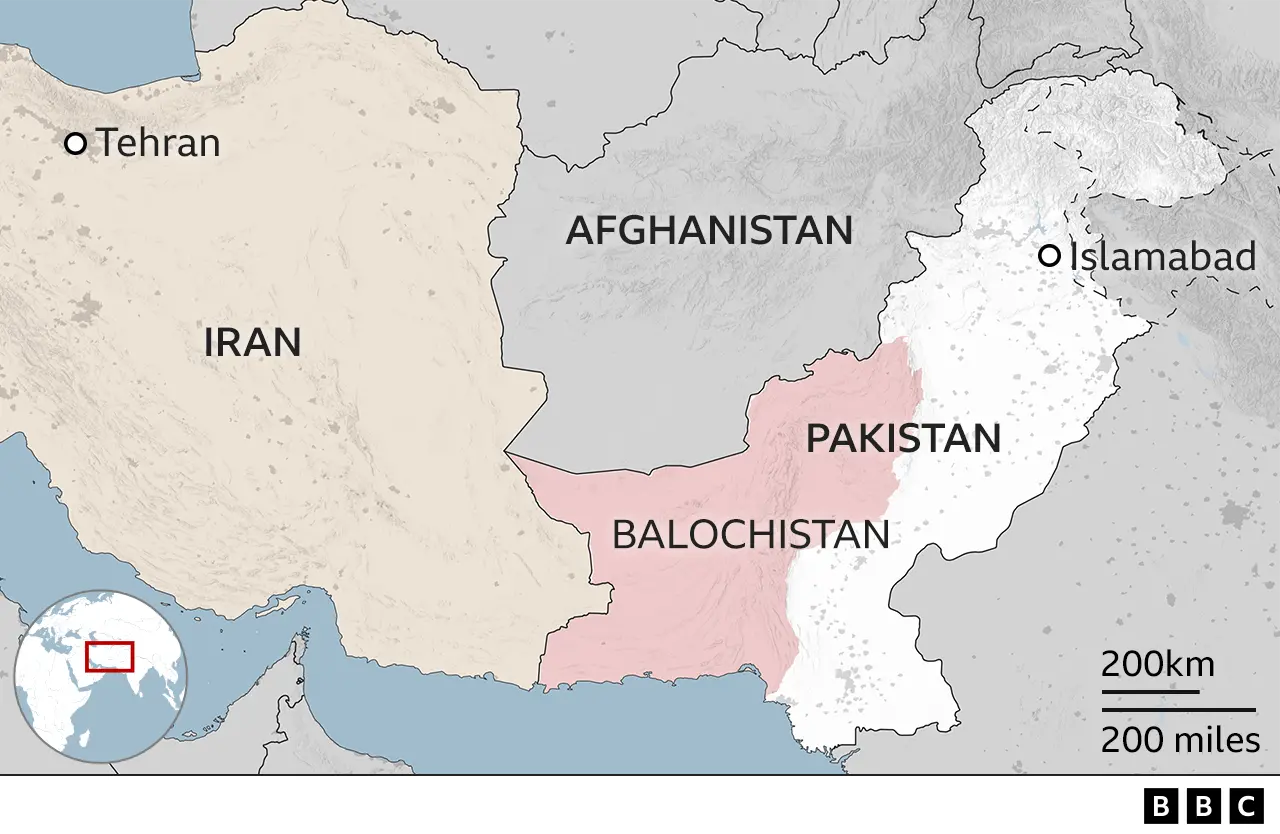
This map highlights the geographically complex and volatile western frontier of Pakistan, with Balochistan province at the nexus of relations with Iran and Afghanistan. This region is central to both security challenges (like the TTP) and economic opportunities (like CPEC).
The core of its approach can be summarized as "restraint with readiness."
This article by Fahd Humayun effectively synthesizes the precarious nature of regional stability and the logic behind Pakistan's strategic posture.
Please read the article in its entirety. It warns that despite an illusion of calm after the crises of 2025, the ground remains fragile. Focus on the core message: that Pakistan must reduce its vulnerability on multiple fronts through a combination of crisis management, external mediation, and credible deterrence. The author concludes that survival in this environment depends on "diplomacy backed by clarity and caution."
Conclusion
We have evaluated Pakistan's strategic positioning by analyzing the global context, its core challenges, and its multi-pronged policy responses. The landscape is indeed fraught with challenges, but it is not without pathways to enhance security and prosperity.
Key Takeaways:
- A Disordered World: Pakistan is operating in a fragmented global order where power politics is resurgent and multilateral institutions are weakening.
- The Pivot to Geo-economics: The cornerstone of Pakistan's new strategy is to leverage its geography for economic integration and export-led growth, thereby building national resilience.
- Multi-Vector Foreign Policy: Pakistan is pursuing a policy of multi-alignment, balancing its relationships with the US and China while deepening partnerships with regional players like the Gulf states, Iran, Turkey, and the Central Asian Republics.
- Diluting Hegemony: A key objective is to foster a multipolar regional order to dilute India's dominance and create more strategic space for Pakistan and other smaller states.
- Internal Strength is Key: Ultimately, the success of this external strategy hinges on internal consolidation: achieving political stability, implementing economic reforms, and strengthening the rule of law.
This lesson concludes our module on National Security. We have moved from specific threats to a holistic strategic evaluation. In our next module, we will dive deeper into the institutional frameworks Pakistan uses to pursue its regional goals, starting with a detailed analysis of SAARC and its potential for regional connectivity.