Introduction
In our last lesson, we examined the deep-seated structural problems that have caused Pakistan's industrial sector to stagnate, noting that its failure to become a powerful engine for exports is a critical weakness. This brings us directly to the heart of Pakistan's recurring macroeconomic crises. The inability to earn sufficient foreign exchange, coupled with the government consistently spending more than it earns, creates a perilous situation known as the 'twin deficit' problem.
This lesson is designed to help you master the learning outcome: Analyze Pakistan's 'twin deficit' problem (fiscal and current account), examining its causes and consequences in the current economic context. This is one of the most fundamental and frequently tested areas in the CSS Pakistan Affairs exam, requiring a nuanced understanding of how these two deficits are defined, how they interact, and why they have become a chronic feature of the nation's economy. Our goal is to dissect this complex issue, moving from clear definitions to a detailed analysis of the causes and devastating consequences of this vicious cycle, using the most current data available for 2025 and 2026.
Defining the Twin Deficits
At its core, the twin deficit problem is straightforward and can be understood like a household budget.
-
The Current Account Deficit: This occurs when a country's total spending on foreign goods, services, and other payments (like interest on foreign loans) is greater than its total earnings from foreign countries (from exports, remittances, etc.). In simple terms, more foreign currency is flowing out of the country than is flowing in. This depletes the nation's foreign exchange reserves.
-
The Fiscal Deficit: This is the government's own budget shortfall. It happens when the government's total expenditure (on salaries, defense, development projects, debt servicing, subsidies) exceeds its total revenue (primarily from taxes). To cover this gap, the government must borrow money.
These two deficits are not independent; they are deeply interconnected and often create a self-perpetuating crisis. A large fiscal deficit forces the government to borrow, some of which may be external debt. Paying interest on this external debt worsens the current account deficit. Conversely, a persistent current account deficit depletes foreign reserves, forcing the government to seek bailout loans from institutions like the IMF, which adds to the national debt and future fiscal pressures.
This dangerous interplay has been a defining feature of Pakistan's economic trajectory, trapping it in a "boom-bust" cycle.
1. The Current Account Deficit: The External Imbalance
Pakistan’s current account has been in deficit for most of its history, a clear indicator of a structural imbalance with the rest of the world. While there have been brief periods of surplus, the underlying trend remains negative.
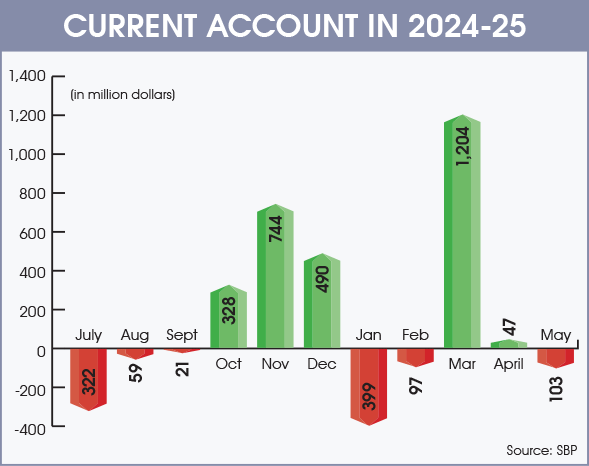
To understand the drivers of this deficit, we will consult the World Bank's latest Development Update for Pakistan, which provides a detailed statistical breakdown for FY25.
Pakistan-Development-Update-Staying-the-Course-for-Growth-and-Jobs-October-2025.pdf
This report provides the most current data and analysis of Pakistan's external sector. It will allow us to move beyond generalities and quantify the problem.
First, read the subsection "The trade deficit widened" to understand the main components of the current account. Note how a wider trade deficit was offset by record-high remittances, leading to a rare surplus in FY25. Next, for a more granular view, examine Table A1.1: Balance of Payments Summary in Annex 1. Focus on the data for FY25 and identify the key figures for: A. Goods trade balance C. Balance on primary income D. Balance on secondary income (especially remittances) This table clearly shows that while Pakistan earns a large surplus on "secondary income" (remittances), this is consumed by massive deficits in the "goods trade balance" and "primary income."
The data reveals three primary causes for the chronic current account deficit:
- A Persistent Trade Deficit: As we discussed in the previous lesson, Pakistan imports significantly more than it exports. Exports are hampered by a lack of competitiveness and low value-addition, while the import bill is driven by energy, machinery, and consumer goods. The World Bank data for FY25 shows a goods trade deficit of US$26.8 billion.
- A Negative Primary Income Balance: This reflects payments made to foreign entities, such as profit repatriation and dividend payments by multinational corporations operating in Pakistan, and interest payments on external debt. In FY25, this amounted to a deficit of US$8.9 billion. This is a direct consequence of past borrowing and foreign investment.
- Over-reliance on Remittances: The secondary income balance, dominated by remittances from overseas Pakistanis, is the only major component that is consistently positive (a surplus of US$40.4 billion in FY25). While these inflows are a vital lifeline, an economy cannot build sustainable growth on them. As one expert in the Brookings discussion notes, remittances are mere transfers; they do not build the country's productive capacity.
The primary consequence of a persistent current account deficit is the depletion of foreign exchange reserves. This creates immense pressure on the currency, leading to devaluation, and can culminate in a balance of payments crisis where the country is unable to pay for essential imports or service its foreign debt, raising the spectre of default.
2. The Fiscal Deficit: The Internal Imbalance
The second, and arguably more foundational, deficit is the fiscal deficit—the government's inability to live within its means. For decades, Pakistan's state expenditure has far outstripped its revenue collection.
Rescuing Pakistan's economy - Atlantic Council
The Atlantic Council's report provides a sharp, incisive analysis of the fiscal problem, framing it in historical and comparative context.
First, read the subsection "persistently large fiscal and external deficits" to grasp the scale of the crisis that peaked in FY2022. Then, read the section titled "The hefty interest burden." This part is crucial. Pay close attention to the analysis of the interest-to-revenue ratio, which the author notes has reached an unsustainable 60%. This single metric powerfully illustrates the severity of the debt trap Pakistan is in.
The causes of the fiscal deficit are rooted in both low revenue and high expenditure.
Causes on the Revenue Side:
- Low and Narrow Tax Base: Pakistan has one of the lowest tax-to-GDP ratios in the world. As explained in the E-CSS video on the economic crisis, the tax system is flawed. It relies heavily on indirect taxes (like GST), which disproportionately affect the poor, while powerful sectors like real estate, large-scale agriculture, and the retail sector remain undertaxed or outside the tax net entirely.
- Large Informal Economy: A significant portion of Pakistan's economic activity is undocumented and therefore untaxed. This "grey" economy limits the government's ability to generate revenue.
Causes on the Expenditure Side:
- Unsustainable Debt Servicing: As the Atlantic Council report highlights, this is the single largest and fastest-growing component of government expenditure. Decades of borrowing to finance past deficits have created a mountain of debt. In FY25, interest payments alone consumed a massive portion of the budget, leaving little for anything else.
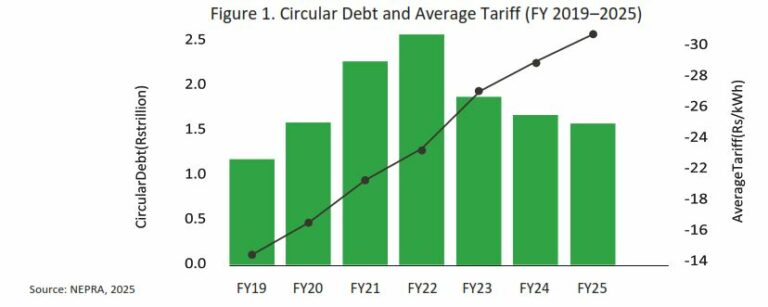
- Loss-Making State-Owned Enterprises (SOEs): Entities like Pakistan International Airlines (PIA), Pakistan Steel Mills, and power distribution companies (DISCOs) have been a colossal drain on the national exchequer for decades. The circular debt in the power sector is a direct result of the inefficiencies and losses in these SOEs.
- High Defense Spending and Subsidies: While politically sensitive, defense expenditure remains a significant portion of the budget. Additionally, untargeted subsidies, particularly on energy, have historically added to the fiscal strain.
The Vicious Cycle and Current Consequences (2025-2026)
The twin deficits lock Pakistan in a vicious cycle. The government runs a large fiscal deficit, which it finances through borrowing. This borrowing increases the public debt stock. Servicing this debt consumes a larger share of the budget, further widening the fiscal deficit and requiring even more borrowing. A portion of this debt is external, and interest payments on it worsen the current account deficit. This depletes foreign reserves, forcing the country to seek more external loans (e.g., from the IMF), which in turn adds to the public debt stock, completing the cycle.
This is not a theoretical model; it is the reality Pakistan has been living. The discussion from the Brookings Institution provides a stark picture of the consequences.
This panel discussion with former Finance Minister Miftah Ismail and economist Atif Mian provides critical context on the real-world impact of these deficits.
First, watch the opening summary from the statistics on the crisis. This will give you a sense of the acute phase of the crisis, with dwindling reserves, currency devaluation, and soaring inflation. Next, listen to the explanation of the immediate causes, focusing on the critically low reserves and the need for IMF support, from Dr. Ismail's initial comments. Finally, to understand the deeper roots, watch the segment where the panelists discuss long-term issues like low productivity, poor governance, and the social factors that inhibit economic growth from the discussion on productivity. This links the economic data back to the fundamental structural problems of the country.
As of late 2025, the consequences are stark, and the World Bank report projects the path forward:
- High Inflation: Fiscal deficits financed by borrowing from the central bank (effectively printing money) and currency devaluations caused by the current account deficit have led to crippling inflation, projected to be 7.2% in FY26.
- Stagnant Growth: The constant need for painful austerity measures under IMF programs—cutting development spending, raising interest rates, and increasing taxes—chokes economic growth. The World Bank projects a modest 3.0% growth for FY26.
- Loss of Economic Sovereignty: Perennial reliance on multilateral lenders like the IMF means that key economic policy decisions are often made under external pressure, limiting the government's autonomy.
Conclusion
Pakistan's 'twin deficit' problem is the central challenge of its political economy. It is not a temporary issue but a chronic, structural condition born from an uncompetitive productive sector and a state that lives far beyond its means.
Key Takeaways:
- Twin Deficits Defined: The current account deficit is the shortfall in foreign currency (imports > exports), while the fiscal deficit is the government's budget shortfall (expenditure > revenue).
- Primary Causes: The current account deficit is driven by a massive trade deficit and large primary income outflows, barely papered over by remittances. The fiscal deficit is driven by a narrow tax base, massive debt servicing costs, and losses from state-owned enterprises.
- The Vicious Cycle: The two deficits reinforce each other in a feedback loop of borrowing, rising debt, and economic stagnation. Fiscal borrowing increases debt service payments, which strains both the budget and the current account.
- Consequences: This cycle leads to depleted foreign reserves, currency devaluation, high inflation, stagnant growth, and a continuous dependence on external bailouts, trapping Pakistan in a low-growth equilibrium.
Preview of the Next Lesson:
Our analysis has unequivocally shown that the twin deficits are the primary engines of Pakistan's ever-growing public debt. This leads us logically to our next topic. In the upcoming lesson, we will perform a deep dive into this issue, addressing the learning outcome: "Evaluate Pakistan's public debt situation and its implications for fiscal sustainability and economic sovereignty." We will dissect the composition of this debt, assess its sustainability, and explore the profound challenges it poses for the nation's future.