Welcome to the next lesson in our course on Pakistan Studies. In our previous session, we traced the country's political evolution from 2008 to the present, focusing on the complex interplay between democratic consolidation and civil-military relations. We saw how the legacy of General Musharraf's rule set the stage for many of the political dynamics that followed.
Today, we will pivot from the political to the economic, zeroing in on the Musharraf era (1999–2008) itself. This period is a recurring and crucial case study for the CSS examinations, often framed around the question of "economic growth without inclusive social development." Therefore, this lesson is designed to equip you with a nuanced, evidence-based analysis of this paradox. We will first examine the macroeconomic boom that characterized these years, and then critically dissect why this growth proved to be neither sustainable nor socially inclusive, ultimately creating societal alienation.
The Anatomy of a Boom (2000–2007)
The economic narrative of the Musharraf era is one of a dramatic turnaround. After the turbulent and debt-ridden 1990s, the period from 2000 to 2007 witnessed a remarkable macroeconomic recovery and expansion. The headline figures were impressive and are often cited to showcase the economic competence of the military-led government.
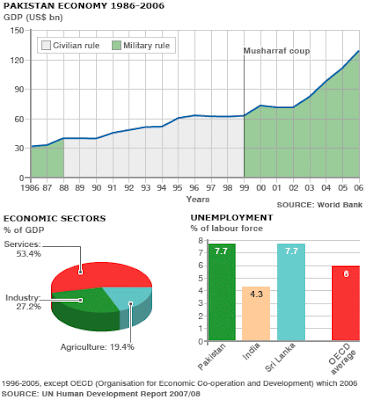

To understand the substance behind these graphs, we will turn to the analysis of Dr. Ishrat Husain, a former Governor of the State Bank of Pakistan, who provides a detailed account of this period.
[PDF] Pakistan's Economy and Regional Challenges - Dr. Ishrat Husain
This paper by Dr. Ishrat Husain offers an authoritative insider's perspective on the economic policies and outcomes of the Musharraf era.
Please read the following sections to understand the drivers of the economic boom: Economic Recovery: Start with the section describing the economic recovery that began in 2000. Note the key statistics: an average GDP growth rate of 6.3% per year, a 10-percentage-point reduction in poverty, and the creation of 11.8 million new jobs. Structural Reforms: Next, read about the structural reforms that were aggressively pursued during this time. Focus on the key policy areas: trade liberalization, privatization of state-owned enterprises (especially in banking and telecommunications), and deregulation. Financial Sector Reforms: Finally, review the section on financial sector reforms. This part explains how the strengthening of the Central Bank and the privatization of major commercial banks transformed the financial landscape, making it more efficient and competitive.
As Dr. Husain outlines, the economic growth was driven by a two-pronged strategy: deep structural reforms and a significant shift in Pakistan's geopolitical landscape. The post-9/11 environment brought a massive influx of foreign aid, debt relief, and preferential trade access as Pakistan became a frontline ally in the "War on Terror." This "geopolitical windfall," combined with the government's reform agenda, created unprecedented fiscal space and fueled the economic engine.
However, it is crucial for a sophisticated analysis to question the oversimplified narrative that aid alone was responsible. Dr. Husain himself provides a more nuanced view.
[PDF] Pakistan's Economy and Regional Challenges - Dr. Ishrat Husain
Let's continue with Dr. Husain's paper to critically evaluate the role of foreign aid.
Read the section on the role of foreign assistance. Pay close attention to his argument that when the economic and social costs of participating in the war on terror are factored in, the benefits from foreign aid "pale into insignificance." He concludes that the perception of aid being the sole driver of the turnaround is "highly exaggerated."
This critical perspective is essential for a high-scoring CSS answer. The boom was a product of both internal reforms and external assistance, but the narrative is more complex than a simple story of American dollars revitalizing Pakistan's economy.
Growth Without Foundation: The Social Deficit
While the macroeconomic indicators were positive, the nature of this growth lacked depth and sustainability. This brings us to the core of the exam question: "economic growth without inclusive social development." Renowned academic S. Akbar Zaidi argues that the boom of the Musharraf years quickly unraveled because it was built on "false foundations."
[PDF] Pakistan's Roller-Coaster Economy: Tax Evasion Stifles Growth
This policy brief by S. Akbar Zaidi provides a sharp critique of the Musharraf-era economic model, explaining its inherent unsustainability.
Please read the section titled "Reasons for Unraveling Growth". Focus on his central argument that the boom was primarily a "consumer-led growth" and was fueled by speculative investments in real estate and the stock market, rather than productive, long-term investments in industry or human capital.
This consumer-led boom created a vibrant urban middle class and a palpable sense of prosperity in major cities. There were tangible social changes, particularly in the media and telecommunications sectors, which experienced explosive growth.
Pervez Musharraf - A Traitor or a Patriot? Musharraf's Crimes & Achievements
This video, while offering a general overview of Musharraf's legacy, captures the specific socio-economic changes of the era well.
Watch the segment discussing the liberalization of the country. Note the expansion of private TV channels, the rise of a new pop culture, the growth of the fashion industry, and the boom in the telecommunication sector, which made Pakistan one of the fastest-growing mobile phone markets in the world.
While these changes were real, they were not necessarily inclusive. The prosperity was heavily concentrated in urban centers and among the salaried and business classes. This created what Dr. Ishrat Husain terms a "social gap," where human development indicators failed to keep pace with income growth, and inequality widened.
[PDF] Pakistan's Economy and Regional Challenges - Dr. Ishrat Husain
Let's return to Dr. Husain's paper for a quantitative look at the social deficit.
Read the section on Growth, Poverty, and Inequality. While poverty numbers declined, note the critical findings: "social indicators have not kept pace with income growth." "income inequality as well as urban–rural disparities have also risen in the 2000s." This widening gap between the prospering urban centers and the lagging rural areas is a key source of the "social alienation" that the CSS question highlights.
The fundamental weakness of the Musharraf-era growth was its failure to address the deep structural flaws of Pakistan's economy. The regime, despite its authoritarian power, did not undertake the politically difficult task of broadening the tax base.
[PDF] Pakistan's Roller-Coaster Economy: Tax Evasion Stifles Growth
Finally, let's examine the core structural failure with Akbar Zaidi's analysis.
Read the section titled "Tax Evasion—the Core Issue?". Zaidi argues that the "main culprit" for Pakistan's economic woes is tax evasion. He points out that even the powerful Musharraf regime "failed to restructure Pakistan’s tax regime" and "backed down" when faced with resistance from traders.
This failure to fix the revenue engine of the state meant that as soon as the external environment changed—with the souring of relations with the US, the global financial crisis of 2008, and rising oil prices—the entire edifice came crashing down. The temporary boom gave way to soaring inflation, severe energy shortages (load shedding), and rising terrorism, which wiped out the public's positive sentiment by 2007-2008.
Conclusion
The economic trajectory of the Musharraf era serves as a classic case study in unsustainable growth. It demonstrates that macroeconomic stability driven by foreign capital and consumption can create a temporary illusion of prosperity, but without deep structural reforms and a focus on inclusive social development, such growth is bound to be fragile.
Key Takeaways:
- A Reform-and-Aid Driven Boom: The Musharraf era witnessed significant GDP growth, driven by a combination of market-oriented structural reforms (privatization, deregulation) and a massive influx of post-9/11 foreign aid and debt relief.
- Growth on "False Foundations": The growth was not rooted in productive industrial expansion but was largely a consumer-led boom concentrated in urban areas and speculative sectors like real estate.
- The Social and Inequality Deficit: Despite a reported decline in poverty, the period was marked by widening income inequality and a growing urban-rural divide. Key human development indicators in health and education lagged significantly behind income growth.
- Failure of Structural Change: The regime did not leverage its political power to address the core structural problem of a narrow tax base, leaving the state's revenue capacity weak and dependent on external flows.
- Unsustainable and Fragile: Consequently, when the external geopolitical and economic environment shifted after 2007, the economic model proved unsustainable, quickly unraveling into a crisis of high inflation and energy shortages.
This lesson provides a critical framework for answering the complex CSS question regarding this era. The economic boom was real, but its foundations were hollow, creating a prosperity that was neither shared widely nor built to last.
In our next lesson, we will build directly on the discussion of the telecom boom during the Musharraf years. We will broaden our focus to analyze the wider impact of information technology on Pakistan's contemporary socio-economic landscape and its educational sector.