Welcome to the next lesson in our exploration of Pakistan's foreign policy. In our last session, we critically examined the volatile and transactional relationship with the United States, concluding with the idea of "strategic autonomy," where Pakistan leverages its assets to navigate great power competition. Today, we will analyze the other, far more stable, pillar of Pakistan's foreign policy: its relationship with China.
This lesson will analyze Pakistan-China relations, with a special emphasis on the evolving economic and strategic significance of the China-Pakistan Economic Corridor (CPEC). This topic is a cornerstone of the CSS syllabus and frequently appears in exams, often with the prompt to evaluate CPEC as a "game-changer" for Pakistan and the region. We will trace the relationship from its historical roots to its modern-day manifestation in CPEC, exploring how it has evolved from an infrastructure project into a comprehensive strategic vision.
A 75-Year Foundation: The "All-Weather Strategic Cooperative Partnership"
To understand the depth of the Pakistan-China relationship, we must look beyond the concrete and steel of CPEC. Unlike the fluctuating ties with the US, this partnership is rooted in decades of consistent mutual support, earning it the unique description of an "All-Weather Strategic Cooperative Partnership."
A comprehensive article published in The Express Tribune to mark the 75th anniversary of diplomatic relations provides an excellent overview of this historical journey. It details the key milestones that forged this "iron-clad" friendship.
This article eloquently narrates the history of the bilateral relationship, highlighting the political trust and mutual support that form its foundation. This context is essential to understand why CPEC is more than just an economic project.
Please read the following sections to grasp the historical depth of the relationship: Begin with the introduction, which sets the tone for the "strong as steel" friendship. Read the section "75 Years of meeting challenges together" to understand key historical milestones, from Pakistan's early recognition of the PRC in 1951 to the upgrade of the relationship in 2015. Next, study the section on "Unshakable Political Mutual Trust." Focus on how this trust is demonstrated through high-level strategic guidance and, most importantly, mutual backing on core interests—China's support on Kashmir and Pakistan's on the one-China policy. Finally, read the section on "Mutual assistance and solidarity" to see how this friendship translates into tangible support during crises, such as the Wenchuan earthquake and the 2010 floods in Pakistan. As you read, contrast this narrative of consistency and mutual respect with the transactional and often turbulent nature of Pakistan's relationship with the US, which we discussed previously.
The history reveals a pattern of deep-seated strategic alignment. Pakistan provided China with a crucial window to the world during its years of isolation, and China has consistently supported Pakistan's sovereignty and territorial integrity. This foundation of unwavering political trust is the soil in which CPEC has grown.
CPEC Phase 1: Tackling Core Deficits (2015–2022)
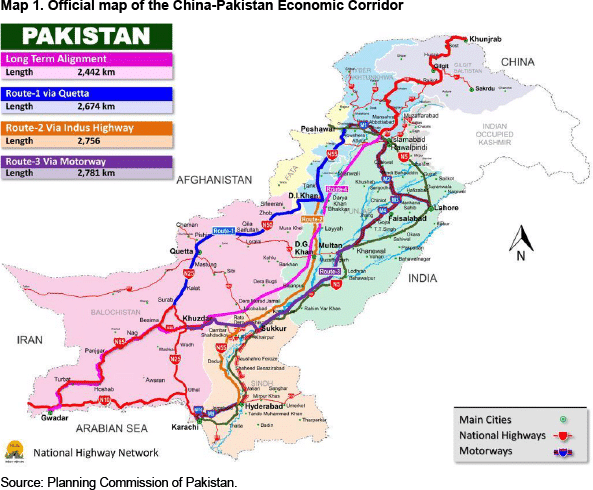
Launched in 2015, the China-Pakistan Economic Corridor (CPEC) is the flagship project of China's ambitious Belt and Road Initiative (BRI). The first phase of CPEC was a direct response to Pakistan's most crippling developmental bottlenecks: a severe energy crisis and outdated transportation infrastructure.
As detailed in the Tribune article, this phase delivered transformative results.
This section of the article details the tangible outcomes of CPEC's initial phase.
Please read the section titled "Fruitful Practical Cooperation: Prosperity Through Extensive Consultation, Joint Contribution and Shared Benefits." Focus on these key points: The overall impact: Note the figures for direct investment, job creation, and infrastructure development. The focus on energy projects to resolve power shortages, which were the "centerpiece of the first phase." The development of transportation infrastructure, including the Karakoram Highway upgrade and key motorway sections. The strategic development of Gwadar Port, transforming it from a small fishing village into a potential regional logistics hub.
This initial phase can be understood as a massive "blood transfusion" for Pakistan's economy. It injected capital and expertise to build the foundational hardware—power plants and highways—necessary for modern economic activity.
The Evolution to CPEC 2.0: A Vision for High-Quality Development
With the foundational infrastructure largely in place, CPEC has entered its second phase, often termed "CPEC 2.0." This phase marks a significant strategic shift from infrastructure development to fostering Pakistan's indigenous industrial and technological capacity—moving from "blood transfusion" to "blood-making."
An analytical paper by the Pakistan Institute of Development Economics (PIDE) outlines this new vision, which is structured around a framework of "Five Corridors" (5Cs) designed to align with Pakistan's national "5Es" policy (Exports, E-Pakistan, Environment, Energy, Equity).
CPEC 2.0: The Road to Pakistan’s Tomorrow
This paper provides the essential analytical framework for understanding the future trajectory of CPEC. It moves beyond infrastructure to discuss industrialization, innovation, and sustainability.
Read through the paper to understand the conceptual shift to CPEC 2.0. Focus on the definitions and goals of the "Five Corridors": Start with the introduction, "A Shared Dream of Progress," which frames CPEC 2.0 as a leap towards a future driven by knowledge and innovation. Briefly review "A Tale of Two Nations" to see how China's own development, particularly with Special Economic Zones (SEZs), serves as a model. Read the description of each of the five new corridors: Growth Corridor: Focuses on industrialization, connecting SEZs, and moving to value-added production. Innovation Corridor: Aims to create a digital economy through tech parks, R&D, and collaboration in AI and biotech. Green Corridor: Prioritizes renewable energy (solar, wind) and sustainable development. Regional Connectivity and Opening Up Corridor: Emphasizes trade openness and knowledge exchange. Corridor of Livelihood: Focuses on social sector development, including healthcare, education, and job creation.
CPEC 2.0 represents a far more ambitious and integrated strategy. It aims to leverage the infrastructure of Phase 1 to build a competitive, innovative, and sustainable economy, transforming Pakistan from a consumer market into a production and export hub.
Analyzing the "Game-Changer"
The term "game-changer" is often used to describe CPEC, and a thorough analysis for a CSS exam requires substantiating this claim by examining its multifaceted significance.
Economic Significance
- Overcoming Structural Deficits: CPEC directly addressed Pakistan's chronic energy and logistics shortfalls, which were major impediments to GDP growth.
- Industrialization Engine: CPEC 2.0's focus on Special Economic Zones (SEZs) offers the potential for industrial take-off, technology transfer, and integration into global value chains, moving Pakistan beyond its reliance on textiles.
- Hub for Regional Connectivity: By linking the Arabian Sea to Western China, CPEC positions Pakistan as a pivotal transit and trade hub for Central Asia, South Asia, and the Middle East.
- Boosting FDI and Trade: Beyond Chinese investment, the improved infrastructure and business environment are designed to attract foreign direct investment from other countries and facilitate trade.
Strategic Significance
- Solidifying the All-Weather Alliance: CPEC interlinks the two economies so deeply that their strategic interests become inseparable. This provides Pakistan with an unbreakable and reliable alliance, a stark contrast to its relationship with the US.
- Providing Strategic Depth: Gwadar Port offers China a shorter, more secure trade route to the Middle East and Africa, bypassing the Malacca Strait chokepoint. For Pakistan, it cements its indispensable role in China's regional strategy.
- Enhancing Strategic Autonomy: As discussed in the previous lesson, CPEC is the primary asset that gives Pakistan leverage in its foreign policy. It allows Pakistan to balance its relationships with competing powers like the United States, preventing it from becoming overly dependent on any single bloc.
- Strengthening Regional Clout: CPEC enhances Pakistan's influence within regional forums like the Shanghai Cooperation Organisation (SCO), where economic connectivity and regional security are central themes.
Conclusion
The Pakistan-China relationship is a unique feature of modern international relations, built on a 75-year foundation of unshakable mutual trust and support. CPEC is its most ambitious manifestation, evolving from a Phase 1 focus on fixing critical infrastructure deficits to a CPEC 2.0 vision for high-quality, sustainable, and technology-driven development.
- Key Takeaways:
- The Pakistan-China relationship is an "All-Weather Strategic Cooperative Partnership" defined by consistent political support on core interests, unlike the transactional nature of Pakistan-US ties.
- CPEC Phase 1 provided a "blood transfusion" to Pakistan's economy by building essential energy and transport infrastructure.
- CPEC 2.0 represents a strategic shift towards "blood-making," aiming to foster industrialization, innovation, and sustainability through targeted corridors for growth, technology, and social welfare.
- Economically, CPEC is a potential game-changer for industrialization and regional connectivity. Strategically, it solidifies Pakistan's most crucial alliance and provides the cornerstone for its foreign policy doctrine of strategic autonomy.
In our next lesson, we will pivot to examine the other defining relationship in Pakistan's foreign policy—the one with its eastern neighbor. We will assess Pakistan's bilateral relations with India, focusing on core disputes and contemporary strategic challenges. This will complete our analysis of the three most critical bilateral relationships shaping Pakistan's place in the world.