Welcome back. In our previous lesson, we examined the anatomy of Pakistan's internal security challenges, distinguishing between religious militancy and ethno-nationalist insurgencies. We concluded by noting how the state's predominantly security-centric response has struggled to address the root causes of these conflicts. Now, we will broaden our perspective to the nation's borders and beyond.
This lesson addresses a crucial element of the CSS syllabus: to analyze Pakistan's external security challenges, focusing on border dynamics and the evolving nature of hybrid warfare. We will explore the persistent threats on Pakistan's eastern and western frontiers and dissect the modern, multi-faceted nature of conflict, where the lines between war and peace, and between internal and external threats, are deliberately blurred. This analysis will build directly on our last discussion, demonstrating how Pakistan's internal vulnerabilities are often exploited by external adversaries.
The "Three-Front" Security Dilemma
To structure our analysis, we can adopt the framework of a "three-front conflict," a concept articulated by security analysts. Pakistan's strategic predicament involves managing simultaneous pressures from:
- The Eastern Front: A conventional and sub-conventional military threat from India.
- The Western Front: A volatile and porous border with Afghanistan, complicated by cross-border militancy.
- The Internal Front: Domestic insurgencies and socio-political fragility, which, as we will see, are often linked to and exacerbated by the other two fronts.
A prominent article in Dawn provides an excellent, high-level analysis of this strategic environment. It introduces the core argument that despite occasional diplomatic or military successes, Pakistan faces structural security challenges on all three fronts.
PAKISTAN’S CHALLENGE ON THREE FRONTS - Newspaper - DAWN.COM
This article by Ejaz Haider offers a strategic overview of Pakistan's security challenges.
Please read the introductory section, labeled "THE THREE FRONT PROBLEM". Focus on the author's central thesis: Pakistan's security dilemma involves simultaneous challenges from the east (India), the west (Afghanistan), and internal instability, which are all interconnected.
This "three-front" model provides the lens through which we can understand Pakistan's external security challenges not as isolated issues, but as an interlocking system of threats. Central to navigating this complex environment is the concept of hybrid warfare.
Defining Hybrid Warfare: The Modern Battlefield
The nature of conflict has evolved. Beyond traditional armies and declared wars, states now employ a sophisticated blend of conventional and unconventional tools to achieve strategic objectives without resorting to full-scale conflict. This is the essence of hybrid warfare.
A clear explanation of this concept is vital for a nuanced CSS answer. The following video breaks down hybrid warfare, distinguishes it from related terms like "fifth-generation warfare," and applies it directly to Pakistan's context.
CSS Exam | Hybrid War: Is it the Fifth Generation Warfare? | CSS Current Affairs, CA | Sir Hesham
This video from "CSS Examined" provides a clear, conceptual breakdown of hybrid warfare and its application to Pakistan.
Please watch the following segments to grasp the core concepts: Generations of Warfare: Watch the introduction from the beginning to understand the evolution from conventional to fourth-generation warfare (politics, economics, information). Defining Hybrid Warfare: From the definition, focus on how it is an asymmetrical and unconventional combination of kinetic (military) and non-kinetic (e.g., propaganda) methods. Note the goal: strategic incapacitation. Examples in Pakistan: Pay attention to the examples given from this section, where the speaker discusses how economic pressure (CPEC narratives), political subversion, and information warfare are used. Exploiting Fault Lines: Finally, watch the segment from applying to Pakistan, which explains how hybrid warfare specifically targets Pakistan's historical, socio-economic, and ethno-regional fault lines.
As the video explains, hybrid warfare is not a future concept; it is the current reality. Its tools include:
- Information and Psychological Warfare: Spreading disinformation to create social chaos and distrust in state institutions.
- Political Subversion: Covertly supporting political opposition or protest movements to destabilize the government.
- Economic Warfare: Targeting a country's economy through sanctions, disrupting trade, or undermining major projects like CPEC.
- Proxy Warfare: Sponsoring and arming non-state actors, such as militants or insurgents (like the TTP or BLA), to wage war on one's behalf.
- Cyber Warfare: Attacking critical digital infrastructure.
The formulation of Pakistan's first-ever National Security Policy (NSP) in 2022 was a direct response to this changing threat landscape. A key driver was the realization that the lines between internal and external security were blurred by hybrid warfare, necessitating a single, coordinated strategy.
The Eastern Front: An Unresolved Stalemate with India
The conflict with India remains Pakistan's most prominent external security challenge. It is a multi-layered confrontation, spanning conventional military standoffs, the nuclear dimension, and a continuous low-intensity conflict along the Line of Control (LoC).
The Dawn article we looked at earlier provides a compelling theoretical framework for why this conflict endures, introducing the concept of a Mutually Hurting Stalemate (MHS). An MHS is a situation where both parties in a conflict realize they cannot win militarily and that the cost of continuing the fight is intolerably high. This realization is often a precondition for genuine negotiations.
PAKISTAN’S CHALLENGE ON THREE FRONTS - Newspaper - DAWN.COM
This article explains why the India-Pakistan conflict persists using the MHS framework.
First, read the section "MUTUALLY HURTING STALEMATE" to understand this key concept from conflict resolution theory. Note the definitions of MHS and its complement, Mutually Enticing Opportunity (MEO). Next, read the section "THE INDIA-PAKISTAN CONFLICT". Focus on the author's argument that no MHS exists between India and Pakistan due to military parity and domestic political factors. The author argues that both sides, for different reasons, perceive political benefits from continued confrontation, which prevents a move towards de-escalation.
In the context of hybrid warfare, the eastern front is not just about troop movements. It involves a concerted effort to exploit Pakistan's internal weaknesses. India has been accused of leveraging information warfare to shape global narratives and sponsoring ethno-nationalist groups in Balochistan to disrupt projects like CPEC and impose costs on the Pakistani state—a classic proxy strategy.
The Western Front: The Afghanistan Conundrum
Pakistan's western border with Afghanistan presents a starkly different, but equally grave, security challenge. Unlike the state-centric conflict with India, this front is characterized by the actions of non-state actors operating from Afghan soil with the implicit or explicit sanction of the ruling Afghan Taliban (TTA).
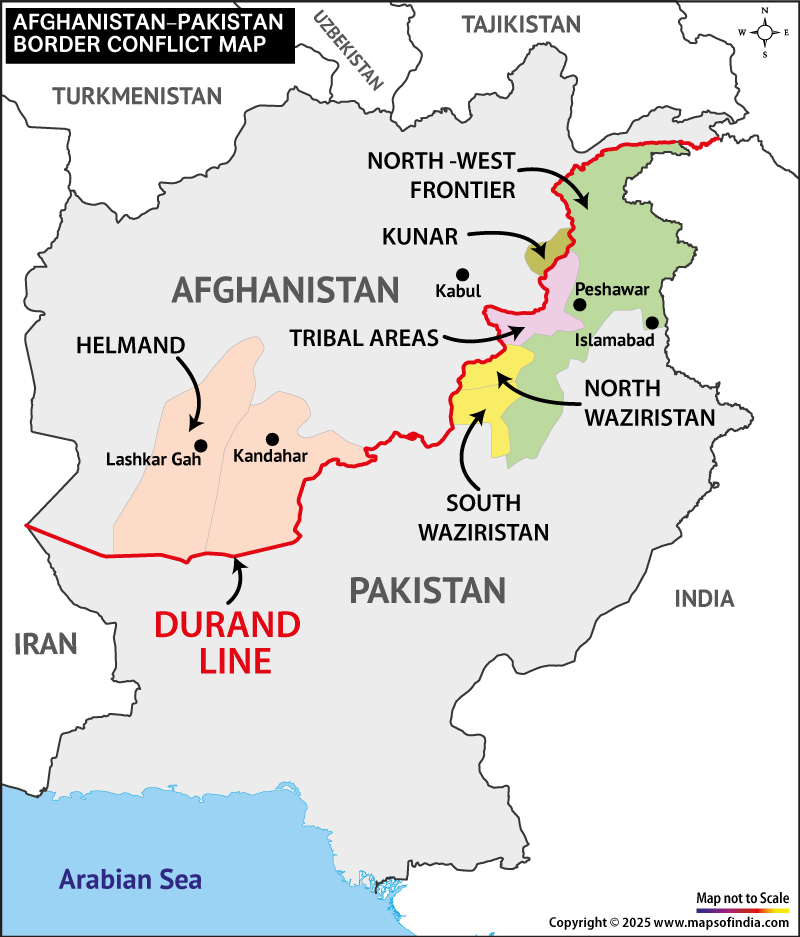
The core of the problem is the continued presence of Tehreek-e-Taliban Pakistan (TTP) safe havens in Afghanistan. This directly connects our previous lesson on internal threats to this lesson on external challenges. The TTP, an internal threat, is sustained by the external safe haven provided across the border.

The Dawn article again offers a sharp analysis, explaining the historical roots of Afghan irredentism over the Durand Line and why traditional deterrence is difficult to apply.
PAKISTAN’S CHALLENGE ON THREE FRONTS - Newspaper - DAWN.COM
This article details the complexities of the challenge from Afghanistan.
Please read the sections "PAK-AFGHAN BLUES" and "SIMMERING CAULDRON". Focus on these key points: The historical context of Afghanistan's refusal to accept the Durand Line. The role of the TTA in providing sanctuary to the TTP. The argument that deterrence is difficult because the Afghan Taliban regime is not a conventional state vulnerable to traditional costs. The linkage of internal insurgencies to external sponsorship, a clear example of the three fronts interacting.
The situation on the western front is a perfect illustration of hybrid warfare. It involves kinetic action (TTP cross-border attacks, Pakistani retaliatory strikes) and proxy dynamics (TTA using TTP to exert pressure on Pakistan). The recent alliance between Kabul and New Delhi, as mentioned in the article, further complicates the situation, creating a potential two-front pincer for Pakistan.
The Cyber Front: The Invisible Battlefield
External security threats are no longer confined to physical borders. The digital domain is now a critical battlefield where state and non-state actors conduct espionage, sabotage, and propaganda.
[PDF] AN ANALYSIS OF SECURITY CHALLENGES TO PAKISTAN AT ...
This academic paper provides a structured overview of modern security challenges, including cybersecurity.
Please read the following sections from this paper: In the "Literature Review," read the paragraph starting The changing concept of security to understand the shift towards hybrid, multidimensional challenges. Find the subsection "Cybersecurity Threats". Read this short section to understand the vulnerability of critical sectors like banking, energy, and defense. In the "Discussion and Recommendations" section, review the paragraph "Cybersecurity: The Emerging Priority". Focus on the argument that a proactive framework is needed, involving regular assessments, capacity building, and international cooperation. Finally, read the recommendation on cybersecurity. It emphasizes making it a national priority and suggests public-private partnerships.
Cyberattacks are a core tool of hybrid warfare. They can be used to cripple economic activity, steal sensitive state secrets, or spread disinformation to create panic and social unrest. An external adversary can inflict significant damage on Pakistan without ever firing a shot, making robust cybersecurity a non-negotiable component of national defense.
Conclusion
Pakistan's external security environment is defined by a complex interplay of traditional and non-traditional threats. The "three-front" paradigm—a hostile eastern border, a volatile western border, and an exploited internal landscape—captures the essence of this challenge.
Key Takeaways:
- Interlocking Fronts: Pakistan's external security cannot be seen in isolation. Challenges on the eastern (India) and western (Afghanistan) borders are deeply intertwined with and actively exploit internal vulnerabilities.
- Hybrid Warfare is the Norm: Adversaries increasingly rely on a blend of kinetic and non-kinetic tools—proxy forces, information warfare, economic pressure, and cyberattacks—to weaken the state from within.
- Contrasting Border Dynamics: The eastern front is a stalemate between two conventional, nuclear-armed states where a Mutually Hurting Stalemate has not been reached. The western front is a more ambiguous conflict against a state that sponsors non-state actors, making traditional deterrence less effective.
- The Cyber Domain as a Key Front: Cybersecurity is no longer a technical issue but a core national security priority, representing a critical vector for external threats.
- Strategic Persistence: The conflicts are locked in what the Dawn article terms a "Nash equilibrium," where no side has a unilateral incentive to change its strategy, suggesting these challenges are likely to persist.
In our next lesson, we will delve deeper into the single most defining issue of the eastern front: the Kashmir dispute. We will analyze its historical and legal foundations, providing you with the detailed knowledge required to address this critical topic in your exams.